
Committee adopts working draft of HB 377 to allow cost recovery for municipal public‑records media requests
Get AI-powered insights, summaries, and transcripts
Sign Up Free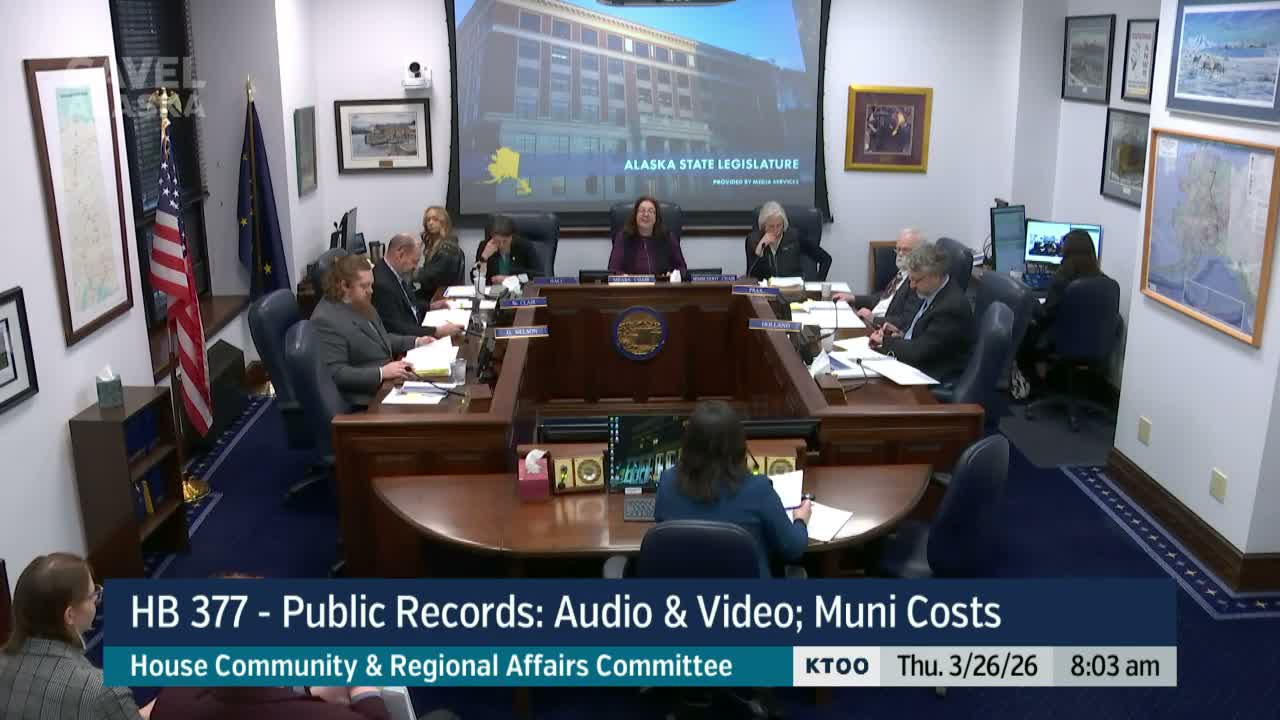
Summary
The House Community and Regional Affairs Committee adopted a committee substitute for HB 377, which would add email to the public‑records definition and allow municipalities to recover actual personnel and production costs for audio and video public‑records requests; witnesses from the Department of Public Safety and Alaska Municipal League described workload and privacy challenges.
The House Community and Regional Affairs Committee on March 26 adopted a committee substitute for House Bill 377 as a working document, advancing legislation that would update Alaska’s public‑records law to account for electronic communications and allow local governments to recover actual costs for producing audio and video records.
The bill’s staff summary, presented by Talia Ames, said the substitute adds electronic mail to the public‑record definition and inserts a subject subsection into AS 40.25.110. It also adds a narrowly drawn exemption that would, in some cases, relieve the Department of Public Safety from the existing five‑hour free‑staff‑time rule contained in current statute.
Why it matters: Municipal officials and police departments told the committee that modern requests for body‑worn camera and in‑car video recordings have grown in volume and complexity, creating pressure on small local clerks and public‑safety units. Nils Andresen, executive director of the Alaska Municipal League, said HB 377 aims to preserve public access while allowing municipalities to recover personnel and software costs needed to search for, redact and transmit digital media.
DPS and finance figures: Austin McDaniel, communications director for the Alaska Department of Public Safety, told the committee DPS’s four‑person audio/video team processed roughly 720 audio/video requests in fiscal year 2025 and collected about $34,450 in electronic‑services receipts. McDaniel said redaction typically requires about two staff hours for each hour of video and that DPS charges an electronic products/services fee (about $36.49 per audio/video request) to recoup the annual cost of three software tools the department uses for redaction, secure transmission and media conversion. He said the department does not charge for staff time to redact consistent with the Fuller v. City of Homer (2005) interpretation and current Public Records Act practice.
Municipal perspective: Andresen and AML members argued the statutory five‑hour free‑staff‑time limit creates an unfunded mandate that commercial and high‑volume requesters exploit, diverting clerk time from core municipal services. Andresen urged safeguards—fee waivers for public‑interest requests, limits to fees to actual costs, and prioritizing Alaskan residents—so the law balances transparency with municipal capacity.
Concerns raised by committee members included whether fees are flat per request regardless of length, how receipts are handled (Legislative Finance confirmed receipts currently lapse to the general fund unless the department is given receipt authority), the risk of increasing litigation or equal‑protection challenges if agencies prioritize or tier requests, and how small municipalities without dedicated staff would manage quoting and billing.
Public comment: Ed Martin Jr., a 71‑year‑old longtime Alaska resident, testified in opposition, calling any proposal that increases costs for public records a threat to transparency and urging protection for public‑interest requests.
What’s next: The committee adopted the substitute as a working document and set an amendment deadline for HB 377 (Monday at noon). The substitute remains subject to change as the committee considers technical language for how fees would be calculated, how waivers would be handled, and whether receipt authority or fund swaps are needed to make cost recovery practical for municipalities.