
Committee hears bill to restore Permanent Fund dividends to people later exonerated; staff estimate ~$100,000 impact
Get AI-powered insights, summaries, and transcripts
Sign Up Free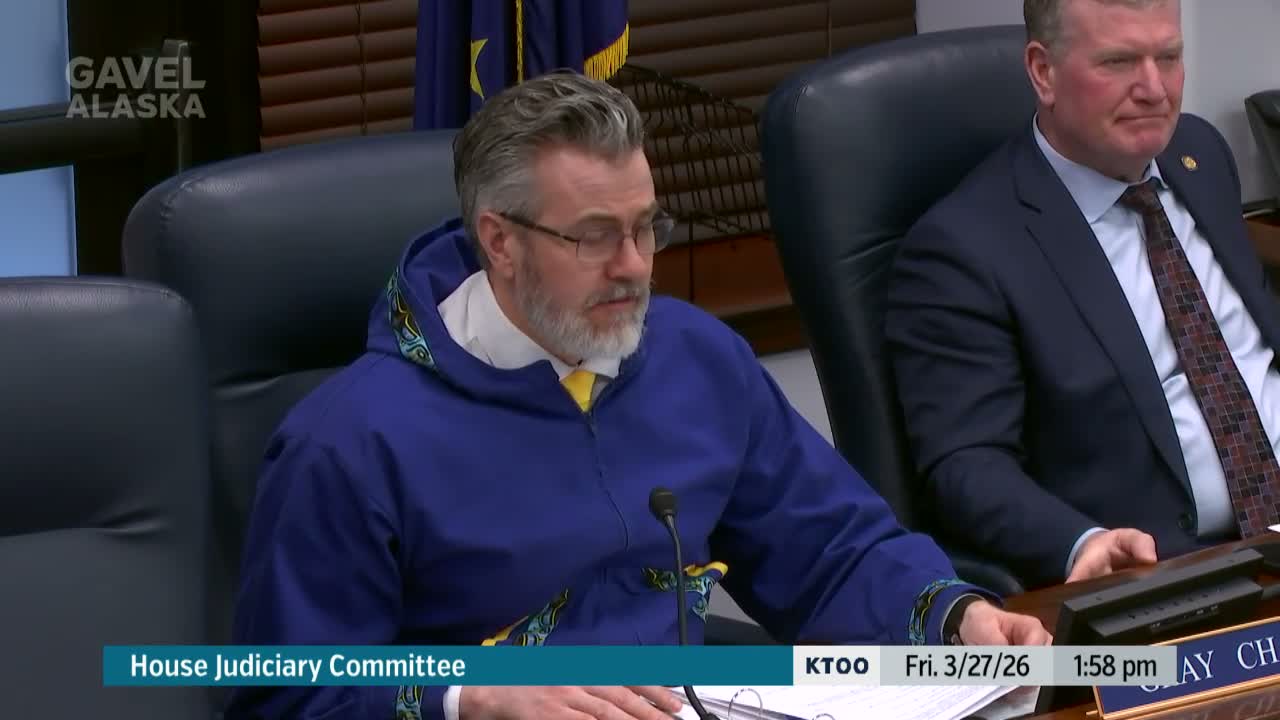
Summary
House Bill 189 would allow people whose convictions are vacated, reversed and later dismissed, or who are retried and found not guilty, to apply for missed Permanent Fund Dividend payments; staff estimated about five people could qualify for roughly $100,000 in back payments, paid from the prior‑year liability fund.
House Bill 189 received its first hearing March 27 before the House Judiciary Committee. Sponsor Rep. Donna Mears said the bill would let individuals whose convictions are later vacated, reversed and dismissed — or who are retried and found not guilty — apply for Permanent Fund Dividend (PFD) payments they missed while wrongfully incarcerated.
Staff explained the bill would amend AS 43.23.005 to create subsection I, allowing a one‑year window to apply for past dividends after charges are dismissed or a not‑guilty verdict. Staff said the dismissal must not be part of a Rule 11 plea agreement; the bill also adds conforming changes for PFD calculation and includes an uncodified section to cover convictions overturned before the bill becomes law.
Talia Ames, staff to the sponsor, said research by the Alaska Innocence Project suggests the change would affect about five wrongly incarcerated people for a total of roughly $100,000. She said most of the anticipated payments would go to the Fairbanks cases known as the Fairbanks Four, and that the payments would be made from the prior‑year liability fund, which a 2024 PFD report listed at about $1.7 million.
Jory Knott, executive director of the Alaska Innocence Project, testified online that the bill is a modest restorative step and not a full compensation statute. He noted that 39 states and the federal government provide compensation statutes for the wrongfully convicted and said Alaska currently provides no such program; he urged the committee to pass HB 189.
Committee members asked detailed legal questions about the difference between appellate reversals, vacations, dismissals and not‑guilty verdicts; Nancy Mead (general counsel, Alaska Court System) explained appeals commonly return cases to trial and rarely declare actual innocence. Members also discussed process questions: who would be notified if the bill passed, how exonerees would apply, and whether the PFD division could issue lump‑sum payments rather than multiple individual checks.
Genevieve Watusik, director of the PFD Division, said applicants would reapply for each missed year and that payments would be processed individually (the division does not combine PFD checks). She added the division is replacing its DAIS application system this summer, so programming costs to add a new application type are indeterminate and could be required to support alternative payment options.
The committee set an amendment deadline for HB 189 of Tuesday, March 31 at 11:59 p.m. and will consider possible amendments and fiscal‑note programming questions before advancing the bill.