
OCS reports more than 21,000 intakes annually, outlines training updates and limits on sharing screened-out cases
Get AI-powered insights, summaries, and transcripts
Sign Up Free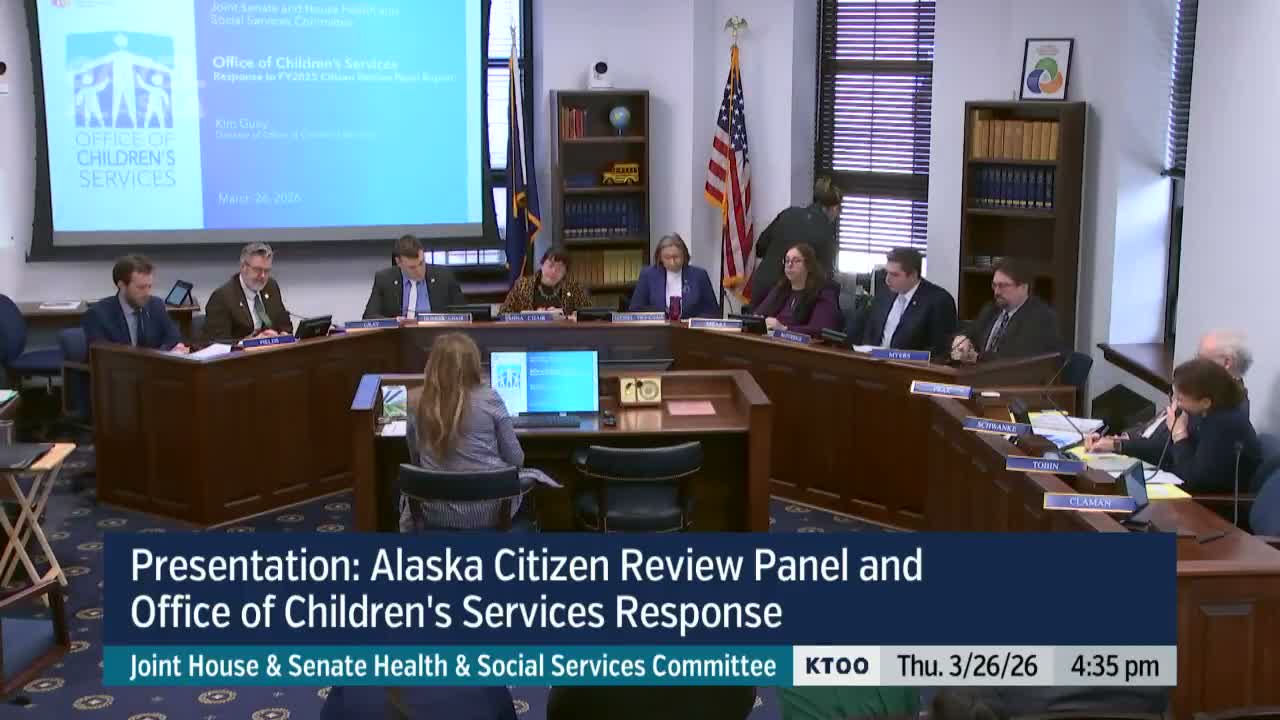
Summary
Office of Children's Services Director Kim Gway told lawmakers OCS received roughly 21,000 reports in FY2024 and FY2025, described plans to update mandatory reporter training via the CJA Task Force and a new learning management system, and flagged a state regulation that limits sharing screened-out family data without parental consent.
Kim Gway, director of the Office of Children's Services, told the joint House and Senate Health and Social Services Committee that OCS received 21,205 reports at its centralized hotline in fiscal year 2024 and 21,512 in fiscal year 2025, and that roughly 15,053 of the 2024 reports were made by mandatory reporters.
Gway said the agency would continue to refine intake and screening processes and is working with the Children's Justice Act (CJA) Task Force to update mandatory reporter training and migrate to a modern learning management system. "The CJA task force currently has a work group to update the trainings ... we're in the process of trying to pick, get through procurement, and get a new learning management system," she said.
On screening rates and data: Committee members pressed why Alaska screens in a lower share of referrals than the national average; Gway explained Alaska's ORCA intake system currently documents every reported contact (with less deduplication), noted differences in case types compared with many Lower 48 jurisdictions, and said the intake unit uses QA and is exploring predictive analytics to support screening decisions.
On information sharing and diversion: Several lawmakers asked whether OCS can refer screened-out families to nonprofits without parental permission. Gway cited a state regulation (7 AAC 54.080) that restricts sharing family information without consent and said OCS has tried outreach (including during COVID) but many families declined offers of services when contacted. She said OCS is looking at ORCA upgrades and automation (e.g., automated reporter notifications and resource links) and would work with legislators on potential statutory or regulatory solutions.
Prevention funding and FFPSA: Chair Mina raised the Families First Prevention Services Act (FFPSA) and why Alaska has not established a Title IV-E prevention plan. Gway said Alaska began work in 2018 but paused because the federal clearinghouse initially listed few programs applicable to Alaska; tribal FFPSA options and recent federal updates have created new possibilities for culturally appropriate tribal plans.
What lawmakers asked: Committee members questioned the feasibility of expecting educators and other frontline workers to do more than file reports, pressed for clearer feedback loops so reporters know whether a case was screened in or out, and urged attention to workforce capacity so OCS can follow up more quickly on referrals. Gway repeatedly said the agency is open to collaboration on regulatory changes and system improvements.
No vote or formal directive was recorded during the hearing; committee members suggested follow-up work on data, regulatory language, and potential legislative fixes to enable diversion and clearer referral pathways.