
Citizen Review Panel urges standardized mandatory reporter training, eyes diversion for families screened out
Get AI-powered insights, summaries, and transcripts
Sign Up Free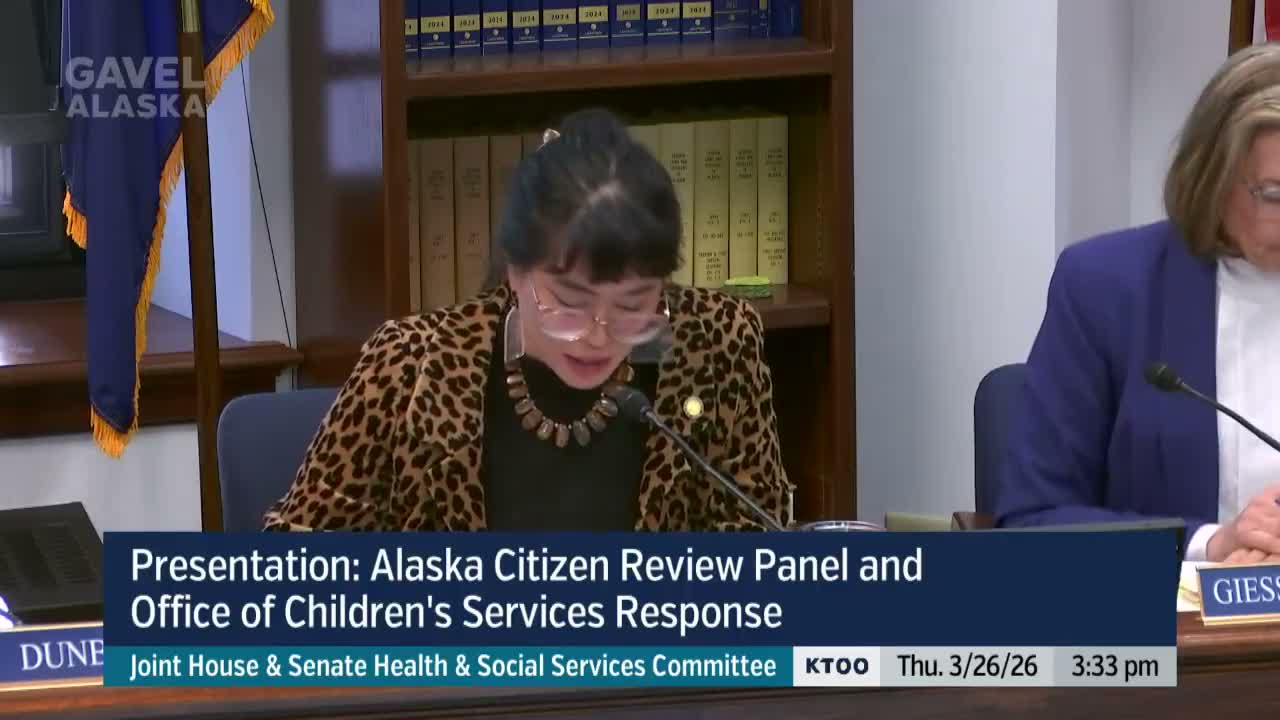
Summary
The Alaska Citizen Review Panel told the joint House and Senate Health and Social Services Committee that inconsistent mandatory reporter training and a lack of referral pathways leave some families without support; the panel recommended a single open-source curriculum and actions on diversion and out-of-home placement data.
Rachanda George Bettisworth, chair of the Alaska Citizen Review Panel, told the joint House and Senate Health and Social Services Committee on March 26 that the panel's annual review found statewide inconsistencies in mandatory reporter training and gaps in how families screened out of the child welfare intake process are supported.
Bettisworth, who identified herself as a clinical professor of social work in Fairbanks and the CRP chair, said the panel's research showed multiple state and agency trainings that vary by audience and no single entity with clear ownership for reviewing or updating mandatory reporter curriculum. "Mandatory reporting training is not standardized,'leading to inconsistent information and varying requirements across professions and organizations," she said.
Why it matters: Committee members pressed the panel on whether mandatory reporter training should be the top recommendation. Bettisworth said the issue emerged after the panel's prior work on screened-out cases, where families that did not meet investigation thresholds often received no referral or follow-up. The panel recommended a standardized, open-access curriculum for Alaska that is informed by mandated reporters, OCS staff and people with lived experience, and that assigns clear ownership for maintenance, evaluation and periodic updates.
Committee responses ranged from support for standardization to concern about focusing on training rather than immediate child outcomes. Representative Ruffridge asked what had changed for children and families as a result of CRP work; Bettisworth said the panel has advanced workforce and training issues but does not have immediate population-level outcome data. "I don't have data to prove that," she said, adding that system change is incremental and that the panel hopes its recommendations will improve practice over time.
The panel also flagged diversion as its next major focus area. Bettisworth described diversion as connecting families to supports "without unnecessary involvement with the child welfare system," and said the CRP will analyze legal and confidentiality barriers to direct support and produce recommendations for OCS by its upcoming annual report due June 30.
Context and details: Bettisworth explained the CRP operates under federal CAPTA authority and state regulation, meets quarterly (with monthly public meetings by Zoom), and organizes priorities on a two-year work plan with Phase 1 education and Phase 2 action. The CRP requested specific data from OCS on reunification practices, kinship placements (licensed versus unlicensed), placement timelines and in-state versus out-of-state residential placements to inform its recommendations on out-of-home care.
What's next: Committee members raised the possibility of a committee bill to create a statewide standard for mandatory reporting training. Representative Fields proposed that idea on the record and the panel expressed support for stakeholder-informed standardization. The CRP's next annual report and OCS's required written response are scheduled to be circulated to legislators by June 30.
No formal committee action was taken during the hearing; the presentation closed with committee questions and a transition to OCS's response.