
Bill would let prosecutors pursue assault charges against health‑care workers even when victims were aware of the contact
Get AI-powered insights, summaries, and transcripts
Sign Up Free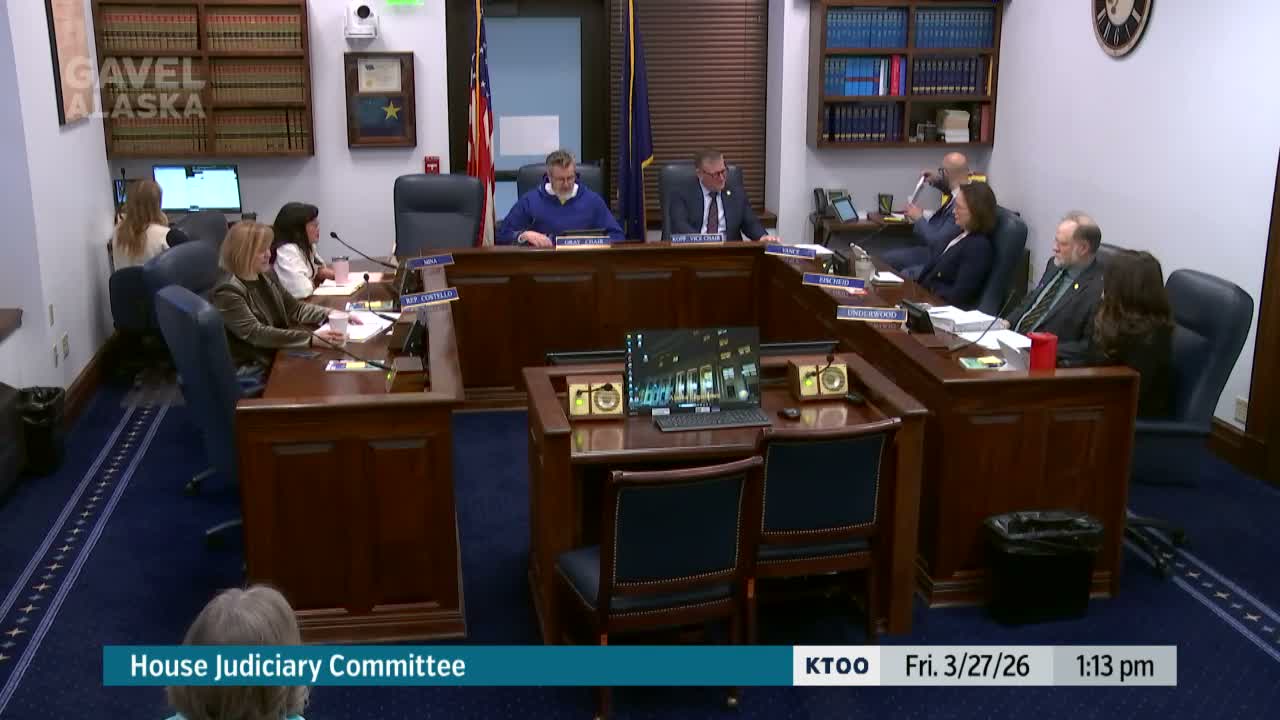
Summary
House Bill 242 would remove an element in Alaska law that requires a health‑care worker know a patient was unaware of sexual contact; sponsors and multiple survivors told the House Judiciary Committee the current wording created a loophole that blocked prosecutions.
House Bill 242, which had its first hearing March 27 before the House Judiciary Committee, would amend Alaska’s statutes to remove a statutory requirement that an offender know the patient was unaware of a sexual contact or penetration when the offender is a health‑care worker and the conduct occurs during professional treatment.
Sponsor Rep. Sarah Hannon said the bill is a technical cleanup prompted by a high-profile Juneau case in which some charges were dismissed because of the statute’s ‘unawareness’ element. "Final passage of this bill would remove this restriction so that a victim of a sexual assault by a health‑care worker could be aware of the assault occurring at the time of the assault, and the specific charges could still be pursued," Hannon said.
Senior Assistant Attorney General Casey Schroeder told the committee the current wording requires proof that the offender knew the victim was unaware; she cited Ritter v. State (97 P.3d 73 (2004)) and explained two judicial applications of the unawareness element: where the patient is unconscious or cannot perceive the touching, or where the patient mistakenly believes the touching is legitimate treatment (the "guise of health‑care"). Schroeder said Alaska has brought very few prosecutions under these subsections (seven charged between 2016 and 2022).
The committee heard invited victim testimony. Jamie Anne Sefton Hasselquist, who said she was one of more than a dozen women who came forward in a criminal case in Juneau, described the power imbalance in medical settings and said the statute allowed a perpetrator to avoid accountability. "Awareness does not mean consent," Hasselquist said. Survivors and advocates urged the committee to close what they called a prosecutorial loophole.
Other witnesses included Laurie Morton of the Alaska Network on Domestic Violence and Sexual Assault, who called sexual assault by health‑care workers a breach of professional standards and a criminal act, and Christina Love, a survivor‑advocate who said the three omitted words — "the offender knows" — have led to dismissals even when victims were aware the conduct was unwanted.
Members questioned how informed consent and clinical practices (for example, the use of chaperones during pelvic exams) intersect with the statute; witnesses and members said implied consent for legitimate medical procedures does not authorize criminal conduct and that removing the unawareness requirement preserves prosecutors’ ability to pursue charges when treatment deviates from accepted practice.
The committee closed public testimony, set an amendment deadline for HB 242 for Tuesday, March 31 at 11:59 p.m., and set the bill aside to return at a later date.
If advanced, the measure would leave intact other elements of the criminal code; the Department of Law said the change narrows a technical statutory element rather than altering burdens of proof for sexual‑assault prosecutions.