
Senate subcommittee hears Department of Health request to fund eligibility systems, maintain virtual contact center amid high SNAP error rate
Get AI-powered insights, summaries, and transcripts
Sign Up Free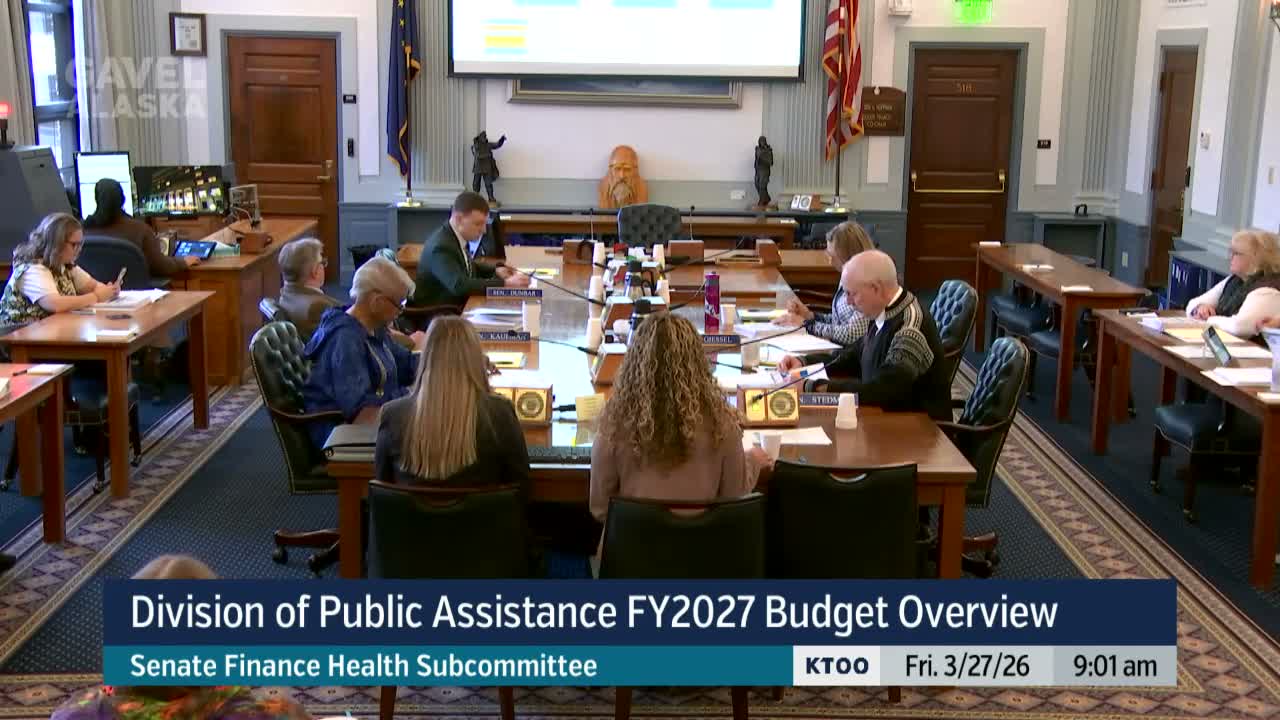
Summary
Department of Health Commissioner Heidi Hedberg and Division of Public Assistance officials told the Senate Budget Subcommittee the FY27 amended budget asks for funding to sustain eligibility systems, the virtual contact center and staffing after pandemic-era backlogs; officials warned a 24% SNAP error rate could force the state to share benefit costs in coming years.
Juneau — The Senate Budget Subcommittee on March 27 heard a detailed presentation from Department of Health officials about the Division of Public Assistance’ s FY2026–27 operating budget, an IT modernization plan and the future of the division’s virtual contact center.
“Last year it was 24 percent,” Commissioner Heidi Hedberg said of the Supplemental Nutrition Assistance Program error rate, warning that persistent high error rates could trigger federal cost‑sharing requirements in future years. Hedberg told the committee that if the error rate stays between 6% and 8% the state could owe roughly 5% of benefits (an estimated $16 million); above 10% the share could rise to about 15% (an estimated $49 million).
The division’s Administrative Operations Manager, Sierra Meek, summarized the numbers behind the governor’s amended request: the FY26 management plan and supplementals totaled about $376.2 million; the FY27 governor’s amended operating budget is about $383.4 million. Meek said the budget is driven primarily by federal receipts and unrestricted general funds that pay benefits and state match requirements.
Meek described several FY27 adjustments, including $120,000 in federal receipts for a Community Care Licensing Specialist classification study, $8 million to address SNAP administrative shifts tied to an upcoming federal fiscal change, $21 million in administrative authority for eligibility system operations and maintenance, $4.5 million in federal authority to address rising WIC food costs, $1.4 million in unrestricted general funds for the senior benefit payment program and $8 million to sustain the division’s virtual contact center (VCC).
“The senate bill 95 adds the funding to the base,” Assistant Commissioner Pam Halloran told the committee when members asked whether elements of SB 95 and the childcare grant appropriation were reflected in the governor’s FY27 request.
Committee members pressed officials on the $21 million ad authority for eligibility systems. Hedberg and Halloran said the increase largely reflects the transition from capital development to ongoing operations: maintenance contracts, licensing agreements and the expiration of prior multi‑year appropriations at the end of FY25 created a fiscal “cliff” the division must now address.
Hedberg told senators the division is automating redeterminations required under HR1 and building data integrations so some renewals can be handled ex parte, reducing manual work by eligibility technicians. She cautioned that automation must be paired with data integrations and training to avoid administrative errors.
One senator urged caution: relying primarily on automation without integrated data could let eligible Alaskans lose benefits for administrative reasons. “I would prefer to see a little bit more money requested … so that tens of thousands of Alaskans don’t lose their Medicaid for essentially administrative reasons,” the senator said.
The VCC — a toll‑free line with menu options routed to contractors and state staff — was described as a stopgap that helped stabilize services during pandemic unwinding. Hedberg said the division receives about 25,000 calls per month and has begun an exit strategy to reduce reliance on contractor staff, aiming to staff the VCC with state employees by 2028 in concert with the integrated eligibility system rollout. “There is no AI used in the VCC,” Hedberg said.
Becca Stovall, the division’s systems operations manager, cited contractor reports showing an average of about 11 calls per day handled per state employee; committee members noted that figure while weighing the division’s staffing plan.
Hedberg reported workforce improvements: the eligibility technician vacancy rate peaked near 34% in 2025 and is about 16% as of the hearing. She credited improved recruitment, internal promotions and revised training that have shortened on‑the‑job readiness from about two years to roughly one year.
On legal and financial exposure, Hedberg said a union grievance went to arbitration and is under appeal; there is currently no recorded financial impact from that arbitration or from several related class actions. The division did disclose SNAP penalties of approximately $4.9 million last year tied to administrative errors.
On timeliness, Hedberg said average processing time for applications is about 45 days and the division is tracking roughly 3,000 SNAP cases beyond the 30‑day federal guidance window; many backlogged cases await client information or contact. The division said recent changes — a smart online SNAP application and texting reminders — have improved completion rates.
Chair Steadman asked the department to provide follow‑up details requested by members, including the status of childcare grant payments, arbitration status and line‑item clarifications; the subcommittee adjourned shortly before 9:50 a.m.
Next steps: the department will provide written follow‑ups on the questions posed at the hearing and the subcommittee may reconvene to review requested materials and any updated fiscal impacts.