
State panel hears industry estimates on economic impacts and financing needs for small modular reactors
Get AI-powered insights, summaries, and transcripts
Sign Up Free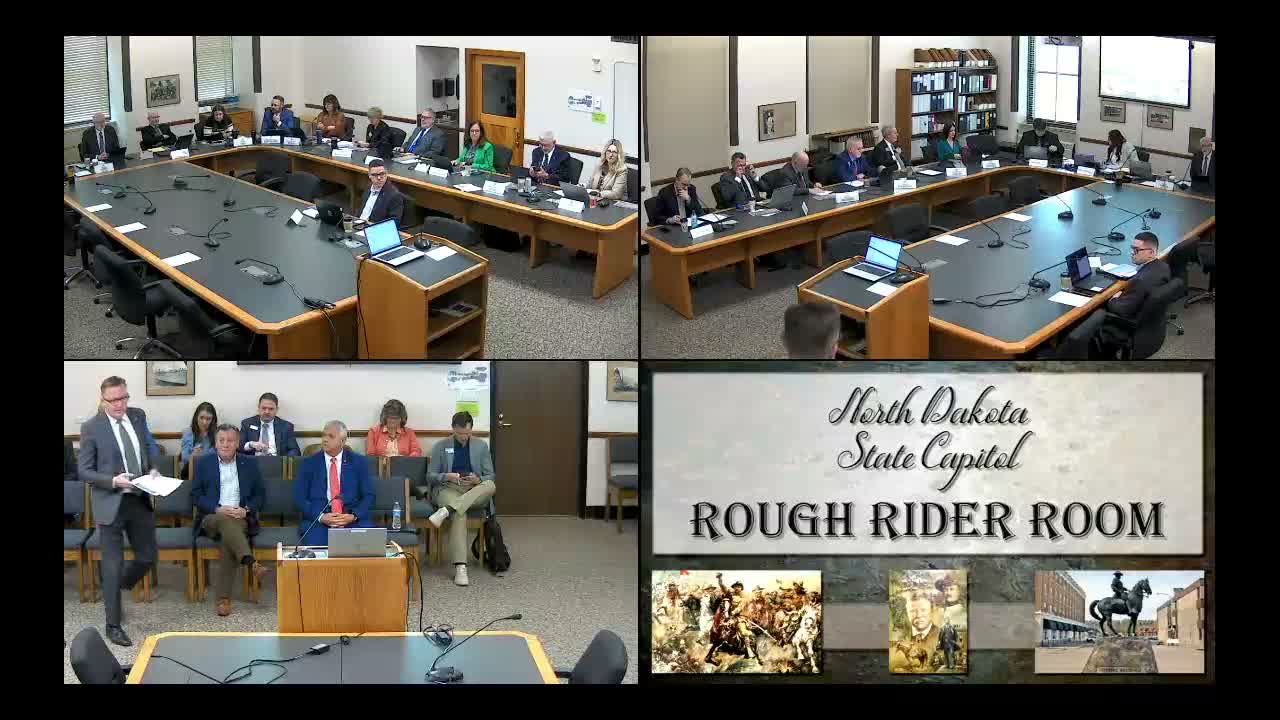
Summary
Industry presenters told North Dakota's Advanced Nuclear Energy Committee that small modular reactors (SMRs) could require high upfront capital (Nucleon used $6,000,000 per megawatt as a modeling proxy), significant construction and operations workforces, and multi‑phase private financing supported by federal loan authority and tax credits; DOE officials and trade groups described tools that can lower investor risk.
The Advanced Nuclear Energy Committee heard industry experts outline the likely costs, jobs and financing hurdles for small modular reactor development during a multi‑hour briefing on March 24.
"So, my name is William Bridge. I am the Chief Technology Officer for Nucleon Energy," said William Bridge, who presented the committee with Nucleon's economic impacts and private financing report. Bridge said the firm used "$6,000,000 U.S. a megawatt as a proxy" for capital costs in its modeling and presented example deployments of 200‑megawatt and 600‑megawatt SMRs. He said those assumptions produced planning estimates of peak construction workforces of about 500 for a 200 MW site and up to 1,000 for larger projects and roughly 100 operational staff for a 200 MW plant.
The nut graf: presenters framed SMRs as capital‑intensive, first‑of‑a‑kind projects that could become more economical as the industry matures, but which will need financing structures and public acceptance to move forward.
Benton Arnett, Senior Director of Markets and Policy at the Nuclear Energy Institute, described how projects are being structured and what private investors look for. He said investors prize predictable costs and long‑term revenue certainty and noted that new business models—special purpose vehicles, long PPAs with large corporate offtakers and factory modularization—are emerging to reduce risk. Arnett told the committee that federal policy and incentives are shaping those structures and that "there's about $250,000,000,000 in loan authority" available to help early movers.
Julie Kazaraki of the Department of Energy’s Office of Energy Dominance Financing (EDF) said EDF has lending authority available through Title XVII and that EDF can provide long tenors and finance a large share of eligible project costs. She described pairing EDF loans with the federal investment tax credit (ITC) preserved in recent federal legislation (30–50 percent availability depending on qualifiers) as a central way to reduce investor risk.
Speakers stressed a phased view of financing: early‑stage risk (community acceptance, permitting and early site work) is the hardest to finance with private capital and often requires public or philanthropic support; later phases (construction financing and long‑term financing after revenue is established) become more attractive to traditional debt and institutional investors.
Committee members pressed presenters on comparisons to projects in Canada and on whether first‑of‑a‑kind costs can be meaningfully reduced. Bridge and Arnett both warned of large uncertainties in first‑of‑a‑kind estimates and said that the path to competitiveness depends on whether costs fall as technologies are repeated and supply chains mature.
The meeting also included a local perspective: Gary Yackel, mayor of Red Wing, Minnesota, described his city’s long experience hosting Prairie Island, saying the plant "pays 42% of our property taxes in the city of Red Wing" and highlighting local emergency training and community benefits.
The committee did not take formal action on SMR policy at the session but recorded the presentations and directed staff to continue the committee's program, including a planned April visit to Idaho National Laboratory to view demonstrations and research facilities.
Next steps: presenters said states should prepare to engage early on community outreach and siting, and that any state considering SMRs should plan how to reduce early‑stage financing risk and how to align workforce and supply‑chain development with projected deployments.