
State says ARPA and BEAD builds largely on track; BEAD guidance on hold, providers describe major fiber investments
Get AI-powered insights, summaries, and transcripts
Sign Up Free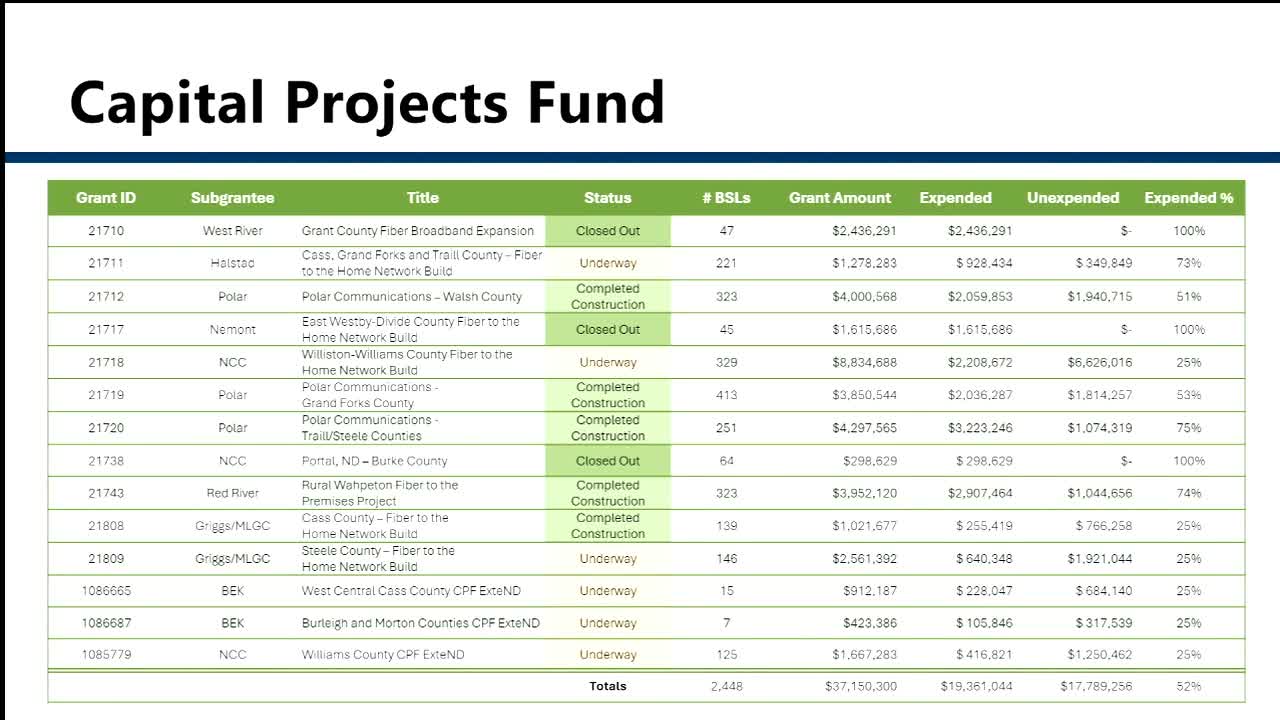
Summary
NDIT reported progress on ARPA CPF awards and BEAD allocations while noting NTIA guidance on remaining BEAD funding is pending; Midco and DCN presented their fiber investments and how they engage with data‑center developers.
Craig Falcley (State CTO) updated the committee on two major broadband portfolios administered by NDIT: ARPA capital projects funds (CPF) and the BEAD broadband equity/access/deployment program.
Falcley said CPF awards covered roughly 2,450 broadband‑serviceable locations with an aggregate grant amount of about $37 million and that project construction and closeout activities were expected to finish in the 2026 build season. "At this point, we're not aware of any challenges to that timeline," he said, while acknowledging supply‑chain and build‑season risks.
On BEAD, Falcley said North Dakota has an estimated $102 million remaining from its original award but that distribution of those funds was on hold pending national guidance from NTIA. "All the funding has been placed on hold," he said. NDIT described ongoing work with carriers on letters of credit, final network designs, permitting and right‑of‑way coordination and said BEAD builds should complete construction in 2027 with post‑closeout monitoring continuing into 2028.
Commercial providers then briefed the committee. Midco (Kayla Polvermacher and Steve Maddern) described a $500 million regional "fiber forward" initiative launched in 2021, recent North Dakota investments (about $44 million to upgrade local fiber), plans to deliver 4x1 gigabit service across Midco's North Dakota footprint by 2028 and new colocation/data‑center support in Ellendale and other localities.
Dakota Carrier Network (Seth Arndorfer) described DCN's owner‑coalition model, a 70,000‑mile in‑ground fiber footprint across the state, DCN data centers in Bismarck and Fargo and the different scale of hyperscale AI/data‑center demand (DCN cited capacity planning measured in terabits and noted one hyperscaler request for hundreds of terabits of connectivity). Arndorfer emphasized that hyperscale sites and AI infrastructure require large, multi‑path fiber investments and substantial power capacity that typically start with a site identifying excess power and then engaging carriers during planning.
Committee members asked about timelines, reimbursement and what would happen if federal guidance changed; Falcley said NTIA guidance could alter program priorities and that the legislature would have an opportunity to weigh in if the federal rules imposed a materially different use of remaining funds.