
North Dakota posts strong audited finances; legacy fund, reserves drive gains
Get AI-powered insights, summaries, and transcripts
Sign Up Free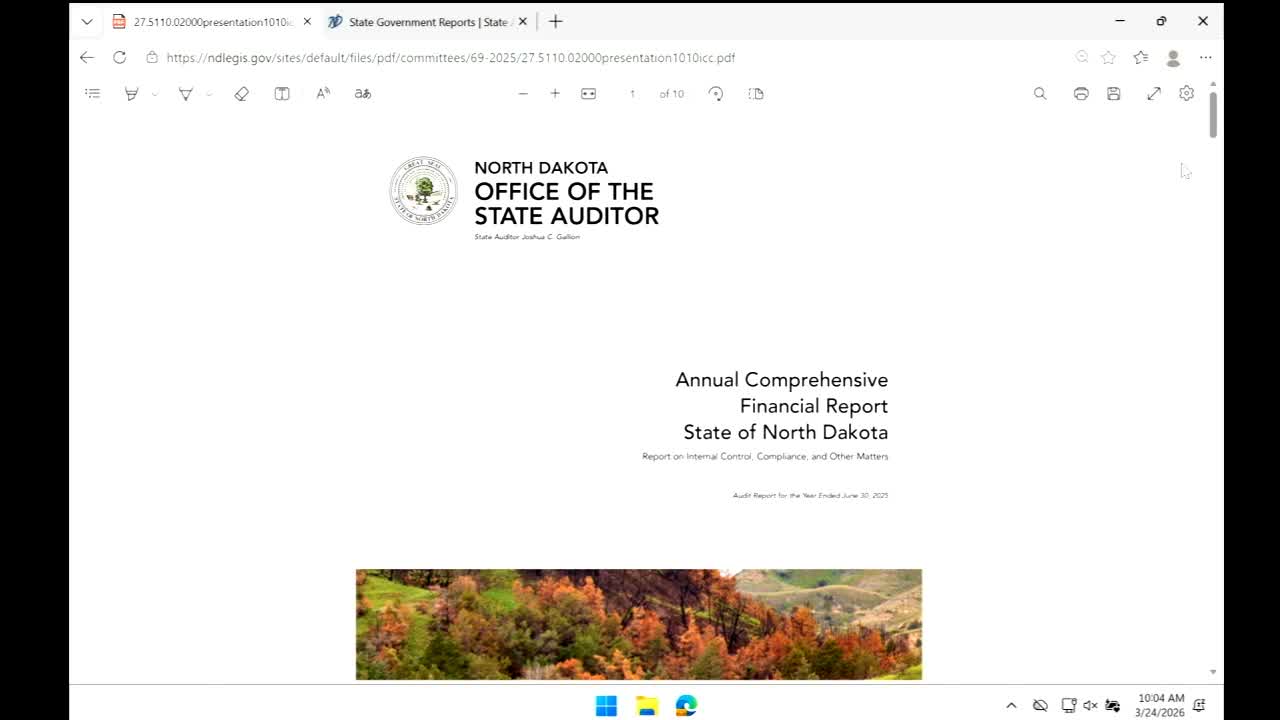
Summary
State auditors issued a clean opinion on North Dakota's 2025 annual comprehensive financial report, showing a $40.61 billion net position and stronger reserves driven largely by legacy fund investment income. Auditors and OMB officials flagged pension accounting and new GASB paid-leave reporting rules.
State auditors gave North Dakota's fiscal 2025 annual comprehensive financial report (ACFR) a clean, unmodified opinion and officials told the Legislative Audit and Fiscal Review Committee the state's balance sheet strengthened over the year.
"So this is a financial audit of the state of North Dakota for the year ended 06/30/2025," Dan Cox, director of audit services for the State Auditor's Office, told the committee. Crystal Hogarth, ACFR manager at the Office of Management and Budget, said the government-wide net position rose to $40,610,000,000 and that assets totaled $30,990,000,000 while liabilities were $1,810,000,000.
Why it matters: the ACFR provides the officially audited snapshot used by bond investors, policymakers and credit-rating agencies. Hogarth told the committee the general fund balance increased by about $1.66 billion and that legacy fund returns were a major contributor: fiscal-year 2025 net investment income from the legacy fund reached $1.44 billion and the fund balance was $13.02 billion.
Officials also explained notable accounting items that affect year-to-year comparability. Hogarth and auditors walked the committee through pension liability fluctuations: changes in actuarial assumptions and discount rates can create large swings in reported net pension liability. The PERS main system received a $65 million state cash infusion during fiscal year 2025 and closed to new members on Jan. 1, 2025, but those events were not reflected in the ACFR's measurement because the pension measurement date was June 30, 2024.
Hogarth and Cox also described a new GASB standard for compensated absences (annual and sick leave) that required recognition of additional liabilities; implementation produced a prior-period adjustment of $39,760,000 for governmental activities and $27,820,000 for business-type activities, the presenters said.
Committee members asked whether short-term spikes in oil and commodity prices are reflected in the ACFR. Hogarth said the figures presented are historical, accrual-based results for the fiscal year and do not include future forecasting assumptions.
The presentation concluded with OMB and the auditor's office standing for committee questions; there were no votes or formal actions tied to the ACFR presentation.