
Deloitte model forecasts $1.3 billion shortfall for North Dakota water projects; offers seven policy and financing options
Get AI-powered insights, summaries, and transcripts
Sign Up Free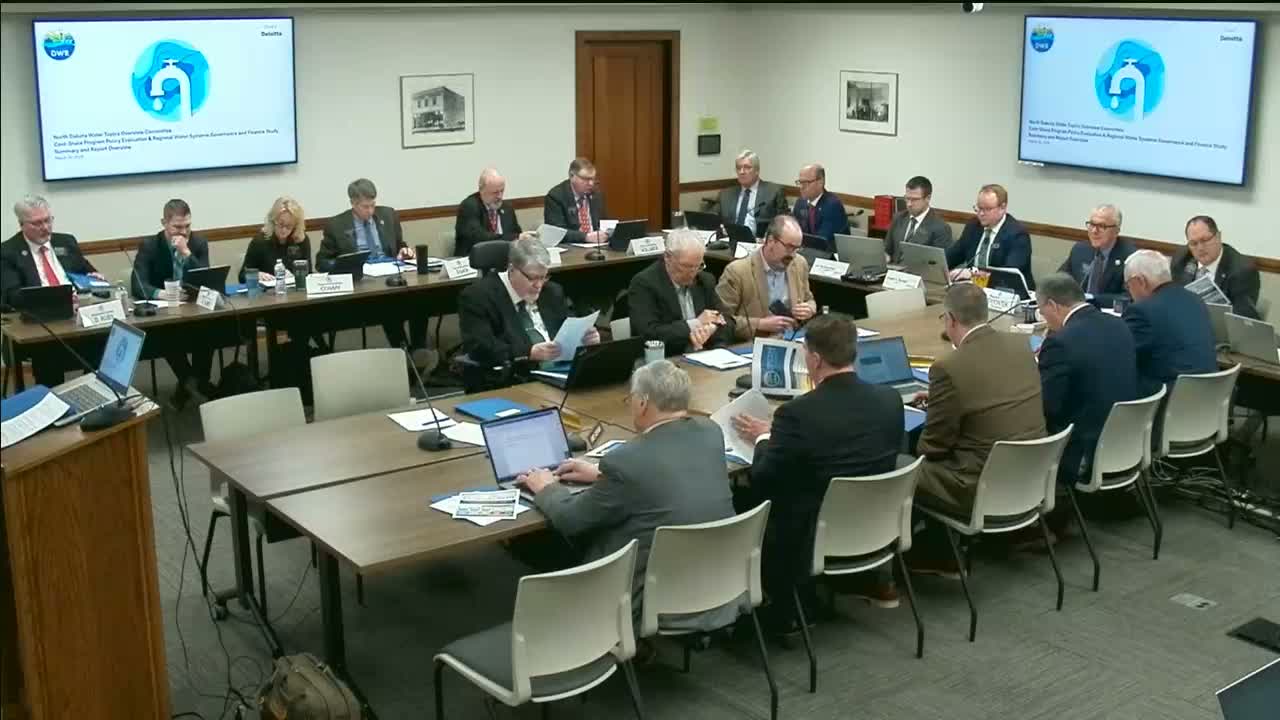
Summary
Deloitte and the Department of Water Resources told the Water Topics Overview Committee that current policy and revenue forecasts leave an estimated $1.3 billion funding gap over 14 years and presented seven options — from caps on large projects to timing changes and bond financing — aimed at reducing near-term pressure and improving long-term predictability.
A Deloitte team and the North Dakota Department of Water Resources presented a financial model to the Water Topics Overview Committee on March 18 that projects an approximately $1,300,000,000 shortfall to fund the state's water-development needs over the next 14 years.
Valerio Dokshukin, a partner with Deloitte, said the model shows the shortfall is "front loaded," producing a near-term gap of roughly $1.18 billion through 2031. "Under no policy-change scenario, the model forecasts an overall shortfall of approximately $1,300,000,000 for North Dakota water infrastructure projects over [a] 14-year period," Dokshukin said during the presentation.
The model is designed for scenario testing, enabling the State Water Commission and Department of Water Resources (DWR) to adjust revenue and policy levers such as cost-share percentages, funding ceilings and project timing. Reese Haas, director of the Department of Water Resources, said DWR has provided project lists and a prioritization guidance document to commissioners and legislators to inform those trade-offs.
Deloitte proposed seven near- and longer-term options to reduce the funding gap. Key recommendations include: reducing state cost-share for eligible replacement projects to 25% with a $2 million cap and tighter eligibility controls (Option 1); establishing state funding ceilings for the largest projects and pairing those ceilings with a bond issuance backed by legacy-fund earnings to cover a defined portion of costs (Options 2 and 3); aligning cost-share percentages to a priority-based scale (50% for high, 45% for moderate, 40% for low) and capping state support per project at $5 million (Option 4); and several near-term liquidity measures — delaying moderate- and low-priority projects, obligating available lines of credit with planned reimbursement after 2031 (with an estimated $128 million of interest expense), and adjusting the Resource Trust Fund reimbursement timing to protect near-term capacity (Options 5—6).
Deloitte framed the options as trade-offs between protecting near-term Resources Trust Fund capacity and shifting more cost or financing burden to local project sponsors. Dokshukin emphasized the model's flexibility: the same tool can be used by legislators or DWR staff to test alternative oil-price, production, and cost-share scenarios.
Haas told the committee DWR will update the Water Development Plan this summer and reiterated the department's conservative reliance on the extraction-tax revenues that fund projects. He also noted the department's two-tier approval and carryover mitigation policies intended to limit funding obligations to shovel-ready projects.
What comes next: Deloitte and DWR said the final cost-share model and recommended-options report will be shared with legislators and the Commission (DWR noted delivery of the financial model by March 31); Deloitte's governance report draft is due May 1 with a final governance and finance report expected May 29. The committee did not adopt actions at the meeting; members pressed staff and Deloitte for follow-up on definitions (for example, deferred maintenance versus replacement), model inputs such as inflation and user-fee assumptions, and options for maintaining affordability for communities.
Reporting note: direct quotations and specific figures in this article are drawn from testimony by Valerio Dokshukin (Deloitte) and Reece (Reese) Haas (Director, Department of Water Resources) at the Water Topics Overview Committee meeting. The committee will consider final reports and possible statutory or appropriation responses in upcoming sessions.