
Edmond reviews four water‑rate plans as city prepares major treatment‑plant expansion
Get AI-powered insights, summaries, and transcripts
Sign Up Free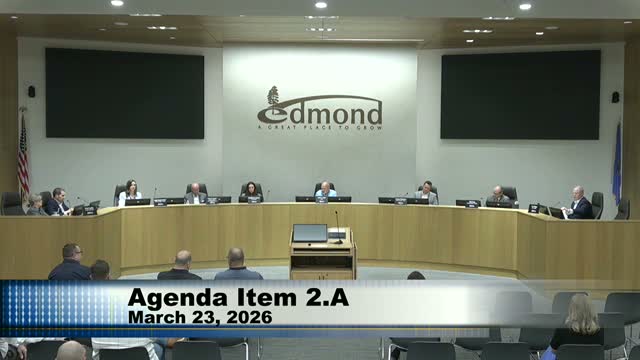
Summary
City staff and consultants presented four rate‑plan options tied to two capital scenarios to fund a multiyear water and wastewater capital program; council favored options that spread increases and asked staff for an apples‑to‑apples bill comparison and additional Public Works review.
Edmond officials spent the bulk of a March 23 budget workshop reviewing a detailed water and wastewater rate study that models four alternative rate structures and two capital‑cost scenarios intended to fund an extensive capital improvement program, including a large water treatment plant expansion.
Consultant Jason Graham of Willdan Financial told the council the study models a midpoint capital plan of about $648.5 million and an upper‑end plan around $716.6 million, and that the water treatment plant expansion is the primary cost driver. ‘‘The biggest impact on the cost of service is principal and interest on new debt issued to fund those CIP projects,’’ Graham said, outlining how total new debt under the midpoint scenario would be roughly $464.3 million and about $530 million under the upper‑end scenario.
Why it matters: Council members framed the discussion around how to balance near‑term bill impacts with long‑term fiscal stability. Staff and consultants said choices about how much to load into base charges versus volume charges, and how much reserve to allow the utility to draw down, will determine whether bills spike immediately or climb more gradually over time.
The four options: Willdan presented (1) a one‑time, large base‑charge increase that leaves volume tiers intact; (2) a two‑year doubling of the base charge that also adjusts some volume rates; and (3) and (4) multi‑year, across‑the‑board increases in both base and volume, with option 4 reflecting the higher capital‑cost scenario. Graham said options 1 and 2 would require roughly a $30 million drawdown from reserves, while options 3 and 4 would require approximately $51–52 million.
Council response: Mayor (speaker 1) said he did not favor option 1’s sudden, large base jump: ‘‘I don’t like option 1 at all,’’ he said, adding that options 2 and 3 had more support. Multiple council members said they preferred spreading increases to avoid a one‑time shock while still protecting reserves. Several council members urged staff to adopt a working reserve policy — several suggested targeting roughly 180 days (about six months) — and to re‑run scenarios with uniform reserve assumptions so options 2 and 3 can be compared directly.
Tier for very high residential use: Staff and consultant recommended adding an extra residential consumption tier for very high users (above 30,000 gallons in a month). Graham said that roughly 3% of residential bills include months over 30,000 gallons and that the additional tier could raise about $200,000–$300,000 annually or reduce modeled year‑one rate impacts by about 1%.
Affordability measures: Council and staff discussed strengthening assistance for vulnerable households. Staff recommended leveraging existing programs — matching the LIHEAP credit that Edmond Electric provides and coordinating with the Hope Center and other community partners — rather than creating a separate new assistance program. Chris Kniping, director of water resources, said staff currently funds assistance that can be targeted to households in crisis and recommended integrating water support with those existing networks.
Next steps: Council directed staff to prepare an apples‑to‑apples bill comparison (minimum charge plus a fixed number of gallons — the mayor suggested 6,000 gallons) for each option and to run options 2 and 3 with the same reserve assumptions for a clearer comparison. Staff and the consultant were asked to return to the Public Works Committee (proposed April 8) and to the March/April budget workshops (including an April 13 discussion) with the revised analyses.
Procedural note: Council recessed briefly during the presentation and voted to reconvene; the meeting remained a workshop (no final rate decision was made).