Get Full Government Meeting Transcripts, Videos, & Alerts Forever!
Get email alerts on the Education Funding Adequacy topic
No spam. Unsubscribe anytime.
Analysts: Arkansas districts spend well above foundation formula; lawmakers ask for waiver, dyslexia and facilities data
Summary
Bureau of Legislative Research staff told the Joint Education Committee that foundation funding covered $7,357 per student for matrix items in 2025 while districts spent nearly $11,000 per student on those same items when other funds are included; members requested detailed waiver breakdowns, per-district dyslexia and mental‑health spending, and clarification of the building fund and partnership program.
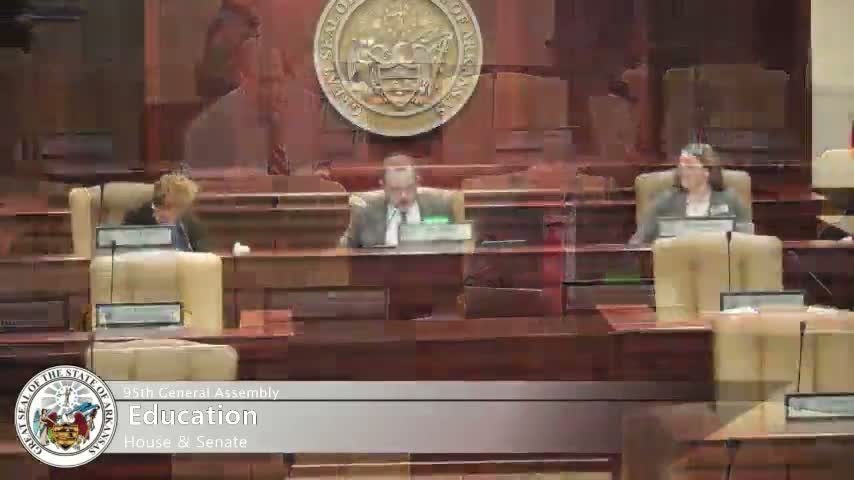
Bureau of Legislative Research analysts briefed the Joint Education Committee in Little Rock on resource allocation for public schools, telling lawmakers that foundation funding covered $7,357 per student for matrix items in 2025 while total (all-funds) spending on those same matrix lines was nearly $11,000 per student.
Elizabeth Bynum of the Bureau of Legislative Research opened the presentation, describing the methodology and data sources used for the adequacy study: expenditures were calculated from the Arkansas Public School Computer Network (APScan) and mapped to matrix lines using the Arkansas Financial Accounting Handbook. "This report is going to look at 3 year public school spending including the most recently available expenditure data, which is from the 2425 school year," Bynum said.
Why it matters: the adequacy statute charges the committee with reviewing per‑student expenditures and recommending foundation funding levels. Committee members said the numbers will inform recommendations due in October and the next biennial funding proposal.
Key findings and figures: Adrienne Beck of the Bureau said districts and charters spent $2,310,000,000 on non‑matrix items in 2025, with 9% of that coming from foundation funds and 91% from other funds. BLR staff reported that foundation funds supplied roughly 68% of matrix spending in 2025 (about $3.46 billion) and that classroom teachers and operations and maintenance accounted for the largest shares of total spending. On total spending, Leah Headley said districts averaged about $15,819 per student in 2025 from all fund sources, more than double the foundation amount.
Member questions and staff follow-ups: Lawmakers pressed staff for more granular data. Representative Duke asked whether waivers explained why charters spend less on some lines; staff agreed to compile a waiver-by-type and repeat-waiver breakdown. Senator Flowers and others asked for spreadsheets showing, per district, the matrix lines where superintendents requested additional funding; staff pointed to exhibit B2 and agreed to provide a more accessible table.
Dyslexia and mental health: Members repeatedly requested a deeper review of dyslexia identification, screening and spending. Representative Mayberry and Representative Ezranco asked BLR and the department to convene stakeholders and provide district-level trend data. BLR reported districts spent $32,000,000 on dyslexia services (about $68 per student) and $44,000,000 on mental-health expenses (about $93 per student), and that superintendents consistently listed mental-health services, school safety and dyslexia support as non-matrix priorities.
Facilities funding clarification: Greg Rogers of the Department of Education told the committee the "building fund does not have it's not partnership fund," explaining that the building fund is district-held money (local millage or savings) used for district projects and distinct from the state facilities partnership program. He described the partnership program's application and master-plan requirements and noted recent adjustments to how one‑time partnership funds are managed.
Data limitations: BLR staff flagged two matrix lines—classified salary enhancement and other personnel health insurance—that cannot be separately identified in AppScan because fund/expenditure codes are not discrete. Staff said commingled fund sources and inconsistent coding limit precise disaggregation of which revenues pay specific expenditures.
What’s next: Staff agreed to provide the committee with the requested waiver breakdowns, per-district funding tables, the financial-accounting handbook definitions, and exhibit B2 details. The committee also agreed to move the planned part 2 presentation to a May session after the fiscal session and to invite the Department of Education for an extended discussion on facilities and implementation questions. The hearing adjourned after staff commitments were made.