
Senate backs study on Long Creek’s future use after members raise public‑safety and resource concerns
Get AI-powered insights, summaries, and transcripts
Sign Up Free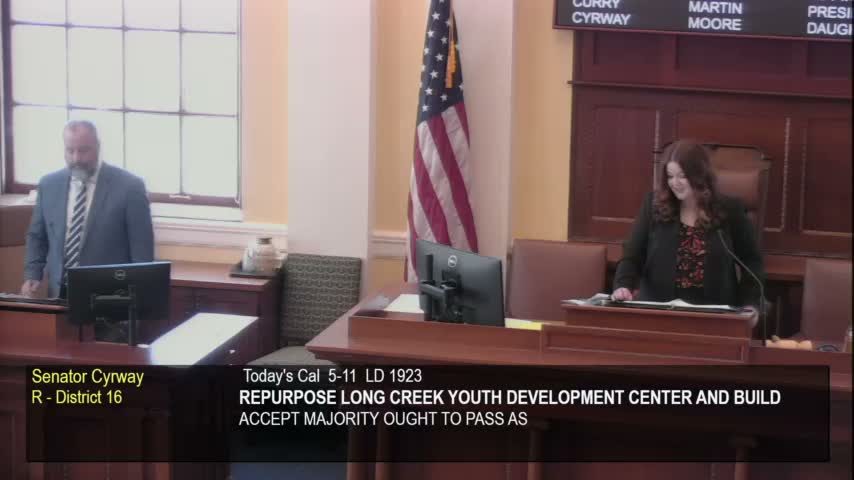
Summary
Senators debated amendments charging DHHS and DOC to study future use of Long Creek facilities; proponents framed the measure as a needed step to improve rehabilitation while opponents warned resources are lacking. The majority ought-to-pass-as-amended report prevailed on a roll call.
Lawmakers debated juvenile justice policy and a study of Long Creek’s future on March 17 as the Senate considered a committee amendment authorizing a formal study by the Department of Health and Human Services (DHHS) and the Department of Corrections (DOC).
Senator Serway (Kennebec) urged colleagues to consider the increase in serious juvenile offenders and recounted prior escapes and public‑safety concerns, arguing many remaining juveniles were serious offenders. "We've had actually five youths that escaped, and they were very serious offenders," he said, urging attention to public safety when weighing proposals.
Senator Curry (Waldo) supported the amendment as a charge to DHHS and DOC to plan for improved facilities and services that better balance public safety and rehabilitation, saying Long Creek had been used historically as the primary route to mental‑health care and that the state needs a different approach. Several senators, including Senator Cyrwey, cautioned that a study of internal correctional facilities must be paired with investment in community resources and services to succeed.
On the question presented, the chair called a roll and announced 19 senators voting in the affirmative and 13 in the negative; the majority ought-to-pass-as-amended report prevailed and the bill advanced through first-reading procedure as amended.
Senators emphasized the measure is a study and planning step, not an immediate closure or operational change; they requested clarity around resources and called for further work to identify community services required for any transition.