Get Full Government Meeting Transcripts, Videos, & Alerts Forever!
Get email alerts on the Traffic Speed Limits topic
No spam. Unsubscribe anytime.
Northlake police brief council on rules, costs and limits of lowering neighborhood speed limits
Summary
Police explained state law, engineering warrants and reporting requirements for changing local speed limits; staff recommended neighborhood petitions and data collection before ordinances, and council discussed cost-sharing and enforcement implications.
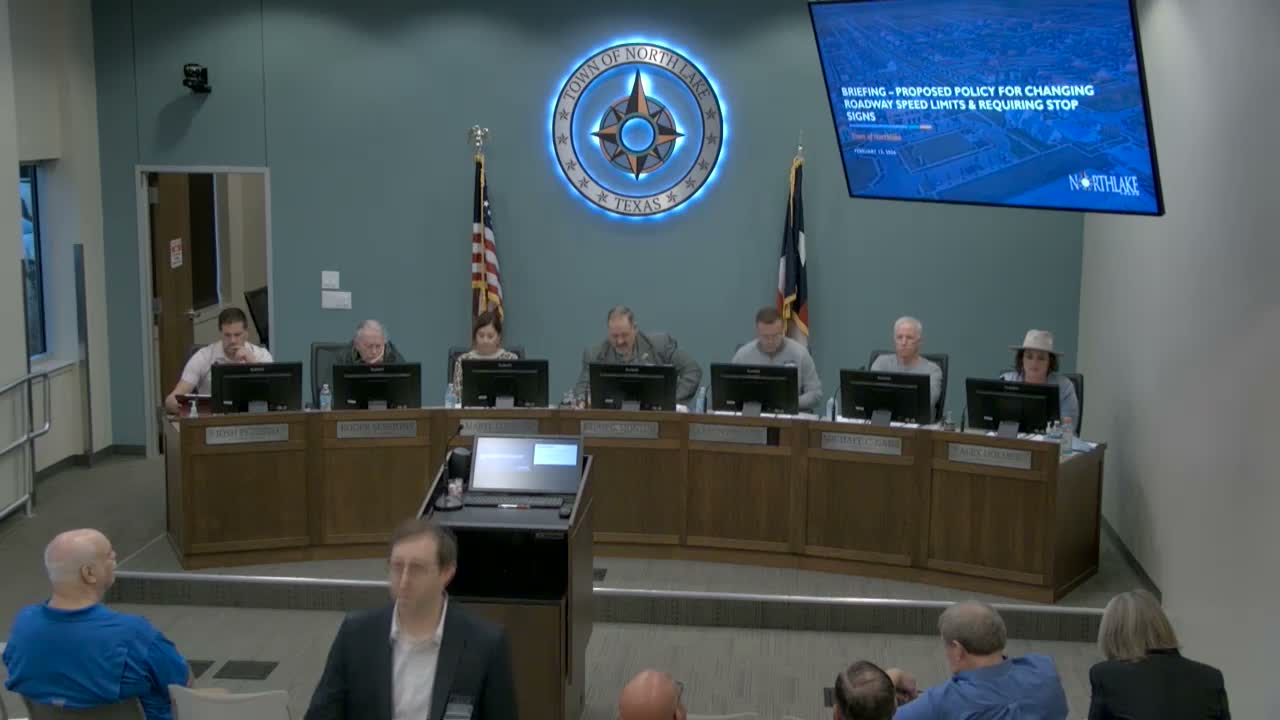
Council heard a detailed briefing on Feb. 12 about how the town can change neighborhood speed limits and when stop signs or signals are warranted. Chief Crawford told the North Lake Town Council that state law sets a prima facie speed of 30 mph when no sign is posted and allows municipalities to adopt 25 mph on two‑lane residential streets without a speed study if an ordinance is enacted and signs are posted. He said higher‑order streets require engineering speed or signal studies and that ‘‘unreasonable or unsafe’’ is not defined in the Transportation Code, leaving some discretion to the council.
The chief outlined implementation costs and operational impacts: individual signs cost about $90, poles and bases about $95, and staff estimated about one hour of crew time per installation. He said the town could install edge signs at neighborhood entrances to limit the number of signs needed. He also urged using a mix of ‘‘enforcement, education, and signage’’ because simply changing signs typically affects speed by only one to two miles per hour.
Councilors pressed staff on how speed‑limit changes would be initiated and verified. Mayor Montini said he favors asking neighborhoods to organize support via an HOA or community petition showing a strong supermajority before staff brings an ordinance request to the council. Several council members asked whether the town could implement changes by neighborhood rather than townwide and how the town would verify resident polling. The chief said the town’s speed trailer and targeted traffic studies can be used to determine the 85th‑percentile (design) speeds and help justify changes.
Residents who spoke during public input offered mixed views. Joel McGregor said a slide in the briefing showed zero speed‑related accidents and questioned whether lowering speed limits would improve safety or simply increase congestion. Other speakers described near‑misses and pedestrian safety concerns in neighborhoods without sidewalks and urged targeted reductions in those areas.
Council did not take legislative action on speed limits at the meeting; members directed staff to accept petitions, gather local speed data with the new speed trailer and return with specific, geographically defined recommendations and cost estimates.