Get Full Government Meeting Transcripts, Videos, & Alerts Forever!
Get email alerts on the HB 650 topic
No spam. Unsubscribe anytime.
Ohio lawmakers advance study commission on frontier tech and quantum information with amendment
Summary
Representative Workman's bill (HB 650) to create a study commission on frontier technologies and quantum innovation was amended to clarify membership, rename the body the Frontier Technologies and Quantum Commission, and define objectives including evaluating a permanent commission, economic and workforce impacts, infrastructure resilience, and ethical standards; higher‑education and industry witnesses urged urgency and broader focus on quantum information.
Lawmakers considered House Bill 650, which would create a time‑limited commission to study frontier technologies, including quantum research, artificial intelligence, automation and advanced mobility.
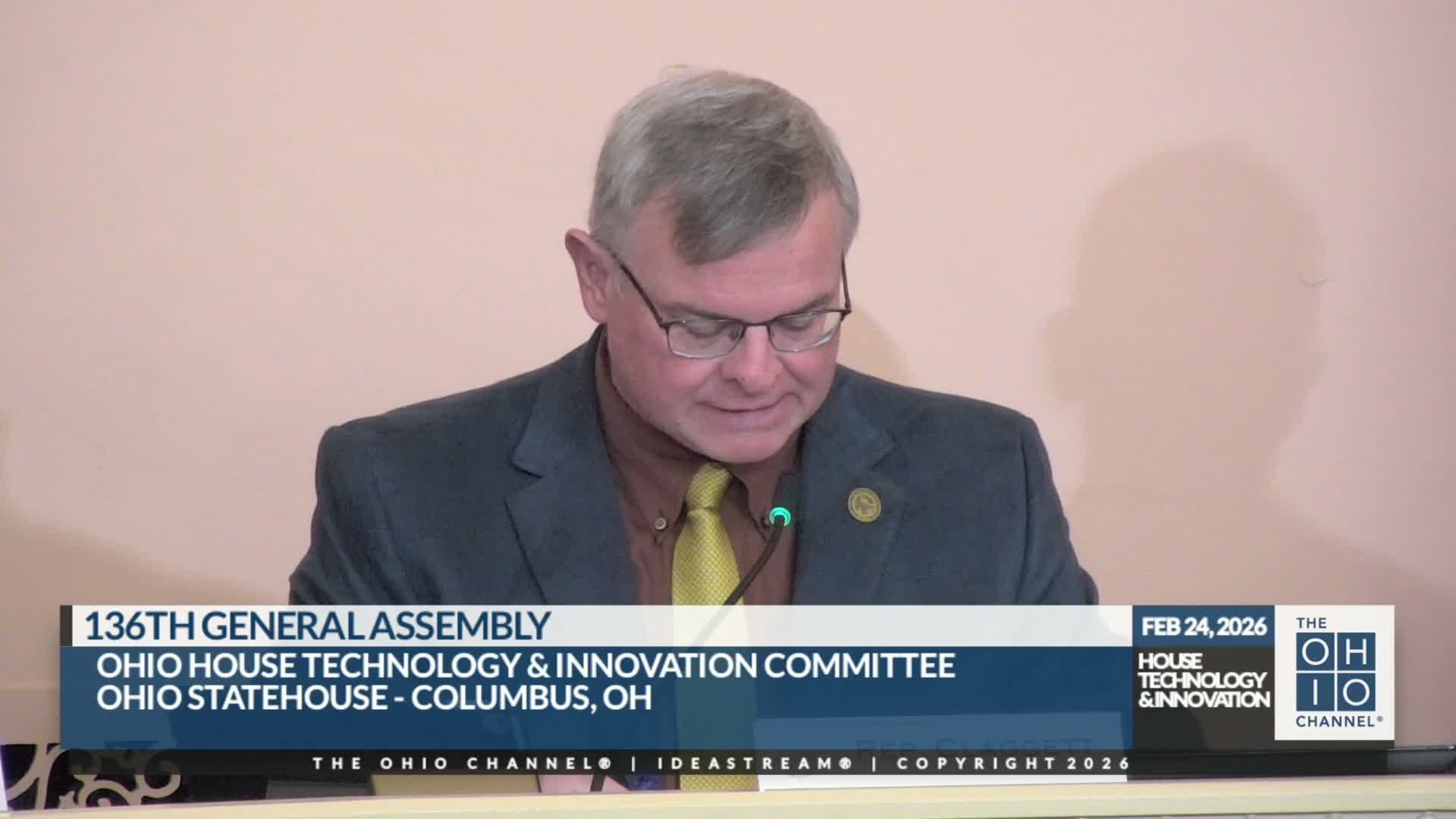
Vice Chair Workman moved to amend HB 650 (AM1361712-3) to update the commission's title to the Frontier Technologies and Quantum Commission, expand internal language from "quantum computing" to "quantum developments," structure membership to include four House members and four Senate members (removing governor appointments), designate one House and one Senate co‑chair, and set primary objectives including evaluating whether a permanent statewide commission is necessary.
Workman said the commission would provide a measured, collaborative forum to gather data, assess risks and opportunities, and provide recommendations to the General Assembly on economic, workforce, security and ethical implications of rapidly evolving technologies. He framed the bill as urgent for positioning Ohio to attract investment and talent.
Nicole Hoyer, director of state relations at Miami University, told the committee that Miami partnered with Cleveland Clinic to launch the Ohio Institute for Quantum Computing and highlighted a bachelor's degree in quantum computing and student internships at Cleveland Clinic as workforce development evidence supporting the commission.
Brett Rubinick, president and CEO of Transportation Research Center, Inc., endorsed the commission as a coordination mechanism for mobility, automation and advanced commuting technologies and stressed the state should avoid overregulation while aligning research, testing and public‑private partnerships.
Tom Walsh of Ohio State introduced co‑directors of Ohio State's Center for Quantum Information Science and Engineering and recommended the committee adopt a wider "quantum information" framing to include quantum networking, sensing and communications, not just computing; witnesses warned that federal and neighboring state investments increase urgency.
Members asked whether removing industry appointments risks politicizing the commission or limiting technical expertise. Workman said the amendment preserves a legislatively led commission while relying on outside experts to provide input and research. The amendment was explained and presented for committee review; the hearing concluded with the committee noting written and in‑person testimonies for the record.