Get Full Government Meeting Transcripts, Videos, & Alerts Forever!
Get email alerts on the Pricing Algorithms topic
No spam. Unsubscribe anytime.
Sponsors tell committee pricing algorithms trained on nonpublic data risk enabling price‑fixing; bill would require disclosures
Summary
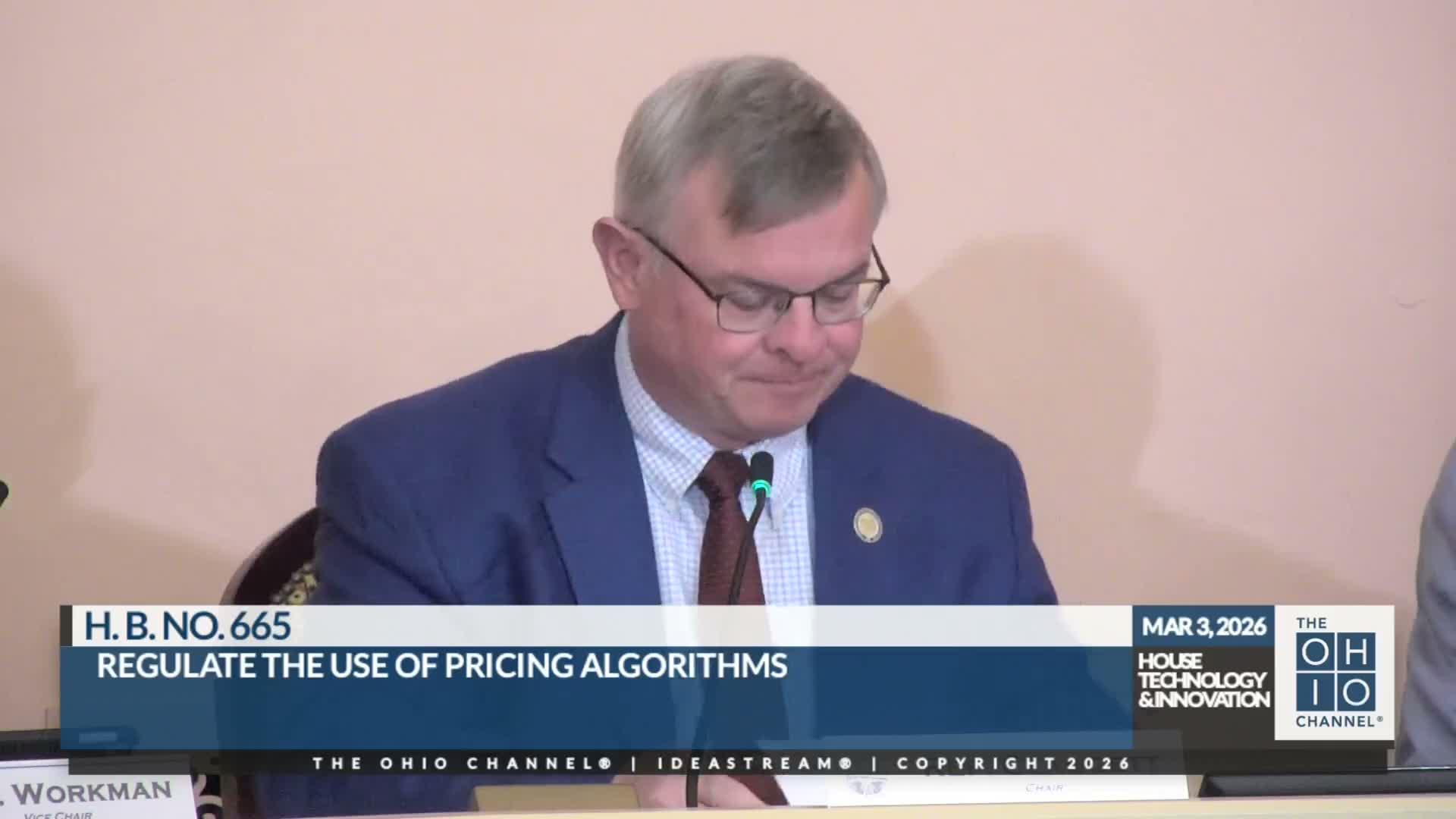
Representatives Cockley and Tex Fisher told the House Technology and Innovation Committee that House Bill 665 would clarify prohibitions on algorithmic price fixing and require companies with over $5,000,000 in gross receipts to disclose use of pricing algorithms trained on nonpublic competitor data; members pressed sponsors on enforcement and evidence collection.
Representatives Cockley and Tex Fisher testified in favor of House Bill 665, telling the House Technology and Innovation Committee that the measure would clarify Ohio law to cover pricing algorithms that use nonpublic competitor data and require companies with more than $5,000,000 in gross receipts to disclose if they use pricing algorithms trained on such data.
"Pricing algorithms that are given non public competitor data can skirt around current laws to engage in price fixing in a roundabout way," Representative Cockley told the committee, arguing that the practice can undermine competition and harm consumers.
Cockley cited the rental market as a current example, saying companies that aggregate nonpublic rental data and apply sophisticated algorithms can have the effect of fixing prices in a geographic area. During his testimony he also cited, as an example, a White House report he said estimated algorithmic pricing raised costs for renters by about $3,800,000,000 in 2023; that figure was presented in testimony and should be independently verified.
Sponsor Fisher said the bill is intended to provide consumer protections without stifling innovation: "We are simply setting up the necessary guardrails so they cannot be used in a predatory manner against consumers," he said, and added the bill is not intended to stop beneficial market signals such as surge pricing used to match supply and demand.
Committee members asked practical questions about enforcement and evidence collection: how an investigation would be triggered, whether time‑stamped pricing data and algorithmic logs would be available to investigators, and which agency would lead enforcement. Representative Cockley said consumer reports would likely initiate inquiries and said it would be his understanding that the attorney general's office would investigate antitrust concerns, but he prefaced that remark as his understanding rather than a definitive assignment of authority.
Members also questioned why the bill sets a $5,000,000 gross‑receipts disclosure threshold. Sponsors described the threshold as a way to limit regulatory burden on small businesses while capturing larger actors more likely to affect market outcomes.
Sponsors and members agreed that implementation details — including mechanisms for evidence collection, the scope of disclosure requirements, and definitions of nonpublic competitor data — need further drafting and stakeholder input before the bill is finalized.
The chair closed sponsor testimony and the committee moved on to additional agenda items; no committee vote on HB 665 was recorded today.