Representative Workman urges codifying Spearin doctrine in House Bill 605 to limit contractor risk

House Commerce and Labor Committee · March 18, 2026

Get AI-powered insights, summaries, and transcripts

Sign Up Free
AI-Generated Content: All content on this page was generated by AI to highlight key points from the meeting. For complete details and context, we recommend watching the full video. so we can fix them.

Summary

Representative Workman told the Commerce and Labor Committee House Bill 605 would create a statutory implied warranty that public owners warrant the accuracy and sufficiency of plans and specifications for design–bid–build projects, citing United States v. Spearin (1918) and a 2007 Ohio Supreme Court decision that narrowed the rule. Workman said codification could reduce change orders and trim millions from public-construction costs; members asked about applying the rule to the private sector and the measure’s economic impact.

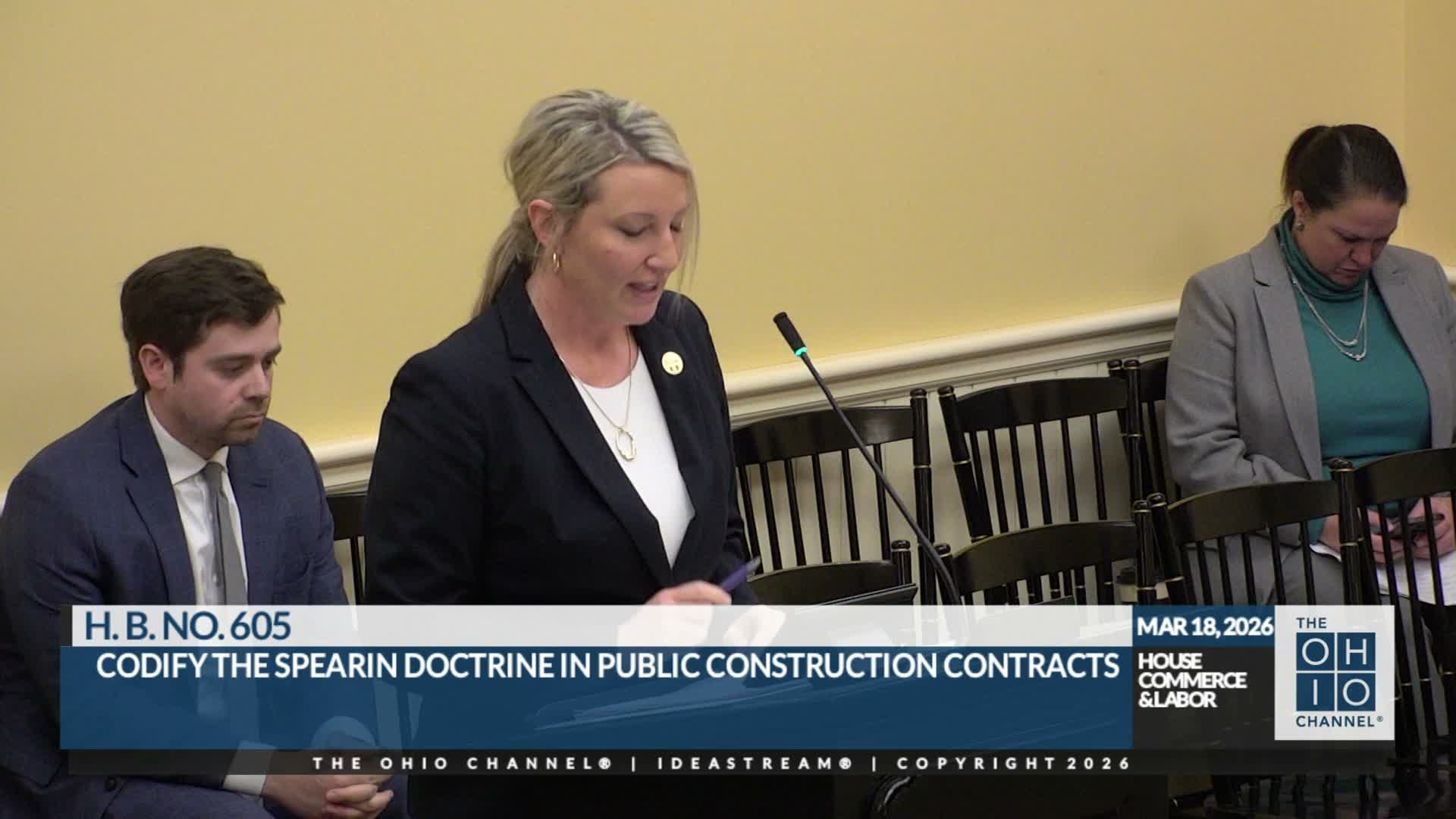
Representative Workman presented House Bill 605 to the House Commerce and Labor Committee and argued the legislation would restore a long-standing principle from the U.S. Supreme Court that public owners implicitly warrant the accuracy of plans and specifications they provide for traditional design–bid–build public construction projects.

Workman summarized the legal background, telling the committee that "In 1918, the Supreme Court decided United States v. Spearin" and that the Spearin doctrine holds that when an owner furnishes plans and specifications and requires a contractor to build exactly to them, "the owner impliedly warrants that those documents are accurate, adequate, and sufficient for the job." Workman said Ohio’s 2007 state supreme court decision limited the rule and allowed public owners to use broad disclaimers that shift design risk to contractors.

Workman cited statewide construction volumes to emphasize the stakes. "Ohio public entities, state agencies, school districts, counties, cities, and townships, spend approximately $13,000,000,000 each year on construction projects," Workman said, and added testimony from industry studies that design defects account for roughly 25 to 40 percent of change orders and construction disputes on public projects. He said House Bill 605 would create a statutory implied warranty applying only to public projects using the design–bid–build method and would not affect private projects, design–build delivery, or a contractor’s workmanship.

Representative Rader praised the measure and asked whether Workman had considered extending the protection to private-sector projects. Workman replied that he had not looked at private projects for this bill but that the idea could be explored later.

Representative Fisher asked about the economic impact of not codifying the Spearin doctrine. Workman said codification could cut costs dramatically because contractors would no longer include large risk premiums in bids and because fewer change orders and claims would reduce delays and litigation. He estimated savings in the long run "in the millions, if not hundreds of millions," but did not provide an econometric analysis or a statutory cost estimate in the hearing.

Workman asked for the committee’s support to move the bill forward. The committee concluded sponsor testimony and adjourned without taking a recorded vote on House Bill 605.

This article is based on sponsor testimony and committee questions in the committee transcript; no agency legal opinions or fiscal analyses were included in the hearing record.