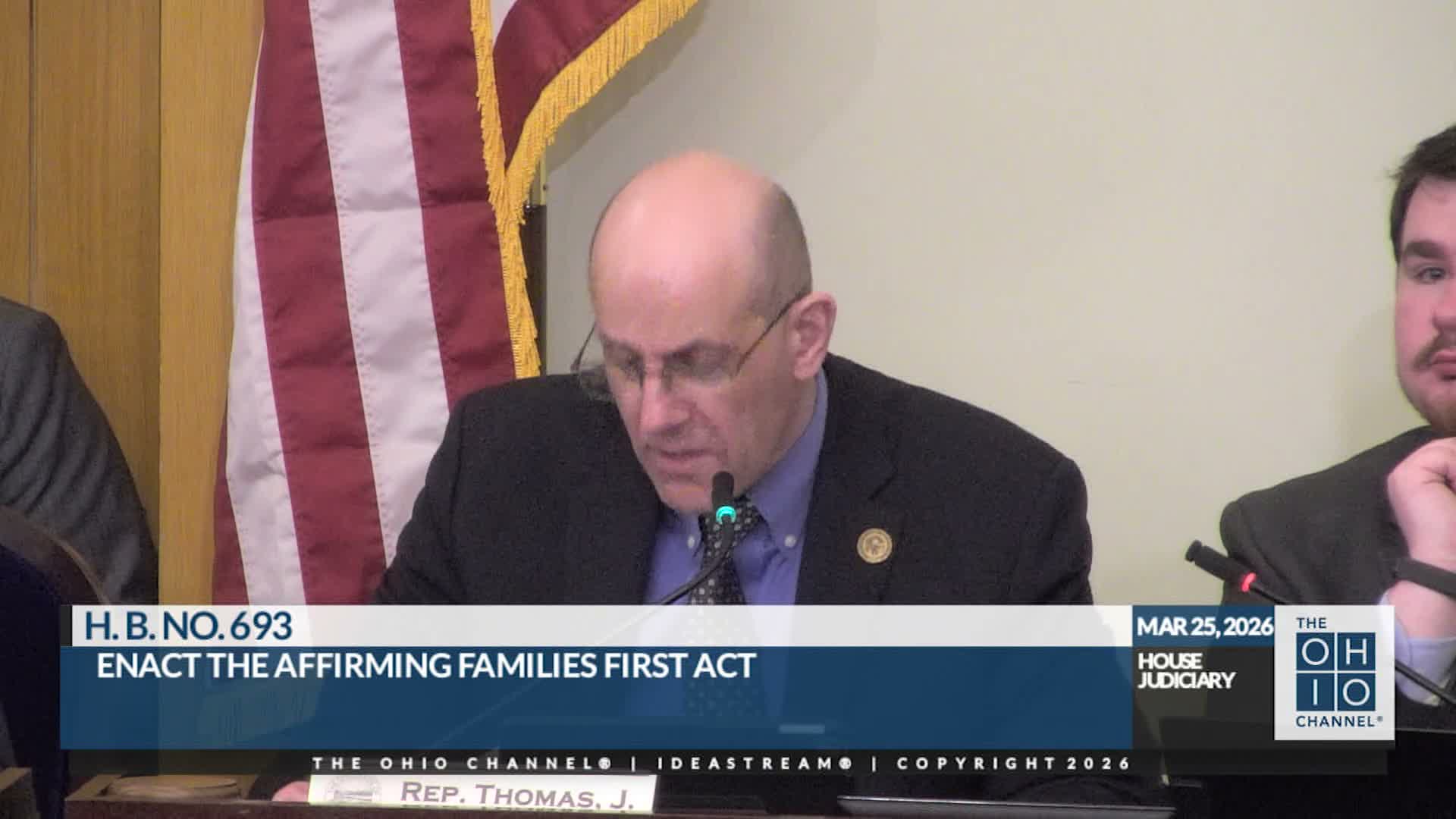
Lawmakers hear hours of testimony for and against 'Affirming Families First' bill

House Judiciary Committee · March 25, 2026

Get AI-powered insights, summaries, and transcripts

Sign Up Free
AI-Generated Content: All content on this page was generated by AI to highlight key points from the meeting. For complete details and context, we recommend watching the full video. so we can fix them.

Summary

The House Judiciary Committee heard extensive pro‑ and con‑testimony on House Bill 693, the Affirming Families First Act, which would limit state and contractor actions that treat parents as abusive for refusing to 'affirm' a child's claimed gender identity. Witnesses offered legal analysis, personal stories of family court and foster care experiences, and contested claims about clinical evidence and agency practices.

House Judiciary Committee members spent several hours hearing testimony for and against House Bill 693, the Affirming Families First Act, a measure sponsors say will protect parents from state action for choices that affirm their child’s biological sex.

Supporters presented legal, policy and personal arguments to the committee. Laura Bryant Hanford, a senior policy analyst who testified she was affiliated with the Heritage Foundation, said the bill would establish national‑level guardrails to prevent what she described as the "ideological weaponization" of child welfare systems. "If you pass this bill, you will set a national standard for protecting families," she told the committee.

Legal advocates echoed that framing. Matt Sharp, senior counsel with Alliance Defending Freedom, argued the bill protects parents’ constitutional rights and prevents school and child‑welfare policies that withhold information from parents. "These policies hide information from parents and violate a parent's right to direct the upbringing and education of their children," Sharp said.

Numerous parents and former clinicians described firsthand experiences they said justify statutory protection. Ron Lee said his son’s school counselors pulled the child into support groups without informing him; he testified that he was later shut out of important decisions. "When that authority is stripped away, children lose their first line of protection," he said. Jeanette Cooper recounted losing parenting time after a family court temporary order and urged lawmakers to "please listen to the fathers."

Other witnesses with clinical or research backgrounds offered contested critiques of pediatric gender care. Jamie Reid, who described herself as a former clinic case manager and an executive director at LGB Courage Coalition, said international systematic reviews show the evidence base for medical interventions in minors is weak and argued the bill would prevent medicalization of children without robust evidence.

Some supporters testified that school policies and certain county programs collected SOGI (sexual orientation and gender identity) data and trained staff to proactively "affirm" young children; Megan Brock, an investigative reporter, said she obtained public records she would provide to the committee and described a Cuyahoga County pilot program she said tracked SOGI information and trained staff on a "safe identification" process.

Committee members asked witnesses for supporting documents and clarifications; multiple witnesses said they would provide citations and records for committee review. Opponents of the bill were not on the record in the excerpted hearing; committee members also raised questions about potential impacts on foster placement and child safety when parents and children disagree.

The hearing concluded with the committee asking for submitted citations and indicating the record would remain available for review. The bill remains under committee consideration; supporters said it is intended to protect parents and clarify limits on state actors, while questions remain about evidentiary claims and how the measure would interact with existing child‑welfare law.

The committee did not vote on HB 693 during the hearing; members asked witnesses to provide documents and citations they referenced.