Get Full Government Meeting Transcripts, Videos, & Alerts Forever!
Get email alerts on the Energy Audit topic
No spam. Unsubscribe anytime.
City considers Schneider Electric energy audit; staff seeks direction on $50,000 investment
Summary
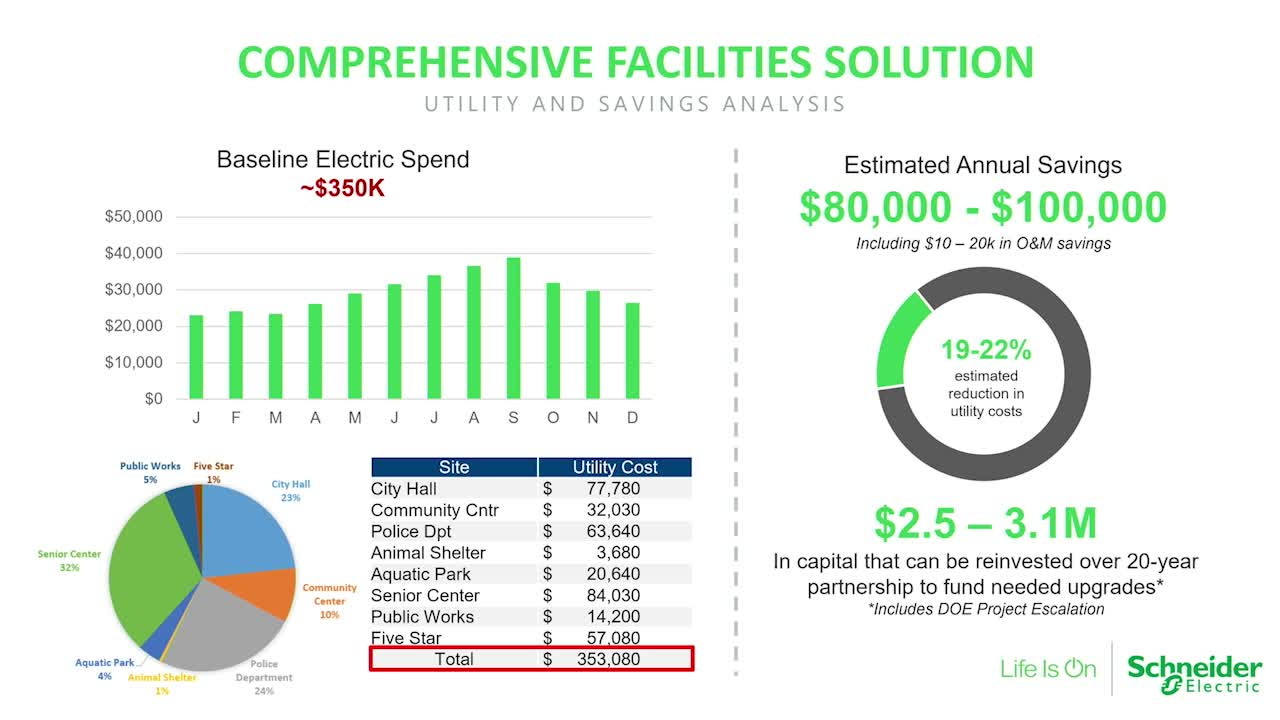
Connelly City Council heard a Schneider Electric presentation on a potential performance‑contract energy program and was asked to authorize a $50,000 investment for a detailed audit. The company estimates $80,000–$100,000 in annual utility savings from a $4–5 million project backed by a 20‑year guarantee.
Connelly officials heard a presentation from Schneider Electric proposing a citywide energy audit and potential performance contract that would use guaranteed utility savings to fund facility upgrades.
Brian Davis, a Schneider Electric representative, said the company completed a preliminary analysis that put the city’s baseline utility spend at about $350,000 a year and identified potential captured savings of roughly $80,000 to $100,000 annually. "We did a preliminary audit," Davis said. "The next step is an investment‑grade audit — that’s what the $50,000 covers — and it tells you exactly what projects and savings you can expect." Paige Bleakley, the firm’s project development manager, told the council the detailed audit would walk nearly 20 facilities and identify opportunities such as LED lighting retrofits, HVAC and controls upgrades, roof and building‑envelope work, and electrical improvements.
Charlie Davis, another Schneider presenter, said the $80,000–$100,000 estimate corresponds to a potential project in the $4 million to $5 million range. He added that Schneider’s model uses third‑party financing over a 20‑year term and that the firm guarantees savings: "If the savings fall short, Schneider makes up the difference," he said.
City staff said the next step would be a contract for the investment‑grade audit. The council was told the audit would be a $50,000 engagement; if the city later moves forward with projects, that fee would be rolled into the overall project cost rather than remain an additional charge. City staff emphasized this work would be a design‑and‑planning step only and that any specific projects would return to council for approval.
Council members pressed for timing and budget forecasting. Schneider estimated a 3–4 month timeline for the investment‑grade audit and said the program is collaborative: the company identifies projects but will avoid duplicating work the city already has under design. "We’re the single source of accountability: design, build and engineer," Brian Davis said, noting the firm’s experience in Texas and municipal markets.
The council directed staff to place the audit contract on an upcoming consent agenda if members wish to proceed; staff said that would not commit the city to construction, only to the detailed analysis required to scope projects and confirm financing options.