
Senate Finance Committee advances House Bill 730, adds federal maternal-health funding and redirects projects
Get AI-powered insights, summaries, and transcripts
Sign Up Free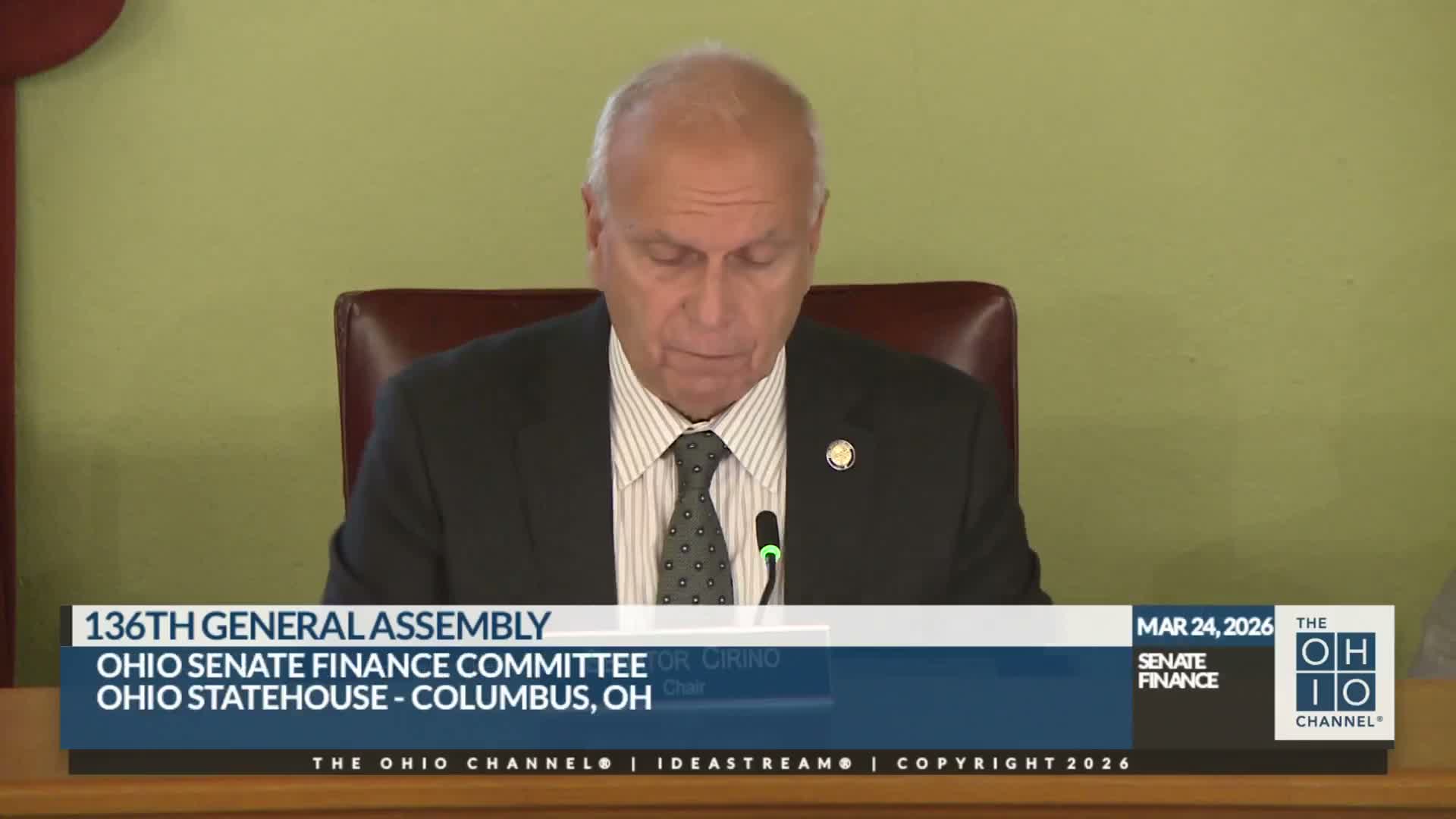
Summary
The Senate Finance Committee favorably reported substitute House Bill 730 after adopting amendments that reappropriate roughly $1.93 billion for capital and school facility projects, add federal Maternal Health Transformation funding and redirect several capital projects; two membership amendments concerning SNAP and an OBM transfer were tabled.
The Senate Finance Committee on the first hearing of substitute House Bill 730 adopted several amendments and favorably reported the bill to the Committee on Rules and Reference.
Chair Cerino opened the session and summarized HB 730 as a reappropriation measure that mirrors provisions in SB 371 and reappropriates about $1,930,000,000 to support public infrastructure and school facility projects statewide. Committee members were provided written biographies for gubernatorial appointments and the committee referred those appointments to the Committee on Rules and Reference earlier in the meeting.
Sen. Craig moved an amendment to redirect $575,000 previously appropriated for a Columbus State Community College capital project to the Maroon Arts Group for cultural lab upgrades. The amendment drew no objections and was added to the bill. “This amendment would redirect the funds previously appropriated … to the Maroon Arts Group for their cultural lab upgrades,” Sen. Craig said.
Ranking Member Hicks Hudson offered two substantive amendments aimed at county-level program administration. The first sought to allocate $12,500,000 from the Family Assistance local and federal fund to county departments for SNAP administration using the traditional distribution formula; Hicks Hudson said the change was intended to make distribution more equitable and to reduce administrative errors. Vice Chair Chavez moved to table that amendment; the clerk called the roll and the tabling motion carried. The transcript records roll-call responses and shows the amendment was tabled.
Hicks Hudson also moved an amendment directing the Office of Budget and Management to transfer $38,203,737 from the Budget Stabilization Fund to the General Revenue Fund to cover county funding shortfalls resulting from federal administrative reimbursement changes, with distributions based on county caseload. Vice Chair Chavez again moved to table; the clerk called the roll and the committee tabled the amendment by majority vote.
After a brief recess to reconcile language, Vice Chair Chavez moved and the committee adopted amendment 2077-4 to appropriate federal dollars awarded under the federal Maternal Health Transformation program. The committee noted the federal award for the state totals approximately $202,000,000 in fiscal year 2026 and a like amount in fiscal year 2027 (a two-year total cited in committee discussion of about $404,000,000 for the first two years of the five-year program). The amendment provides appropriation authority for those federal funds and identifies programmatic allocations, including: at least $30,000,000 in each fiscal year for competitive awards to improve maternal health and help reconstitute or expand maternity services in rural areas; $42,000,000 over two years for school-based health centers; $33,000,000 over two years for chronic-disease-prevention initiatives; and $50,000,000 over two years to expand the Ohio c initiative as described in the amendment.
Committee members pressed staff for implementation details and for assurances that the Department of Health would follow the legislative intent to prioritize rural hospitals. Chair Cerino said applications would be made to the Department of Health and that department staff would determine award recipients and amounts. “The individual providers will have to make application for these grants,” Chair Cerino said. Ranking Member Hicks Hudson and Sen. Ingram questioned whether the funds would supplement or duplicate existing Appalachian-targeted dollars; members were repeatedly told that the Department of Health, working with legislative negotiators, would administer the competitive process and that the intent is to prefer rural hospitals.
Sen. Romichuk raised concerns that language limiting selection criteria had been removed in later versions of the amendment; committee leadership said the change prompted the earlier recess so staff could reconcile clearer criteria and parameters before the hearing resumed.
Following the amendment debates, Vice Chair Chavez moved to favorably report substitute House Bill 730 to the Committee on Rules and Reference. The clerk called the roll; the bill was favorably reported. The chair also asked for, and the committee granted, authority for the Legislative Service Commission (LSC) to harmonize amendment language as needed.
What happened next: HB 730 was reported out of the Finance Committee to Rules and Reference with several adopted amendments and with two member amendments tabled. The next procedural step is consideration in the Rules and Reference process before the bill’s next floor or committee action.
Votes and formal actions recorded in committee included adopting Sen. Craig’s $575,000 project redirect, tabling two amendments by Ranking Member Hicks Hudson (one on SNAP allocation and one requesting an OBM transfer), adoption of amendment 2077-4 appropriating federal Maternal Health Transformation funds, and favorably reporting the bill to Rules and Reference. The committee also referred the governor’s appointments to Rules and Reference earlier in the meeting.
Funding and implementation detail noted in committee: the Maternal Health Transformation allocations are federal funds; the Department of Health will administer the competitive award process and determine recipients and amounts. Several members sought clarity on overlap with existing Appalachian-targeted funds and on whether previously announced awardees would be eligible; committee members were told the funds covered future activities and that Department of Health rules and federal guidelines govern eligible uses.