Get Full Government Meeting Transcripts, Videos, & Alerts Forever!
Get email alerts on the Social Services topic
No spam. Unsubscribe anytime.
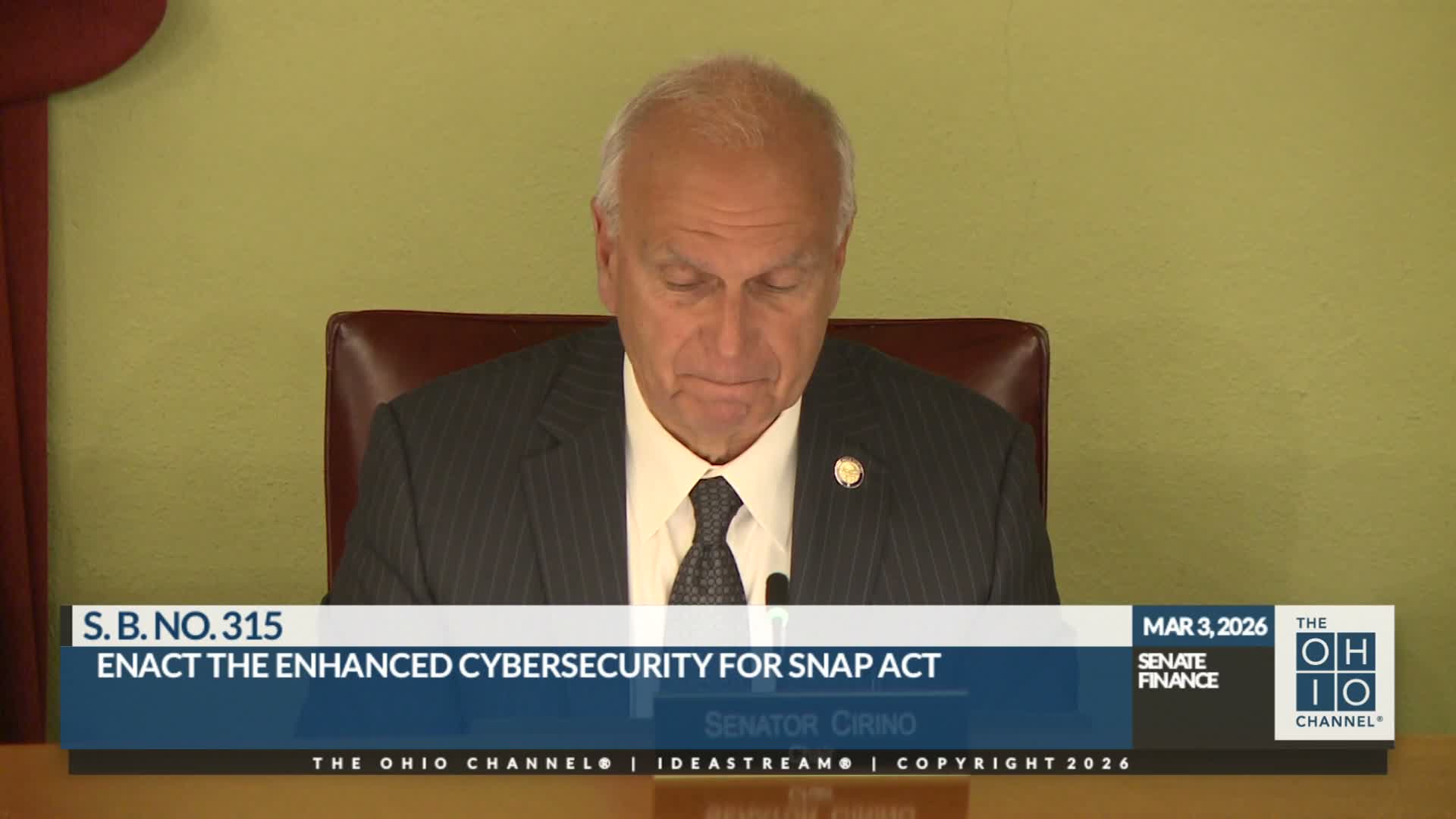
Sponsor says SB 315 would spend $10.6M to install chip security on SNAP EBT cards after $17M in benefit thefts
Summary
Sponsor testimony says SB 315 would appropriate $10,600,000 to the Department of Job and Family Services to implement chip technology on SNAP EBT cards and require cybersecurity rules and a public reporting portal; sponsor cited $17,000,000 stolen in over 30,000 cases across June 2023–Dec 2024 and said the federal government would reimburse roughly half.
A sponsor told the Senate Finance Committee that Senate Bill 315 would fund a security upgrade to Supplemental Nutrition Assistance Program (SNAP) EBT cards by adding chip technology similar to private‑sector debit/credit cards.
The sponsor said that between June 2023 and December 2024, "$17,000,000 in SNAP benefits was stolen in over 30,000 cases," citing Ohio Department of Job and Family Services figures. To address the fraud, SB 315 would appropriate $10,600,000 to the Department of Job and Family Services to implement chip technology, replace existing cards, and adopt cybersecurity rules; the sponsor said roughly half the funding (about $5,300,000) would be reimbursed by the federal government, leaving an estimated $5,300,000 state exposure.
Sponsor testimony explained the technology rationale: chip cards are less vulnerable to skimming and easier to cancel than magnetic‑stripe cards; the sponsor said the legislation would require JFS to adopt rules within one year after the bill's effective date and give JFS until Oct. 1 to complete replacement of existing cards. Witnesses said the new cards do not necessarily require PIN entry and that the bill is intended to reduce fraud and associated state and federal costs, including future increased state administrative shares under recent federal changes.
Committee members asked how the fraud is perpetrated and whether vendors participate; the sponsor said a small minority of unethical vendors have long participated but that the majority of retailers are reputable. Members also queried whether recently appropriated funds for system upgrades overlap with the proposed $10.6M; the sponsor said prior appropriations (about $10,000,000) were targeted to local JFS software and staffing upgrades, while this bill focuses on card technology and issuance. Sponsors emphasized timing to avoid increased costs tied to federal changes in administrative match and potential penalties if error rates remain high.
Next steps: Sponsor testimony concluded; committee members asked for follow‑up on costs, prior expenditures, and precise rule language.