Lifetime Citizen Portal Access — AI Briefings, Alerts & Unlimited Follows
Educators and businesses urge computer science requirement, warn of teacher shortage
Loading...
Summary
Supporters told the Senate Education Committee Senate Bill 326 would expand access to computer science and require a unit for graduation phased in over years; witnesses said it is a workforce and equity move but urged clarity on what counts for the unit and noted a current shortage of certified teachers.
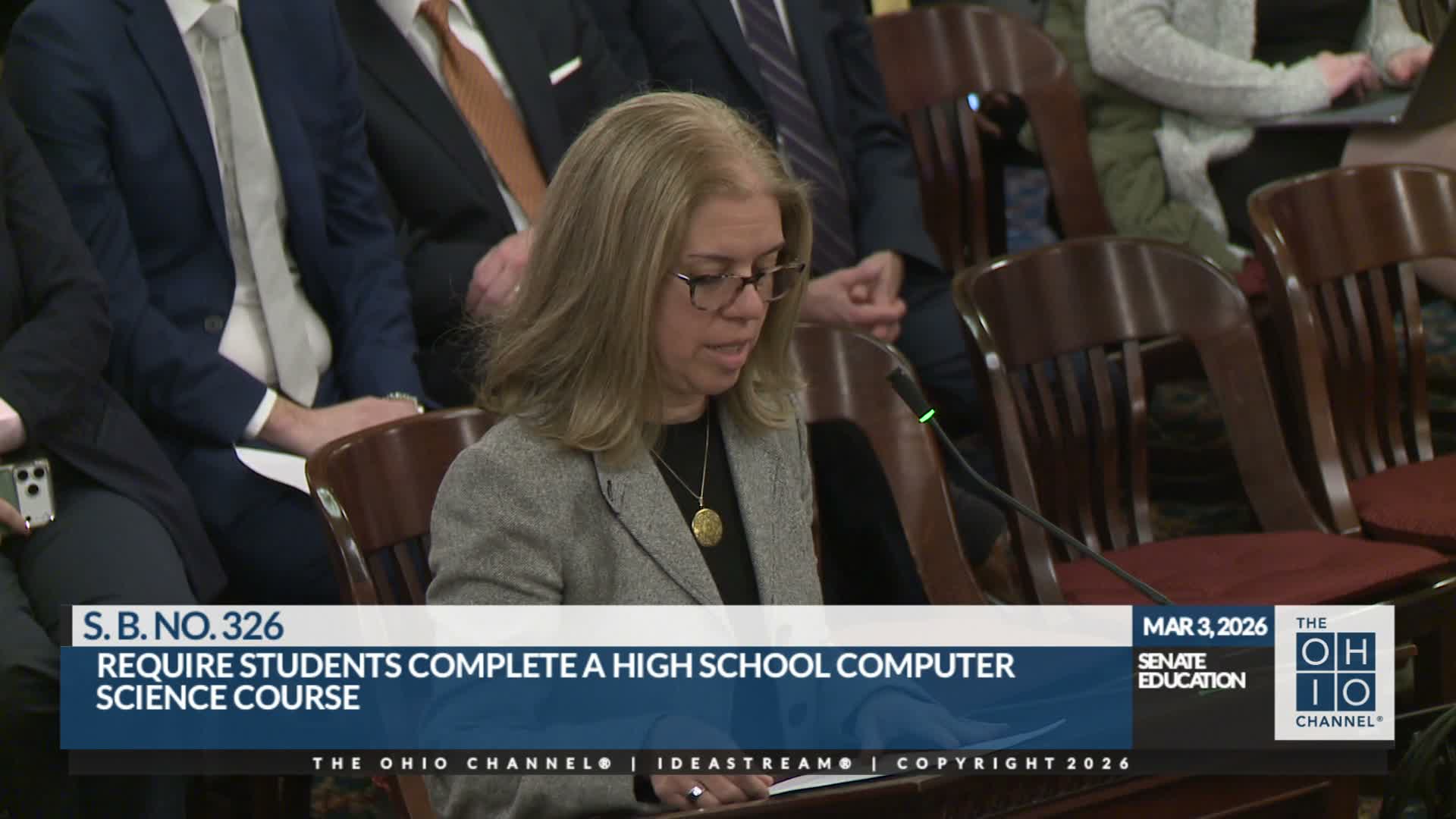
A coalition of educators, nonprofits and business groups urged the Senate Education Committee to advance Senate Bill 326, which would require Ohio schools to offer computer science and ultimately require a unit of computer science for high‑school graduation with flexibility for substitutions and a phased implementation.
"Computer science today is what biology was a generation ago," said Renee Coley of the Computer Science Teachers Association in testimony supporting SB 326 as essential foundational learning.
Industry and education witnesses — including Code.org, Battelle Education, Lorain County Joint Vocational Schools, OhioX and the Ohio Chamber of Commerce — framed the measure as a workforce and equity initiative designed to give every student access to CS and AI fundamentals. Supporters highlighted state investments such as Teach CS grants and licensure waivers that expand teacher pipelines.
Skeptical or cautionary notes from academics and practitioners focused on implementation capacity. Professor Chris Orban said Ohio currently has roughly 1,000 computer‑science teachers and estimated the state may need several thousand more (public figures cited in testimony ranged up to 7,000–8,000) to implement a year‑long graduation unit at scale. Orban recommended clearer statutory language that allows high‑quality courses in other subjects (for example, math classes with substantial CS content) to count toward the requirement.
Committee members asked about the definition of a "unit," seat‑time requirements, what kinds of courses may qualify, and the Department of Education and Workforce’s role in identifying eligible courses. Sponsors said flexibility was included in the bill’s language and that the department would implement detailed guidance, but witnesses urged the committee to specify counting rules to reduce ambiguity.
No committee vote was taken; members signaled interest in ensuring implementation supports (teacher training, phased rollout, course‑counting guidance and funding) accompany any mandate.