Lifetime Citizen Portal Access — AI Briefings, Alerts & Unlimited Follows
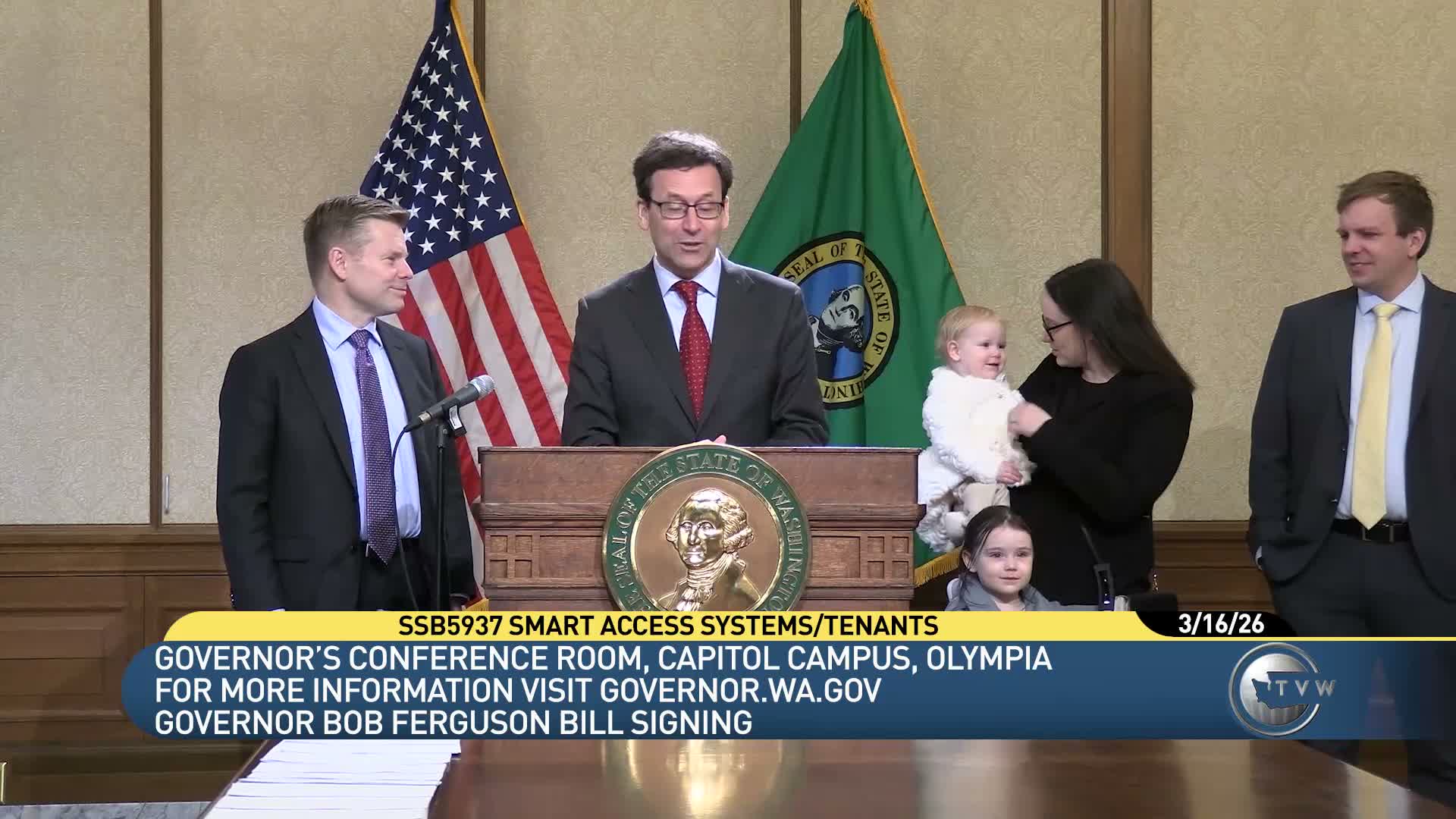
Presenter signs a package of roughly two dozen bills in Olympia, citing tenant privacy, transgender ID protections and an AI-image ban
Loading...
Summary
A presenter in Olympia signed about 23–24 bipartisan bills covering renter privacy and non-digital access (SB 5937), transgender ID privacy (SB 6081), a ban on nonconsensual AI-generated images (SB 5886) and other measures affecting housing, health and transportation.
A presenter signed a package of roughly two dozen bills in a morning ceremony in Olympia, saying the measures — spanning tenant privacy, health-care administration, transportation safety and labor protections — were the product of bipartisan work and public engagement.
"Digital locks, biometric access, and smart access systems are reshaping modern homes across Washington state," the presenter said, introducing Senate Bill 5937, which the presenter described as strengthening renter protections by requiring landlords to provide non‑digital alternative access methods when tenants request them and by setting limits on data collection.
The presenter also signed Senate Bill 6081, which the presenter said "exempts from public disclosure gender designation data and documentation used to change gender with the Washington Department of Licensing and the Department of Health," framing the change as a privacy protection for transgender and gender‑diverse Washingtonians.
The bill package included measures across multiple policy areas: HB 2254 (authorizing certain administrative assessments tied to the Partnership Access Line, a mental‑health consultation service for primary care); HB 2340 (expanding substance‑use‑disorder monitoring programs to include nursing assistants and access to an existing stipend); HB 2410 (creating a Commercial Truck Safety and Education Council within the Washington Traffic Safety Commission); and HB 2428 (requiring insurers to allow policyholders to designate a third party to receive lapse notices and verify receipt).
The presenter described several measures aimed at workforce and public‑safety concerns. SB 5995 preserves a prohibition on ports using public money for automated marine cargo‑handling equipment, which the presenter said "ensures human operation and oversight at our ports." SB 5834 allows the Department of Retirement Systems to use interest earnings from administered retirement funds to pay for fraud prevention. SB 5886, the presenter said, bans the use of AI‑generated images of Washingtonians without consent to guard against identity exploitation.
Several bills modify administrative or technical rules: HB 2353 raises the threshold for requiring a predesign study on capital construction from $10 million to $15 million with annual inflation adjustments; SB 5915 streamlines the Health Care Authority's review process for new health technologies; and SB 6039 (introduced later in the sequence) allows the Department of Labor and Industries to send electronic notices in place of paper notices for many programs while preserving paper as an option for those who prefer it.
The presenter repeatedly thanked prime sponsors named in the ceremony, identifying several by name and title as they handed pens to sponsors for photographs. Sponsors mentioned in the transcript include State Senator Jamie Petersen (SB 5937 and SB 6081), State Senator Mark O'Lios (SB 6091), State Representative Lisa Kallen (HB 2254), State Representative Tara Simmons (HB 2340), State Representative Michael Keaton and State Representative Marie Levitt (HB 2353 sponsors), State Representative Jake Pfeiffer (HB 2410 and companion sponsor on other bills), State Senator Sharon Shumate (SB 5252), State Senator Steve Conway (SB 5834), State Senator Matt Behnke (SB 5886), State Senator Paul Harris (SB 5915), State Senator Tina Orwell (SB 5957), State Senator June Robinson (SB 5988) and State Senator Jesse Solomon (SB 5995), among others. The transcript attributes those sponsor names and titles to the presenter when the bills were introduced at the ceremony.
The presenter noted the number of bills being signed as "I think we have, like, 23 or 24 bills this morning," and the event included repeated moments for photographs after each signing. The ceremony record shows no roll‑call votes taken at the event; the presenter signed bills that had already passed the Legislature and were being enacted by signature.
What happens next: the ceremony concluded with photos and acknowledgments; the transcript does not specify effective dates for the signed bills, nor does it record further administrative steps beyond the signature ceremony. Where precise implementation dates, funding amounts, or agency rules were not stated in the transcript, those details were "not specified."