Get Full Government Meeting Transcripts, Videos, & Alerts Forever!
Get email alerts on the Animal Welfare topic
No spam. Unsubscribe anytime.
Sponsors say narrow bill would register wolfdog hybrids after Ashtabula neglect incident
Summary
Representatives Thomas and Creech told the Agriculture Committee HB 676 would require registration, fencing, insurance and recovery of county cleanup costs for wolfdog hybrids after a large neglect incident; sponsors said the measure aligns hybrids with existing dangerous‑dog standards and improves coordination among local officials.
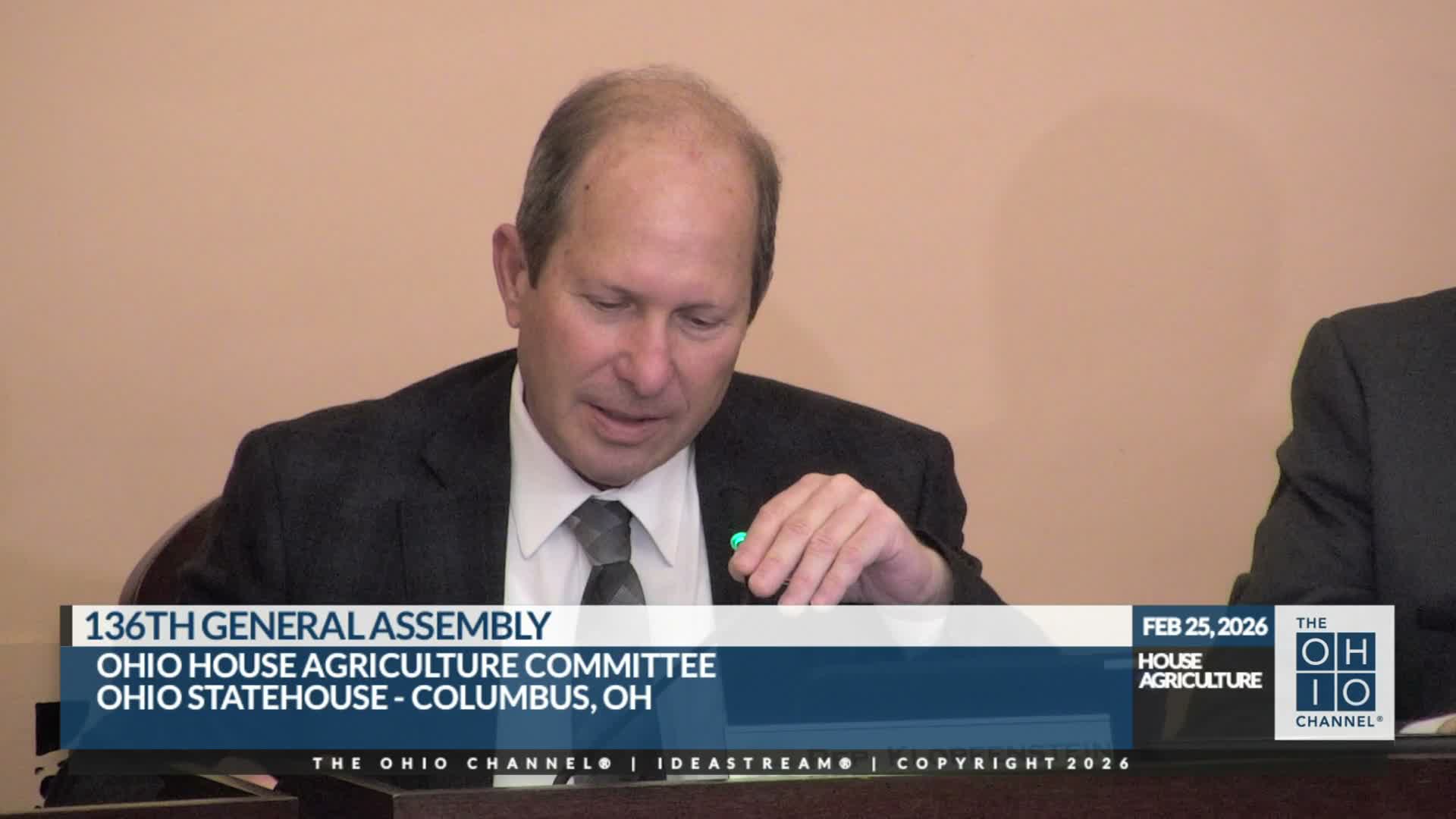
Representatives Thomas and Creech presented sponsor testimony to the House Agriculture Committee on House Bill 676, which they described as a narrowly tailored response to a severe animal‑neglect incident in Ashtabula County. Thomas said roughly 400 animals of mixed species were found on a residential property and that local authorities had to intervene; he said the bill would have helped prevent that outcome by creating uniform registration and safety standards for wolfdog hybrids.
Thomas said the legislation would copy dangerous‑dog standards for fencing, insurance and public notice, provide county commissioners defined authority and procedures to address related nuisances, and allow counties to place nuisance abatements on properties to recoup cleanup costs. He estimated the county's basic feeding and welfare expenses at roughly $20,000 for the incident and said Humane World donated major veterinary and relocation services.
Representative Creech said the incident exposed gaps in Ohio law where ownership and oversight of exotic or hybrid animals fall "between the cracks" of multiple agencies. Creech said aligning wolfdog hybrid rules with existing dangerous‑dog standards would be familiar for law enforcement and would give local officials tools to respond effectively while the sponsors continue work with stakeholders, including Humane World, on broader fixes.
Committee members asked for technical background on why these hybrids pose greater safety risks and whether zoning or agricultural classifications limit local authority. Sponsors explained that jurisdiction can be split among the Department of Agriculture, the Ohio Department of Natural Resources and local dog wardens depending on whether animals are considered domesticated or wild, and said the bill is narrowly scoped to avoid overburdening responsible owners.
The committee completed a first hearing; sponsors said they will continue stakeholder engagement and bring further details in later sessions. No vote occurred.