Get AI Briefings, Transcripts & Alerts on Local & National Government Meetings — Forever.
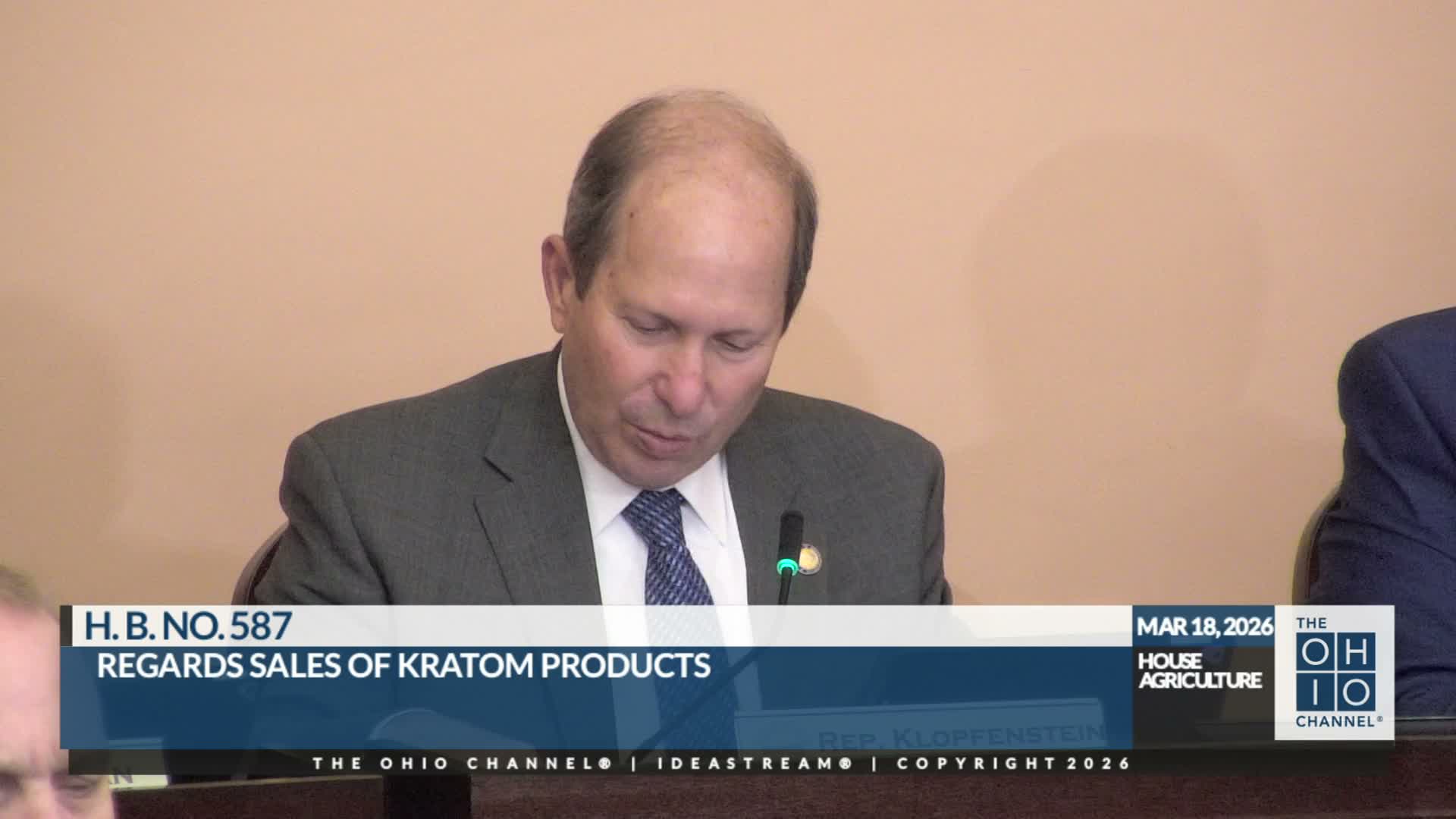
Ohio House Agriculture Committee hears competing calls to regulate or ban kratom alkaloid in HB 587
Loading...
Summary
At hearings on House Bill 587, grieving family members and public‑health advocates urged a ban or stricter controls on kratom products after fatal cases were described, while researchers, industry representatives and consumer groups called for tightly regulated access, testing and age limits rather than prohibition.
Members of the Ohio House Agriculture Committee spent the bulk of a day hearing sharply divergent testimony on House Bill 587, a proposal that would restrict certain kratom alkaloids including 7‑hydroxymitragynine (7‑OH).
"My son, Austin, died on 12/06/2023. He was 25 years old," said Dan Gibbs, who testified he found the Montgomery County coroner’s report attributing the cause of death to mitragynine and urged lawmakers not to move policy before the Board of Pharmacy completes scientific review. Gibbs displayed product packaging and said the labeling and distribution model normalize ingestion while disclaiming safety.
Grieving parents also spoke in opposition to keeping the products widely available. "My son was found face down ... his tongue was bitten completely in half from the force of a deadly seizure," testified Jennifer Young, who said her son had seizures after beginning kratom and urged the committee to uphold the Ohio Board of Pharmacy’s unanimous expert review.
Researchers and many industry witnesses urged a different approach. Dr. Kirsten Smith, who described two decades studying kratom and related compounds, told the committee the human toxicology signal is rare and "the forensic case reports and data that are out there ... it is extremely rare." Smith said preclinical animal studies show toxic levels exist but do not translate directly to typical human oral use, and she recommended a framework of strict regulation — age gating, testing, labeling and retail restrictions — rather than an outright ban on 7‑OH.
Industry and consumer‑advocacy witnesses echoed that position. John Cleveland of HEART and manufacturers including Matt Schwarman urged milligram‑based caps, blister‑pack packaging, 21+ point‑of‑sale limits and marketplace testing. Schwarman said his company and others produce standardized products and that removing regulated supply would push consumers to untested illicit markets.
Committee members pressed witnesses on causation, available toxicology and the effect of bans. Witnesses cited a mix of sources: coroner reports, poison control center data, federal adverse event reporting and academic studies. Testimony included disputed empirical claims (for example, differing interpretations about the number of adverse events and whether deaths are unambiguously attributable to 7‑OH or mitragynine) and strongly personal accounts.
The committee did not take a vote. Members were reminded that written testimony was available on their iPads and the chair adjourned following the scheduled testimony.
What’s next: The committee has not recorded a legislative vote in the hearing; the Board of Pharmacy’s administrative review and any amendments the committee adopts will shape next steps on HB 587.