Get Full Government Meeting Transcripts, Videos, & Alerts Forever!
Get email alerts on the Budget Reappropriations topic
No spam. Unsubscribe anytime.
Ohio budget office testifies reappropriation bill would reauthorize nearly $1.93 billion to keep projects moving
Summary
Ohio Office of Budget and Management Director Kimberly Murnix told the House Finance Committee that the governor’s capital reappropriation proposal (estimated $1.93 billion) simply reauthorizes unspent balances so ongoing projects continue; lawmakers pressed her on revenue drivers, timing to meet a March 31 enactment deadline, and debt service implications.
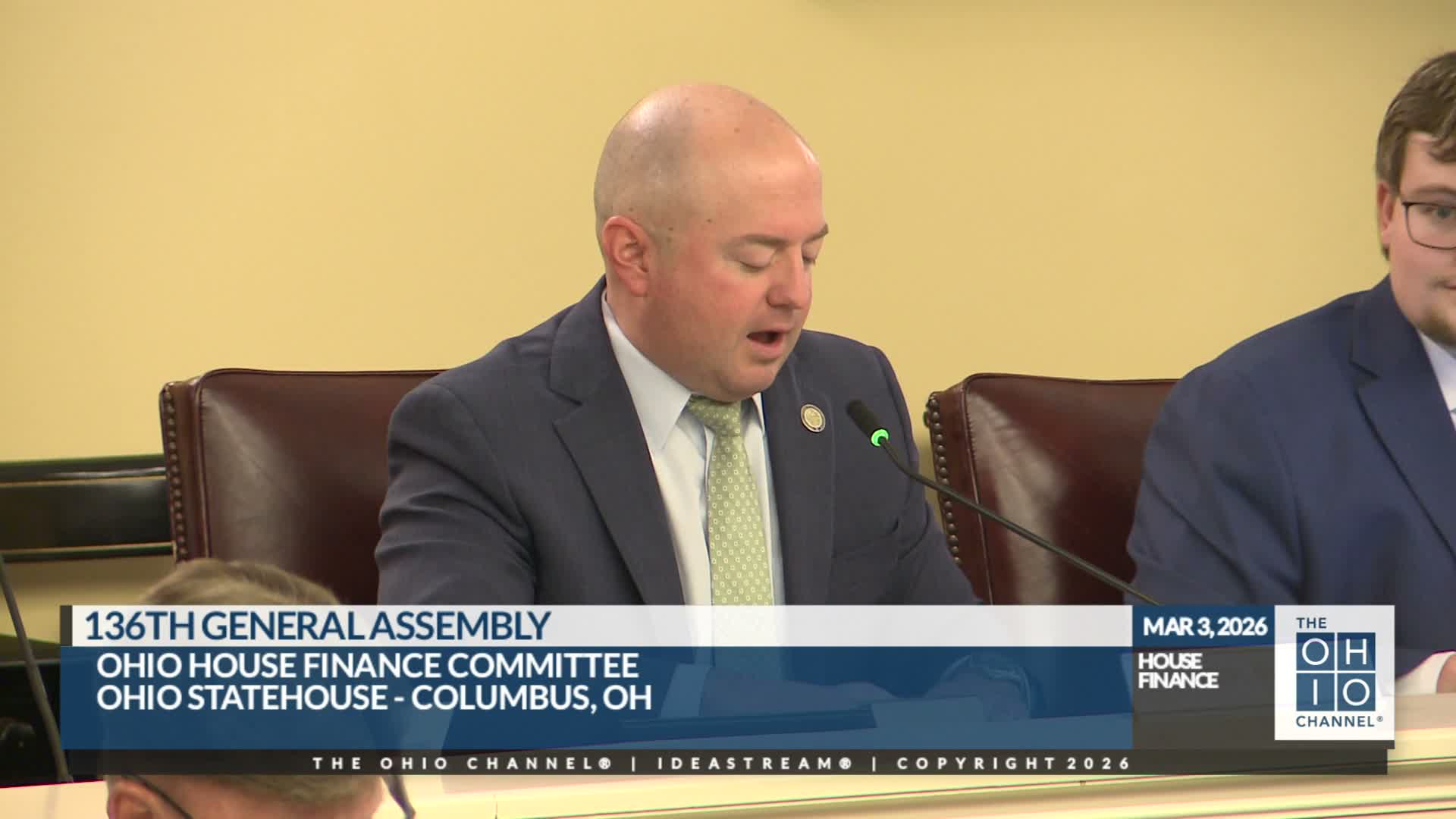
Director Kimberly Murnix of the Ohio Office of Budget and Management told the House Finance Committee on Tuesday that the governor’s capital reappropriation proposal is designed to reauthorize unspent balances from previous capital budgets so ongoing projects can continue without interruption. "Reappropriations reauthorize the unexpended balances for previously approved projects from past capital budgets to ensure that work continues uninterrupted," she said.
Murnix said the measure is not intended to create new capital spending. She explained that state law and constitutional practice limit appropriations to two years, so reappropriation is the routine mechanism that allows multi‑year capital projects to proceed. She also cited Section 509.14 (as referenced in testimony) tying the actual reappropriated amount to each project’s unencumbered balance on June 30, 2026.
The director said OBM included estimates in the bill because the precise unencumbered balances cannot be known until the fiscal year ends. "The dollar amounts listed in the bill are reasonable estimates developed by OBM based on our review of agency plans and expenditures to date," she said, adding that the final amounts are likely to be less.
Murnix told the committee the bill contains an estimated $1.93 billion in capital reappropriations, and that roughly $1.10 billion — about 57% of the estimate — is concentrated in three entities: the Public Works Commission, the Facilities Construction Commission and the Department of Higher Education (including institutions). She cautioned that capital appropriations require a 90‑day delay before taking effect, which is why the bill would need to be enacted by March 31 for funds to be effective by July 1.
Lawmakers questioned the underlying fiscal outlook. Ranking member Rob Sweeney asked what is driving an OBM report that general‑revenue tax receipts are 3.7% above forecast. Murnix said February collections showed sales tax roughly 2.5% above estimate, personal income tax about 4.8% above and the commercial activity tax nearly 10% above estimate. She described OBM’s approach as deliberately conservative and said mid‑year estimate changes are rare absent extraordinary events.
Committee members also asked about the interplay between capital bond financing and the operating budget. Murnix explained that capital projects are financed with bonds for bondable purposes and that the operating budget must carry debt‑service payments; she said Ohio’s projected debt service represents about 2.12% of estimated revenues, well below the 5% constitutional cap. "Ohio’s economy is strong, and our finances are solid and will support the projects in this bill," she said.
Chairman Stewart closed the informal hearing after members reviewed the bill text on committee devices and thanked Murnix for her testimony. The committee plans to keep its regular Finance slot as it considers the reappropriations bill ahead of the 90‑day effective‑date deadline.
Next steps: the committee did not take a formal vote in this hearing; members indicated the reappropriations bill must be enacted promptly to avoid construction delays and that staff will continue to review line‑item estimates.