Get Full Government Meeting Transcripts, Videos, & Alerts Forever!
Get email alerts on the Debt Resolution Regulation topic
No spam. Unsubscribe anytime.
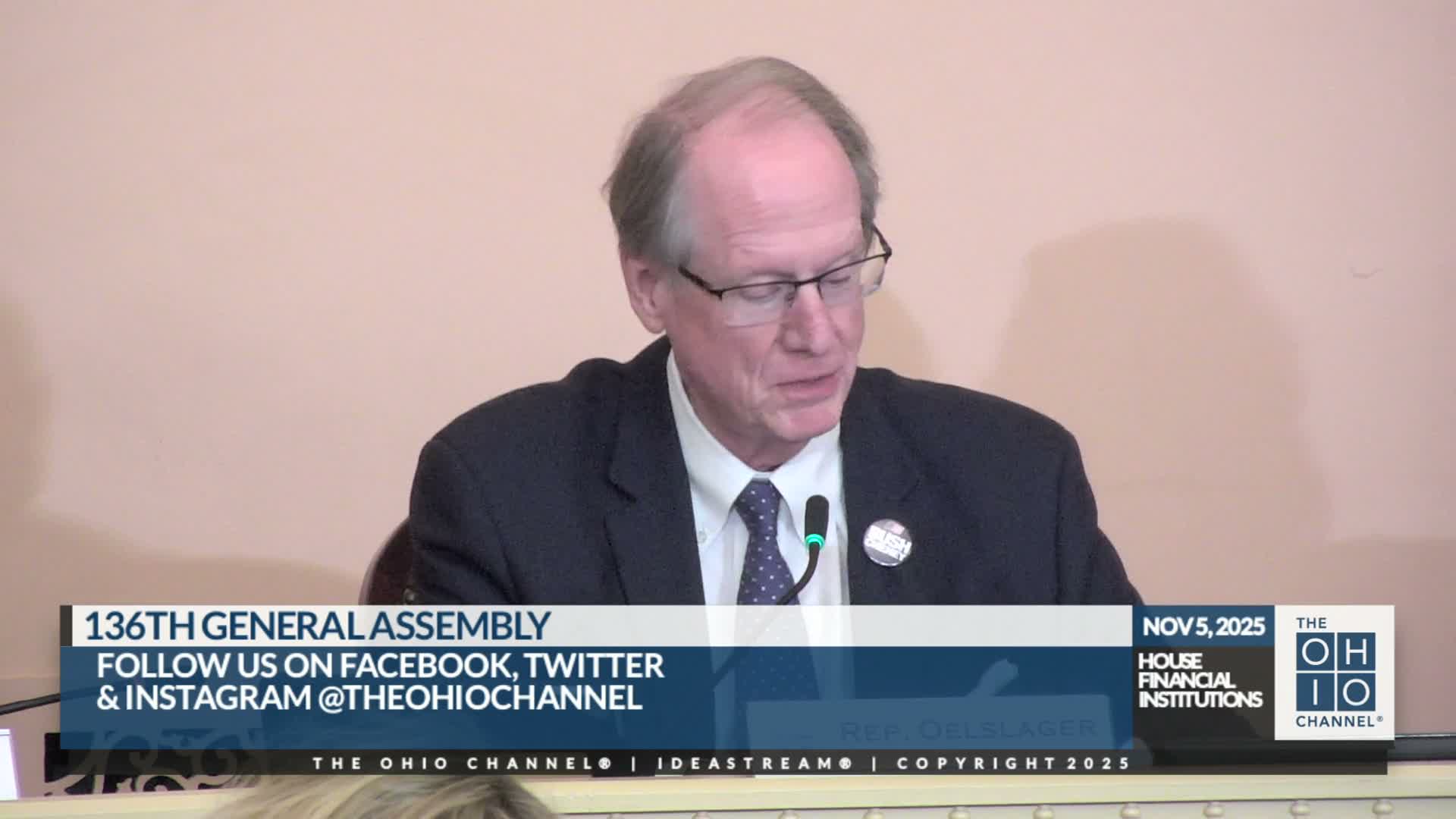
Ohio House panel hears testimony on bill to license debt‑resolution companies
Summary
The House Financial Institutions Committee heard proponent testimony on HB 534, which would license and regulate companies that provide debt‑resolution (debt‑settlement) services in Ohio, require disclosures and bonding, prohibit advance fees and align state rules with federal protections, while lawmakers pressed witnesses on fees, arbitration and credit impacts.
The Ohio House Financial Institutions Committee heard several hours of proponent testimony on House Bill 534, which would create a state licensing framework for companies that help consumers settle unsecured debts.
Supporters at the March hearing told committee members the bill would align Ohio law with the Federal Trade Commission’s telemarketing sales rule (TSR), ban advance fees, require background checks and bonding, keep consumer funds in FDIC‑insured accounts controlled by consumers, and impose detailed disclosures and accounting requirements on providers.
Proponents said the measure would give Ohioans a third, regulated option between credit counseling and bankruptcy. "HB 534 provides a sensible regulated third option, debt resolution, that allows consumers to settle their unsecured debts for less than they owe, avoid bankruptcy, and regain financial stability in a dignified way," said Mike Kamashka, government affairs manager for the Association for Consumer Debt Relief.
The bill’s supporters included industry representatives and business groups. Natalia Brown, chief consumer affairs and (client) relations officer for National Debt Relief, described lengthy enrollment conversations, a contract walk‑through and internal compliance and audits designed to ensure transparency. "We never cold call clients," Brown said, adding that clients usually seek help by searching online, hearing referrals, or responding to advertisements.
Michael Goodman, a partner at the Hudson Cook law firm and a former FTC staff attorney, told the committee the bill builds on the FTC’s TSR and would be relatively straightforward for regulators to implement. Derek Clay, president and CEO of the Columbus Chamber of Commerce, said the measure would help rehabilitate indebted consumers and support local economic stability.
Lawmakers pressed witnesses on several protections and risks. Representative Russo asked whether HB 534 sets an explicit cap on provider fees; witnesses replied that the bill allows fees as a percentage of enrolled debt or of savings and that fees are only charged after a three‑part test is met (a negotiated settlement, consumer acceptance, and at least one payment to the creditor). Kamashka said in practice there is a ‘‘natural sort of boundary’’ on fees and noted that federal rules and some states have rejected explicit caps in favor of market competition and disclosure.
Committee members also raised dispute‑resolution and enforcement concerns. Several legislators asked whether consumers retain a private right of action if arbitration fails; proponents said arbitration is required under the bill’s terms and emphasized licensing and regulator tools to enforce compliance, while some witnesses said they would follow up with more detailed answers on whether other states provide additional private‑action remedies.
On credit reporting, witnesses said FTC guidance requires providers to disclose that debt settlement can negatively affect consumers’ credit because creditors typically require accounts to be delinquent before negotiating. Brown said that once accounts are reported "settled in full," consumers often see faster credit recovery than after bankruptcy, though witnesses declined to quantify average score changes.
Supporters repeatedly distinguished debt settlement from payday lending. "There is no comparison," Kamashka said. "It's not even apples and oranges. It's apples and Jupiter." Critics on the panel raised concerns about targeting of vulnerable people and whether the bill sufficiently prevents harmful practices; supporters said licensing, background checks, bonding and detailed disclosures would curb bad actors.
No formal committee vote was recorded in the hearing transcript. The committee adjourned after the hearing concluded.
Next steps: witnesses agreed to follow up on several technical questions, including whether other states provide a private right of action beyond arbitration and data on bankruptcy rates following failed settlements, and to provide that information to the chair and committee staff.