Get Full Government Meeting Transcripts, Videos, & Alerts Forever!
Get email alerts on the Financial Institutions topic
No spam. Unsubscribe anytime.
House Financial Institutions panel advances Treasury modernization bill; shifts some pension account duties
Summary
At a second hearing, the House Financial Institutions Committee adopted a substitute for House Bill 278 to modernize treasury statutes. The Ohio Treasurer's Office said the changes clarify custody of pension-related accounts, enable contracting flexibility, and add anti-fraud measures; lawmakers asked whether the change will apply to all pension systems.
The House Financial Institutions Committee on a second hearing adopted a substitute version of House Bill 278, the Treasury Modernization Bill, as the working document and heard proponent testimony from the Ohio Treasurer's Office.
By unanimous consent the committee accepted substitute bill 1053-5 as the working document after Vice Chair Pazuli moved to adopt it and the chair seconded. The measure, as presented, updates roughly 40 code sections that the treasurer's office says are out of step with current operations.
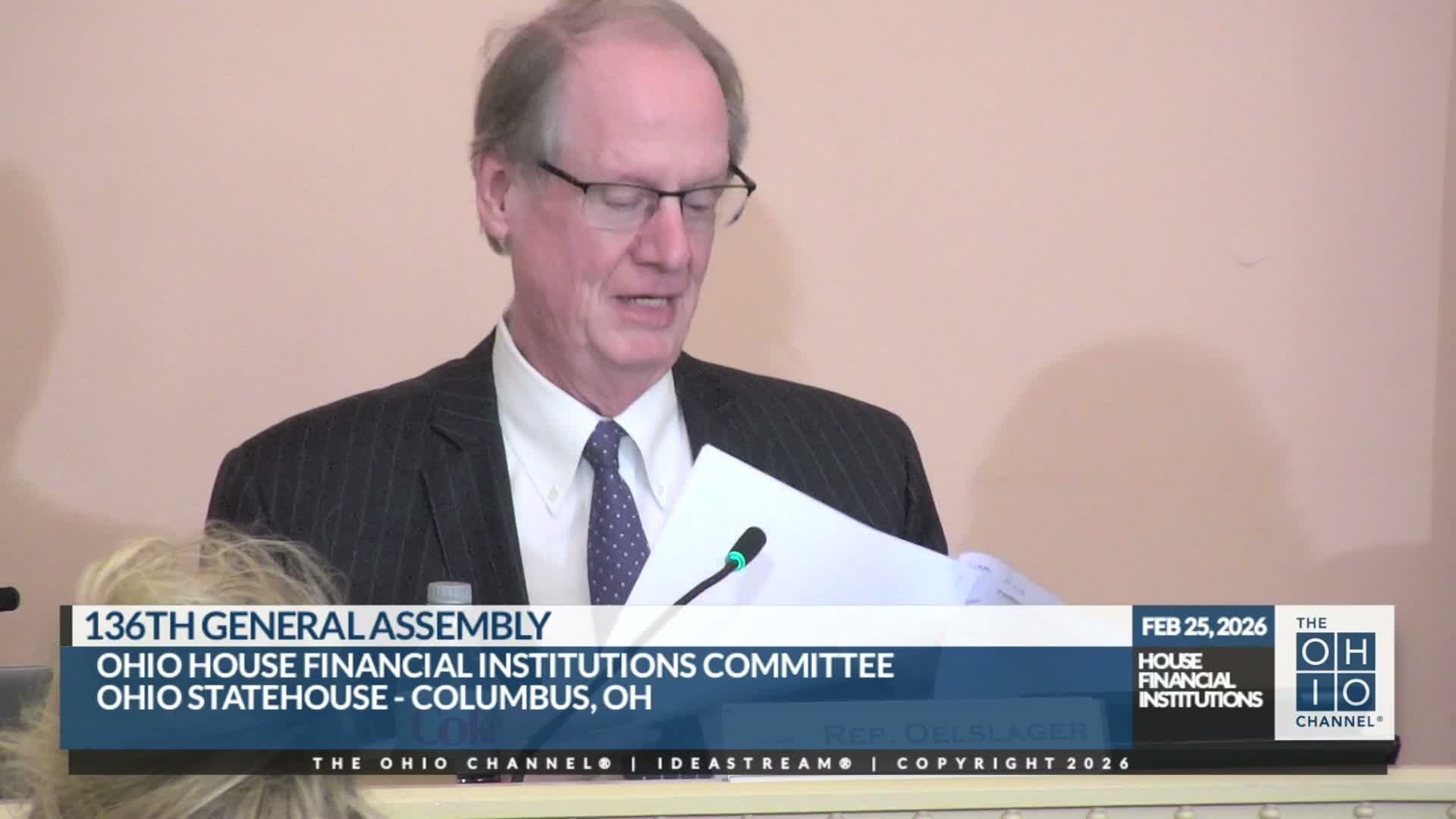
Zach Prouty, deputy chief of staff for the Ohio Treasurer's Office, told the committee the office is the state’s banker and chief investment officer and outlined the agency’s scale and responsibilities. "I'm here today, obviously, to give proponent testimony for House Bill 278, our Treasury Modernization Bill," Prouty said. He said the office handled roughly $95.5 billion in deposits during the most recent fiscal year, manages multiple investment portfolios totaling more than $50 billion, and serves as custodian for several hundred billion dollars in public assets.
Prouty described several specific statutory updates included in the subbill: giving the treasurer greater flexibility to contract with qualified custodial-service providers for complex portfolios; clarifying continuing-education rules for county treasurers; aligning statute with industry-standard "positive pay" procedures at the state depository bank; and adding anti-fraud controls for participant accounts in programs such as Star Ohio. "Positive pay as an aside is a better way to protect the state treasury from potential fraud," he said.
A focal point of the exchange concerned language affecting custodial bank accounts tied to pension-fund real-estate investments. Ranking Member Russo asked about changes in section 3307.12 and how they differ from current practice, particularly for the State Teachers Retirement System. "Can you just explain to me how does that differ from what the current practice is and why this change is... necessary?" Russo asked.
Prouty replied that the bill clarifies the legal distinction between state dollars and custodial dollars (pension and similar funds). "Custodial dollars, pension funds ... are monies that are under the purview of an entity created by the state legislature, but not really state dollars per se," he said, explaining that bank accounts tied to commercial properties owned by STRS are investment-related custodial accounts rather than operational state-deposit accounts. He said that requiring the treasurer to open or manage every property-linked bank account has caused unnecessary delays and that the change would allow pension systems with their own investment staffs to manage those accounts directly. Prouty added the office intends to apply the same phrasing to all five state pension systems to ensure uniformity.
Prouty also said some provisions that had been in the bill as introduced were removed because they were enacted in the budget, and that the treasurer's office and other agencies had worked through additional technical fixes. He noted there will likely be one minor amendment brought at a future hearing to refine some provisions further.
The committee concluded the second hearing on House Bill 278 and adjourned with no further business announced. The bill will proceed with the substitute text as the working document and may return for additional amendment in a subsequent session.