Get Full Government Meeting Transcripts, Videos, & Alerts Forever!
Get email alerts on the Elder Financial Exploitation topic
No spam. Unsubscribe anytime.
Ohio lawmakers hold first hearing on bill that would let banks pause suspected elder‑fraud transfers
Summary
Sponsors of House Bill 560, the "Protect Our Parents Act," told the House Financial Institutions Committee the measure would give banks optional, temporary authority to place transactional holds when they suspect financial exploitation of older or vulnerable adults, require notice to state and county agencies, and provide civil and administrative immunity for good‑faith actions.
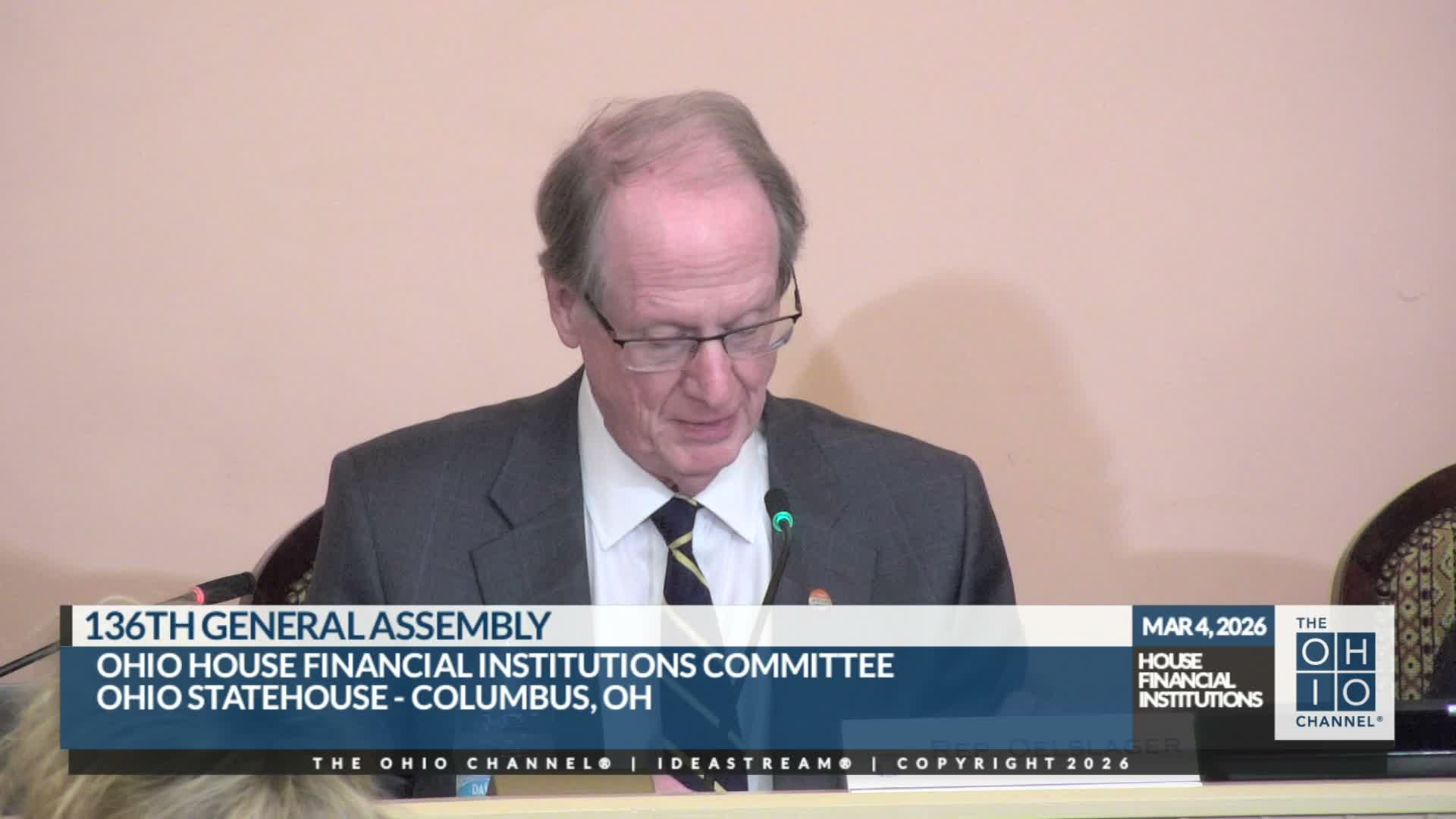
Representatives Charles Swearingen and Representative White told the Ohio House Financial Institutions Committee on the bill’s first hearing that House Bill 560, the "Protect Our Parents Act," would let depository institutions temporarily place a hold on transactions when they have reasonable cause to believe an eligible adult is being financially exploited.
Representative Charles Swearingen, sponsor, said the bill responds to a steady stream of calls from constituents about scams targeting seniors and the growing risk from voice‑mirroring and other AI tools. "With the prevalence of AI, especially with some of the voice AI on the phone that can mirror your friends or family members, this is only gonna become, increasingly more prevalent over the next several years," Swearingen said.
The bill defines an "eligible adult" as a person 60 years of age or older or someone eligible for protective services under Ohio law and defines "financial exploitation" to include wrongful or unauthorized taking, withholding, directing, appropriation or use of an eligible adult’s money, assets or property, including misuse of a power of attorney or guardianship. Under the draft language discussed in committee, when a depository institution has reasonable cause to believe financial exploitation has occurred, it "may place a transactional hold on a disbursement from the account." The hold, as introduced, may remain for up to 15 business days.
Sponsors described operational safeguards and notice requirements. If a hold is placed, the institution must immediately provide written notice to the Division of Financial Institutions and to the county Department of Job and Family Services (JFS) in the eligible adult’s county, including a summary of relevant facts. Within three business days the institution may notify account‑authorized parties and any trusted contact listed by the account holder, except parties believed to be involved in the suspected exploitation. Records relating to transactional holds must be retained for at least five years, sponsors said. The bill would also provide civil and administrative immunity for financial institutions and employees who act in good faith when placing a hold, making a report or declining to act while attempting to comply with the statute.
Representative White, the joint sponsor, said the bill will be amended to broaden eligibility beyond the 60‑and‑older threshold and to give banks flexibility. "This is not a requirement, this is optional," Swearingen added, stressing that institutions could opt in; "banks want to do this, they can, we're giving them that ability." White said sponsors plan to align training requirements with existing federal rules such as the Bank Secrecy Act and other federal guidance where appropriate.
Several committee members pressed sponsors on timing and scope. Ranking member Representative Russo asked why the draft used a 15‑business‑day maximum and what accountability exists to ensure JFS or law enforcement act within that period. Swearingen and White said they were considering changes to allow a reasonable period and to include mechanisms for extension when investigations require more time, including review at the state division level for extensions beyond 60 days.
Representative Young urged a shorter hold and raised whether brokerage and investment accounts are covered; sponsors said the intent is to cover investment accounts as well and that language can be clarified to explicitly include those products. Representative Miller asked about JFS’s role and law enforcement involvement; sponsors replied JFS already handles vulnerable‑adult matters and that banks would contact law enforcement to investigate, subpoena records and, where appropriate, seek court orders to preserve funds longer.
The committee did not vote on the bill. Chair Olsager closed the first hearing and the sponsors said they will work with stakeholders on amendments, including expanding the eligible population, clarifying coverage for investment accounts and refining the language on hold duration and extension procedures.
The committee is expected to take further testimony from financial‑industry proponents and other stakeholders as the sponsors craft the sub bill and amendments.