Lifetime Citizen Portal Access — AI Briefings, Alerts & Unlimited Follows
Representatives Kishman and Miller propose licensing, holds and disclosures for crypto kiosks to protect seniors
Loading...
Summary
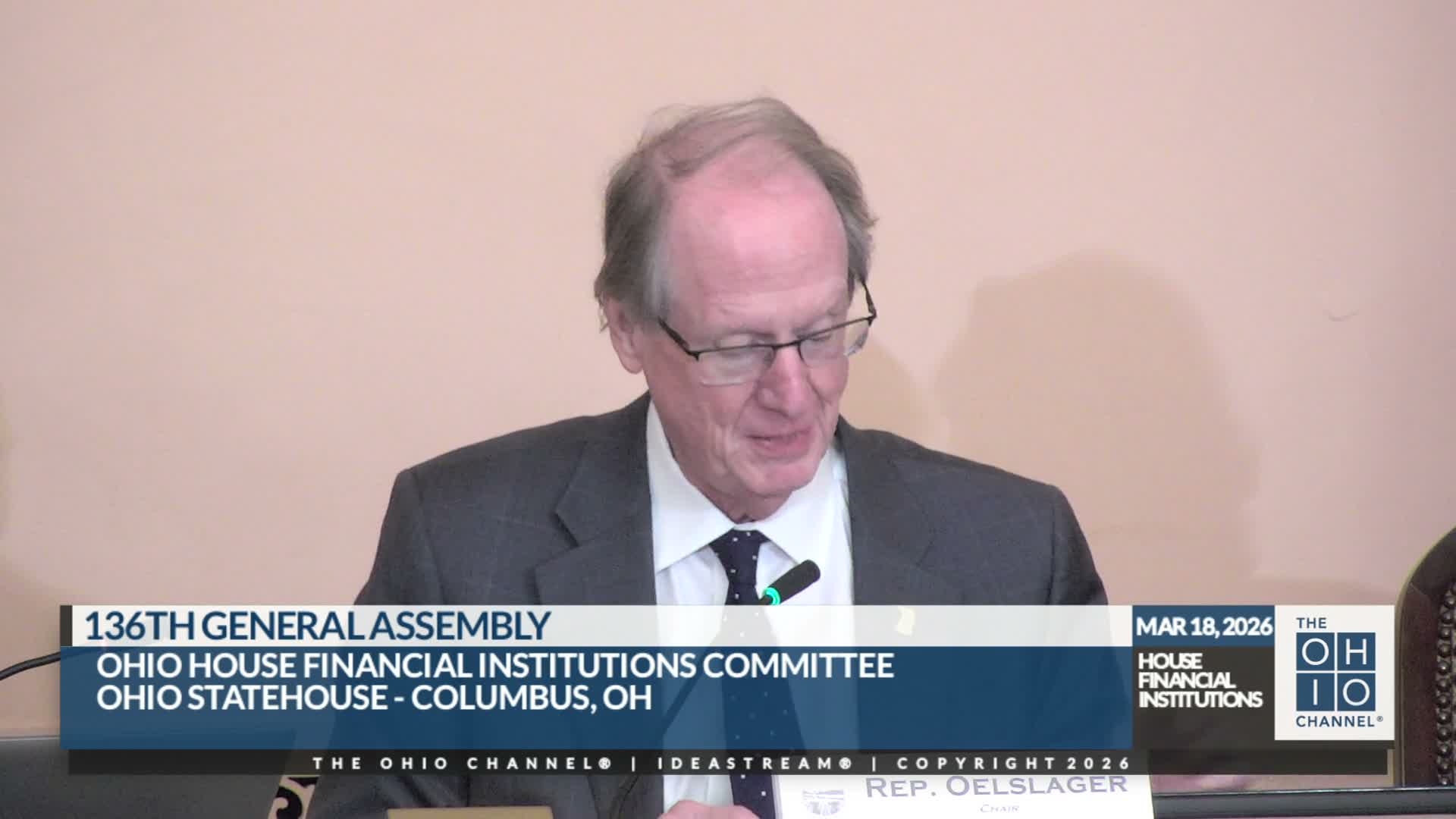
Sponsors of House Bill 648 told the Ohio House Financial Institutions Committee the bill would require operators of digital-asset kiosks to be licensed as money transmitters, impose holds and transaction limits, and mandate clear consumer disclosures aimed at preventing scams that target older Ohioans.
Representatives Kishman and Miller urged the Ohio House Financial Institutions Committee to advance House Bill 648, which they described as a consumer protection measure for people who use digital-asset kiosks commonly found in retail locations.
Representative Kishman said the bill would require anyone who owns, operates or facilitates a digital-asset kiosk in Ohio to be licensed as a money transmitter under Ohio Revised Code chapter 1315 and to provide plain-English disclosures before transactions take place. “Ohioans deserve to know that businesses handling their money are legitimate and properly regulated,” Kishman said.
Representative Miller, the joint sponsor, outlined the bill’s substantive safeguards: a 72-hour hold for new customers, daily transaction limits ($2,500 for new customers and $10,500 for existing customers), identity verification for transactions of $1,000 or more, and an additional phone-contact requirement for new customers age 60 or older that requires staff to discuss the purpose of the transaction and review common scam tactics. “These are the exact lies that fraudsters tell our neighbors and grandparents every day,” Miller said.
The sponsors described a restitution pathway for victims who report fraud to law enforcement within 30 days: kiosk operators would be required to refund transaction fees and commissions within 10 business days, and operators would be required to maintain compliance staff, including a chief compliance officer.
Ranking Member Russo said he supports the bill’s intent but asked why the committee is taking a regulatory approach rather than banning kiosks outright, noting that other states have moved toward bans. “Based on both the number of transactions that we’re talking about… it appears this is such a minuscule part of cryptocurrency transactions,” Russo said, adding that his concern is the high proportion of kiosk-related fraud reported by the attorney general.
Sponsors replied they had considered bans, that some states have taken different approaches, and that the introduced bill is intended as a starting point that can be modified after stakeholder discussions.
Representative Zulli moved amendment 18-73 to name the measure the Ending Losses and Deception in Electronic Resources for Elders Act (Elder Act); the amendment was seconded and, with no objections, was adopted and made part of the bill. The committee concluded the bill’s first hearing without taking a vote.
The committee is expected to continue deliberations on the bill and potential modifications as stakeholders — including advocacy groups and kiosk operators — provide input.