Get Full Government Meeting Transcripts, Videos, & Alerts Forever!
Get email alerts on the Charitable Raffles topic
No spam. Unsubscribe anytime.
Ohio House Finance Committee Hears Testimony on Allowing Online Charitable Raffles
Summary
At a second hearing on House Bill 476, witnesses and lawmakers debated whether online raffles should be allowed under Ohio charitable-gaming law and how to protect consumers through licensing, geolocation and age verification; the Attorney General's office urged statutory changes to bring online raffles under existing regulatory structures.
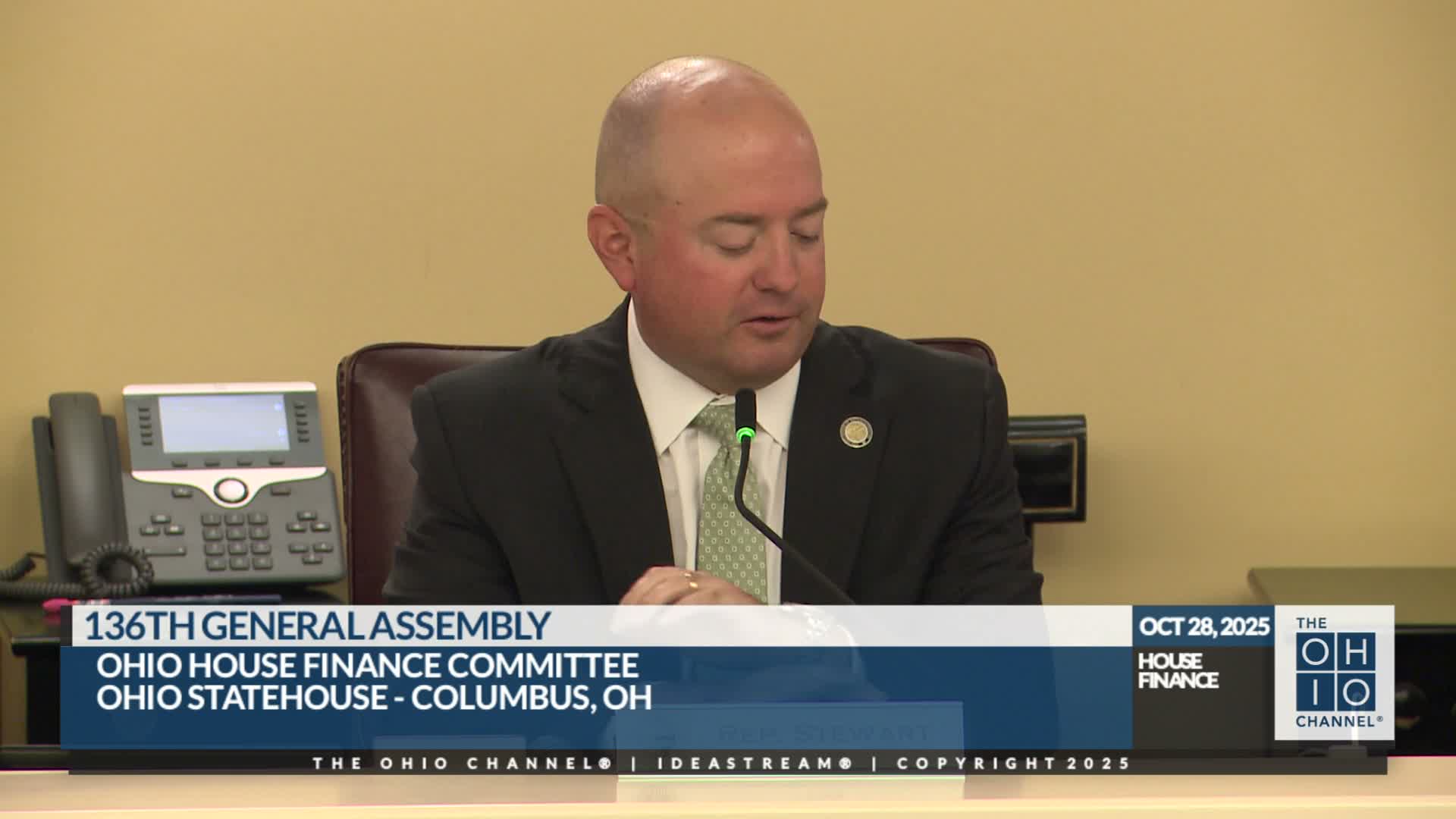
The Ohio House Finance Committee held a second hearing on House Bill 476, which would authorize online raffles under Ohio's charitable gaming laws, and heard competing views about consumer protections, constitutional limits and oversight.
Ryan Foles of the Center for Christian Virtue told the committee he was "in strong opposition to House Bill 476," arguing online raffles "open a significant new frontier for gambling" and would "bring Internet gambling into Ohio homes and communities disguised under the banner of charity." Foles said the bill, as written, lacks geo‑tracking, age verification and financial‑reporting requirements that would prevent fraud, addiction and abuse.
The hearing included multiple exchanges between witnesses and committee members that focused on the scale of potential harms and practical safeguards. Representative Ritter asked whether online raffles could be a "gateway" to broader gambling problems; Foles replied that while not the only factor, online access increases risk because raffles remain a game of chance.
Derek Longmire, executive director of the Problem Gambling Network of Ohio, described his organization as neutral on legalized gambling but urged the committee to require robust consumer protections if online raffles proceed. "Raffles, like any form of gambling, carry potential risks for harm, fraud, and abuse," Longmire said, and he recommended Know Your Customer verification, licensing of both charities and platforms through the Attorney General's charitable‑law office, and prominent links to the Ohio Problem Gambling Helpline and resources.
Longmire also pointed to a recent embezzlement case in which an individual allegedly diverted roughly $32,000 in online raffle proceeds, saying the example underscores the need for oversight and verification.
David Corey of the Bowling Centers Association of Ohio said his group is "not against" the bill and urged the General Assembly to pursue a comprehensive gaming policy so brick‑and‑mortar businesses can remain competitive. Corey suggested any online‑raffle policy be considered in the context of broader gaming expansion.
Corey Jordan, director of policy and legislation at the Ohio Attorney General's Office, provided legal and regulatory context. Jordan said Ohio's constitution (Article 15, Section 6) lists the types of gaming the General Assembly may authorize and that raffles have historically been treated as a form of bingo under statute. He told the committee that the AGO has sent cease‑and‑desist letters to three volunteer organizations conducting online raffles and recommended that online raffles be added explicitly to Ohio Revised Code 29.15.08 and treated within the existing charitable‑gaming licensing framework.
Jordan recommended several specific safeguards for any online‑raffle authorization: requiring online platforms and charities to be licensed by the Attorney General's charitable‑law office, implementing geolocation rules to avoid interstate gambling, requiring age verification, establishing a high fundraising threshold to avoid burdening small community raffles, subjecting platforms to independent testing of random number generators and aligning fees with existing bingo licensure. He said these measures would address constitutional and federal constraints and reduce opportunities for money laundering or embezzlement.
Committee members pressed witnesses on practicalities. Several representatives noted the trust‑based nature of small in‑person raffles at festivals and firehouses and asked whether simple safeguards (paired cash handlers, thresholds for licensing) could balance community fundraisers with protections against large‑scale abuses. Members also queried the accuracy of a cited "3,000 calls" figure to the problem‑gambling helpline; witnesses offered to verify call‑type breakdowns for the record.
No formal vote was taken. Chair Stewart closed the hearing, noted additional written testimony had been provided to members, and adjourned the committee. The bill will return for further consideration and possible amendment at later committee meetings.