Get Full Government Meeting Transcripts, Videos, & Alerts Forever!
Get email alerts on the Public Comment Rights topic
No spam. Unsubscribe anytime.
Committee hears testimony on bill to restore uniform public-comment rights at local meetings
Summary
Proponents told the House General Government Committee that House Bill 609 would require reasonable public-comment opportunities before local governments vote; witnesses cited cases where comment was suspended and urged the state to set consistent rules while allowing reasonable time, place and manner limits.
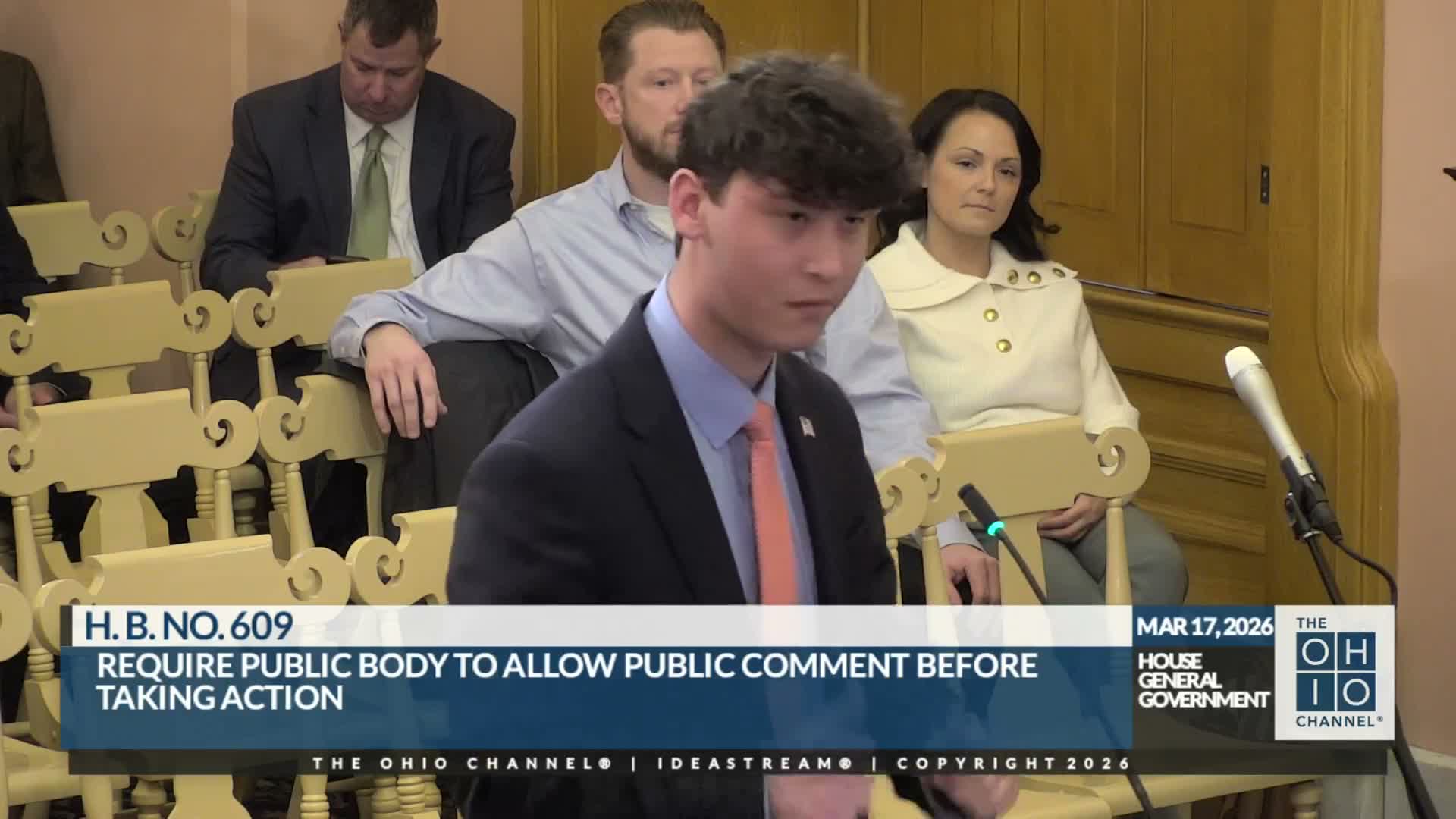
Representative Benjamin McEwen and local officials told the House General Government Committee that House Bill 609 would create a statewide floor for public comment at local government meetings and restore opportunities that some communities have removed.
"House Bill 609 creates uniformity in our state that affirms all Ohioans will have the right to participate in local government through the power of their speech," Benjamin McEwen said in proponent testimony, describing his decision to run for local school board after Lakota Local Schools suspended public comment for more than two years.
The bill, proponents said, would require public bodies to provide a reasonable opportunity for comment before votes while permitting officials to enforce time, place and manner rules. McEwen told the committee that his district suspended public comment amid internal discord, and that restoring comment is a matter of transparency and accountability.
Corey Wasmus, a township trustee, described a local meeting where a podium and sign-up sheet were removed and residents improvised a sign-in. "I urge you to consider this House Bill 609," Wasmus said, arguing that consistent rules matter for residents trying to be heard in rapid-growth communities.
Witnesses and written testimony presented examples they said show the problem is not isolated: Americans for Prosperity’s Hannah Kubitz told lawmakers that some Ohio localities have imposed strict restrictions or eliminated public comment and that the Sixth Circuit has recently struck down similar limits as inconsistent with the First Amendment. Kubitz said the bill is designed to preserve officials’ ability to manage meetings while ensuring people can speak before final action.
Committee members asked proponents about scope and implementation. One lawmaker noted the tension between local control and state-set standards, asking when the legislature should step in if local rules appear to limit public participation. Proponents said the bill aims to set a baseline across municipalities, school districts and townships while leaving room for reasonable procedural rules.
The committee took testimony from multiple local officials and nonprofit advocates and did not take final action on HB 609 at the hearing. The chair closed the second hearing and adjourned the committee at the scheduled time.