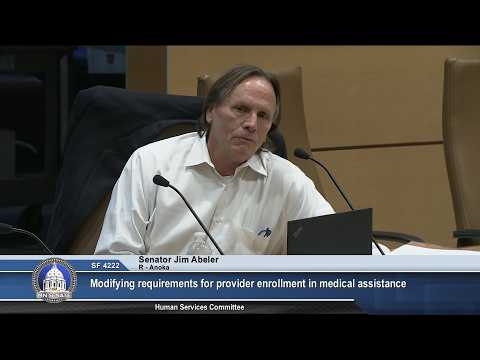
Senate panel advances integrity vehicle to finance after lengthy debate over payment withholds, timelines and due process

Minnesota Senate Committee on Human Services · March 27, 2026

Get AI-powered insights, summaries, and transcripts

Sign Up Free
AI-Generated Content: All content on this page was generated by AI to highlight key points from the meeting. For complete details and context, we recommend watching the full video. so we can fix them.

Summary

After extended debate, the Senate Human Services Committee sent an integrity vehicle (SF 4222) to the Finance Committee without recommendation. Members discussed defining temporary payment withholds, a proposed 60‑day standard (extendable to 180 days via in‑camera review), and tensions between provider due process and agency investigative confidentiality.

The Minnesota Senate Human Services Committee opened markup on Senate File 4222 as a vehicle for a package of program‑integrity reforms and debated several contested proposals before voting to send the bill to the Finance Committee without recommendation.

Senator Abler, who led floor discussion of the integrity package, said the vehicle is intended to collate policy language from a range of stakeholders and committees into a single place for further negotiation. "We want this to be the start of a collaborative…on program integrity conversations between our two committees," he said.

Matthew Bergeron, counsel for residential providers, described a recurring problem: payment withholds imposed by the Department of Human Services on providers as a response to credible allegations of fraud have gone undefined in duration and sometimes lasted months or years. "I've had clients…11 months later they got a letter saying, 'we've completed our investigation. You're okay.' That agency was long gone," Bergeron said, urging a structured timeline and outside review so temporary suspensions do not permanently close provider operations.

Bergeron outlined a compromise the committee discussed: an initial 60‑day period for a temporary payment withhold that could be extended up to two times—capping at 180 days—by an administrative law judge conducting an in‑camera review (submitted under seal) to balance confidentiality of possible criminal investigations with a provider’s need for an independent check.

DHS staff and other senators raised capacity and confidentiality concerns. A DHS representative warned the department lacks staff and system capacity to absorb additional reporting and review responsibilities without additional resources; members debated whether to fund ongoing administration tasks in the budget process. The committee acknowledged both the agency’s resource limits and providers’ arguments that indefinite withholds can destroy small programs.

Senator Rasmussen moved to remove Article 1 of the bill (which includes some new definitions and program‑integrity language); the roll‑call motion failed. Committee members later adopted a set of standalone amendments (A12, A13, A17 among others) and agreed on instructions for Senate counsel to engross new standalone language into the bill consistent with drafting practice.

Ultimately the committee agreed to refer SF 4222, as amended, to the Finance Committee without recommendation to give sponsors, agencies and stakeholders more time to reconcile drafting, fiscal and operational issues before the bill proceeds further.

Committee leaders said they expect continued negotiation and drafting between now and floor action, and they instructed counsel to place adopted standalone sections into the engrossment copy for the Finance Committee to consider.