
Senate committee amends human services omnibus, keeps continuity‑of‑care protections for people with disabilities
Get AI-powered insights, summaries, and transcripts
Sign Up Free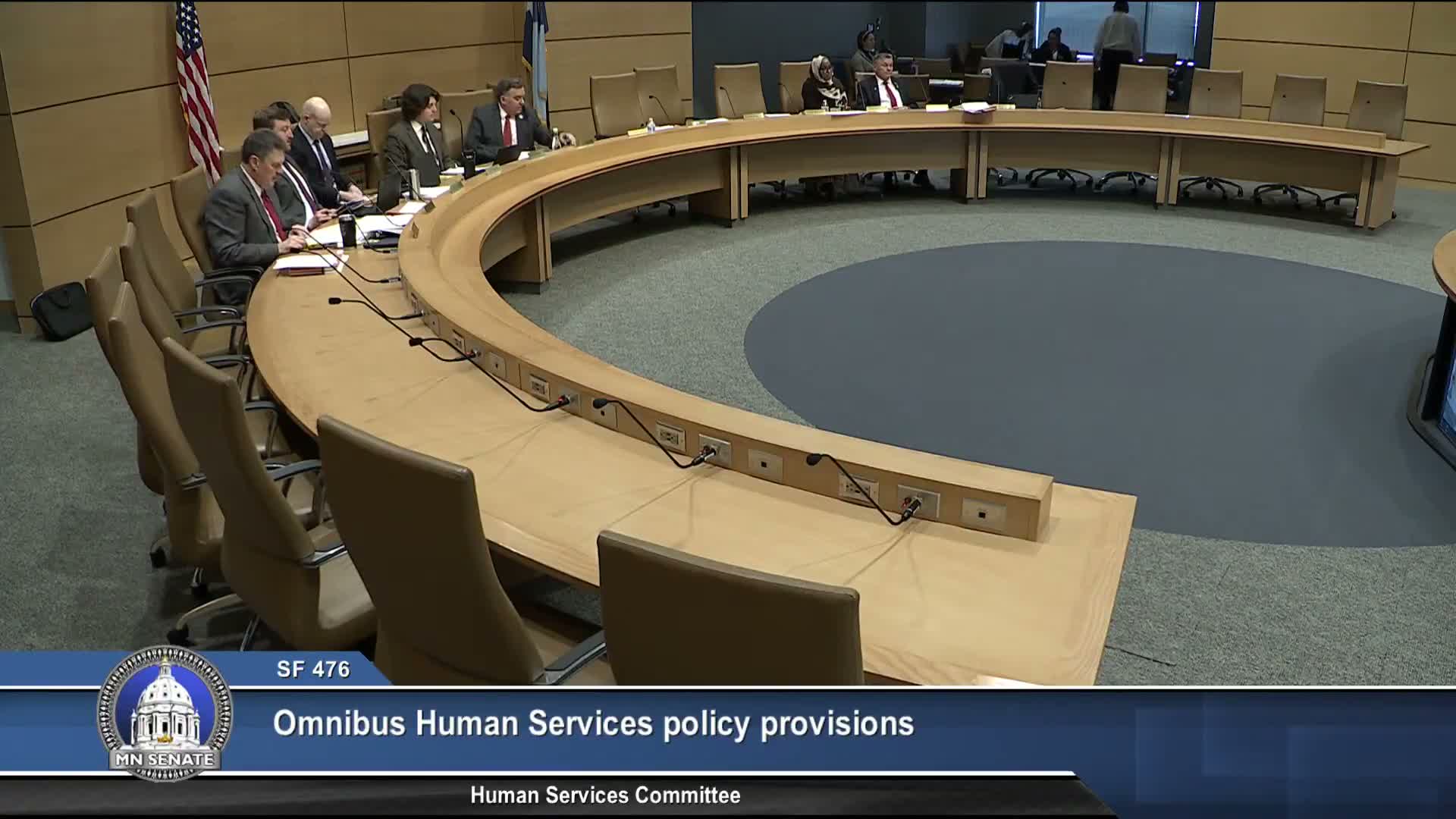
Summary
The Senate Human Services Committee advanced the human services omnibus (SF 476) after testimony from disability advocates, providers and practitioners; members adopted several amendments retaining a DHS continuity‑of‑care team and prohibiting payment withholds until protections are in place, while removing a number of provisions flagged as fiscal items.
Chair Hoffman convened the Minnesota Senate Human Services Committee and opened markup of the human services omnibus, Senate File 476, saying the committee would take numerous member amendments and hear public testimony.
Matthew Bergeron, a healthcare and government‑relations attorney at Larkin Hoffman representing the Residential Providers Association of Minnesota, told the committee the bill contains provisions affecting congregate care and small assisted‑living settings that need to be scalable. “There are a number of pieces in the bill regarding new regulations for assisted living facilities,” Bergeron said, and he urged the committee to preserve language that gives flexibility for small five‑bed settings to relocate when needed.
Dr. Eric Larson, chair of the Autism Treatment Association of Minnesota, supported fraud‑prevention measures but warned that some proposed requirements could harm access to services. “We fear that this financial requirement will very likely lead to some small nonprofit providers being forced to sell out to large for‑profit and equity‑based companies,” Dr. Larson said, urging exceptions, smaller compliance amounts and a two‑year delay for surety‑bond rules.
Sumuka Cherkanambi of the Minnesota Council on Disability, who testified both as a policy consultant and as a person who relies on waiver services, urged retention of Article 1 continuity‑of‑care protections. Cherkanambi praised language establishing a DHS continuity‑of‑care team, timely notifications to impacted individuals and a prohibition on payment withholds until continuity protections are in place, calling those measures “a meaningful step toward person‑centered fraud prevention.”
The committee also addressed a package of technical and fiscal‑related amendments. Nonpartisan counsel Liam Monahan walked members through A23, described as technical revisions and recodification instructions reflecting agency drafting requests (including changing ‘‘Designee’’ to ‘‘Delegate’’ in one provision and inserting the word ‘‘medical’’ in several emergency‑response references to avoid ambiguity).
Members voted to adopt a sequence of amendments. The committee approved A22, which strips provisions flagged by agencies as having fiscal costs (removing portions of bills related to home‑and‑community‑based services billing limits and congregate‑care requirements), and adopted A18 and other technical fixes. Senator Abler’s A5—adjusting the discharge‑summary timeline from five calendar days to five business days and clarifying a five‑day exclusion for withdrawal‑management authorizations—was supported by practitioners and DHS technical assistance and was added to the markup.
Throughout the session members emphasized that several provisions flagged as fiscal items would be evaluated again in a finance bill or on the floor. Chair Hoffman and senators said the committee intends to keep working on the omnibus language and fold the negotiated changes into the budget process where appropriate.
The committee recessed to prepare for the next item; SF 476 remained amended and in progress, with members signaling continued collaboration between Senate sponsors, agency staff and stakeholder groups before final floor action.