
Committee reviews occupational-licensing boards: securities, historical boilers, home inspectors and construction trades testify
Get AI-powered insights, summaries, and transcripts
Sign Up Free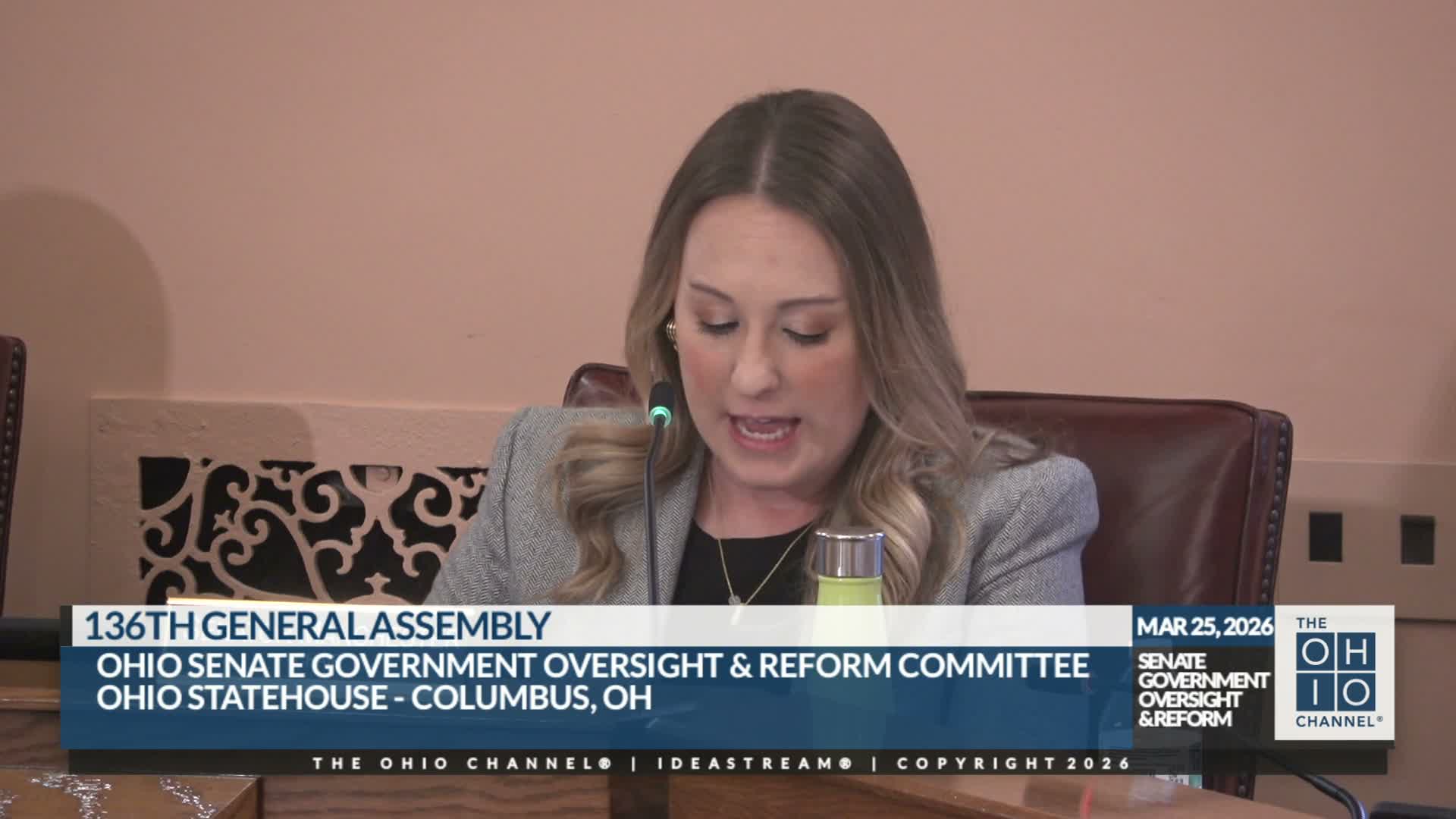
Summary
During the third hearing on House Bill 59, officials from the Ohio Department of Commerce and several licensing boards described the scope of licensure, enforcement activity, fees and reciprocity arrangements; commissioners defended licensure as a public-safety measure while answering questions about reciprocity and complaint volumes.
The Government Oversight and Reform Committee held the third hearing on House Bill 59, an occupational-licensing review, and heard presentations from the Ohio Department of Commerce and several licensing boards. Andrea Seidt, Ohio Securities Commissioner, described the Division of Securities' licensing categories, enforcement work and a proposed reciprocity rule, saying the division "oversees the activities of more than 267,000 financial professionals and firms" and asking the committee to support continued occupational licensure under the division.
Seidt told the committee the division licenses broker-dealer firms, salespersons, investment-adviser firms and representatives, state retirement investment officers and funding portal operators; she said the division proposed extending reciprocity from two to five years (pending JCAR) to facilitate licensure mobility while retaining authority to discipline licensees. On enforcement, she said the division assisted criminal prosecutions of 20 individuals and reported 5 convictions and more than $3.5 million in restitution, and that a newly created investor recovery fund has awarded more than $2 million in restitution to victims.
Aaron Johnson described the Historical Boilers Licensing Board, clarifying that the board regulates operators of historical, riveted boilers typically used on steam locomotives and tractors and licensed for hobby or demonstration purposes. He recounted the board's origin in response to a 2002 Medina County fair accident that caused five fatalities and described operator requirements: training, an exam, and 100 hours of operating experience, plus a $50 lifetime license.
Ed Woodruff, attorney with the Division of Real Estate and Professional Licensing, presented the Home Inspector Board's qualifications and requirements, including an application, proof of competency, a criminal-history check and passing the National Home Inspector Exam. Woodruff said the initial licensing fee is $250, licenses renew every three years, and the division collects an estimated $100,000 annually; he said complaint volume in the past one to two years is "well under 100." Vice Chair Brenner asked whether licensed home inspectors might gain authority to perform building inspections if they received additional credentialing; Woodruff said discussions have occurred but no formal change had reached his office.
Michael Basden described the Construction Industry Licensing Board's role licensing specialty commercial contractors across trades and laid out entry requirements, continuing-education rules, liability-insurance minimums, and fee schedules (application $25, annual renewal $60, three-year option $180). He also listed reciprocity agreements with multiple states. Each presenter defended licensure as a public-safety measure and offered to answer committee questions; no committee votes or formal actions were recorded at the hearing.