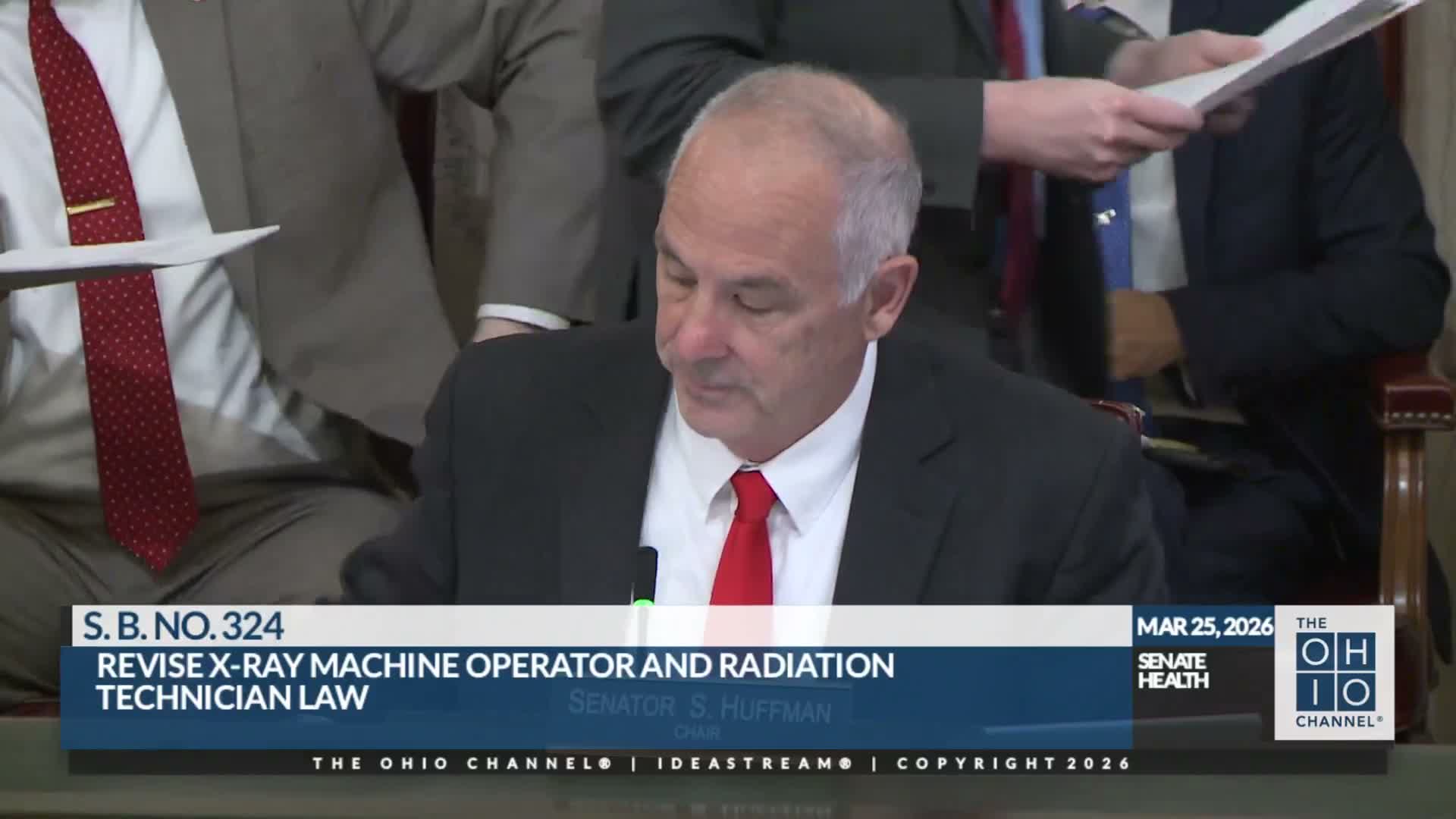
Radiologic technologists tell committee SB 324 would lower imaging standards in urgent care
Loading...
Summary
Lisonbee Stokes of the Ohio Society of Radiologic Technologists testified that Senate Bill 324 would allow individuals with limited GXMO training to perform diagnostic imaging in urgent care settings, reduce necessary supervision and increase patient safety risks including improper dose management.
Lisonbee Stokes, junior chair of the Ohio Society of Radiologic Technologists Board of Directors, told the Senate Health Committee that Senate Bill 324 would lower education and supervision standards for imaging in ways that endanger patients.
"Radiographic imaging is simply not just pressing a button," Stokes said, arguing that imaging requires knowledge of radiation physics, anatomy, radiation protection and real‑time image evaluation developed through more than 2,000 combined didactic and clinical hours for registered radiologic technologists.
Stokes said the bill would expand use of general x‑ray machine operators (GXMOs) in urgent care settings—environments that involve a wide range of patients, pediatric and geriatric populations, and acute injuries—where GXMO training (often 16 to 60 didactic hours and limited clinical experience) is not sufficient. Testimony warned that modern digital imaging can mask technique errors and lead to "dose creep" where excessive radiation is delivered despite seemingly acceptable images.
A specific concern raised in testimony was a provision cited as Section 4773.06(c), which Stokes said could create a loophole allowing GXMO practitioners who are also nurse practitioners to operate without required supervision. She also objected to authorizing supervision by nurse practitioners and physician assistants who, while clinically trained, generally do not receive formal education in radiographic positioning, dose optimization, or image analysis.
Stokes recommended aligning GXMO education with American Registry of Radiologic Technologists (ARRT) limited x‑ray machine operator standards, ensuring structured real‑patient competency requirements, and preserving Ohio Department of Health oversight for accreditation and a state examination.
The committee asked clarifying questions about supervision categories (direct, general, personal) and whether physicians supervising GXMO procedures should receive radiation training. Testimony emphasized that direct oversight and real‑time image evaluation are important patient‑safety safeguards.