Get Full Government Meeting Transcripts, Videos, & Alerts Forever!
Get email alerts on the Scope Of Practice topic
No spam. Unsubscribe anytime.
Ophthalmologists and physicians tell Senate Health Committee substitute SB 36 risks patient safety and lacks oversight
Summary
Representatives of the Ohio Ophthalmological Society and Ohio State Medical Association told the Senate Health Committee that substitute Senate Bill 36’s short procedural training and placement of surgical certification with the vision professions board raise patient‑safety and oversight concerns.
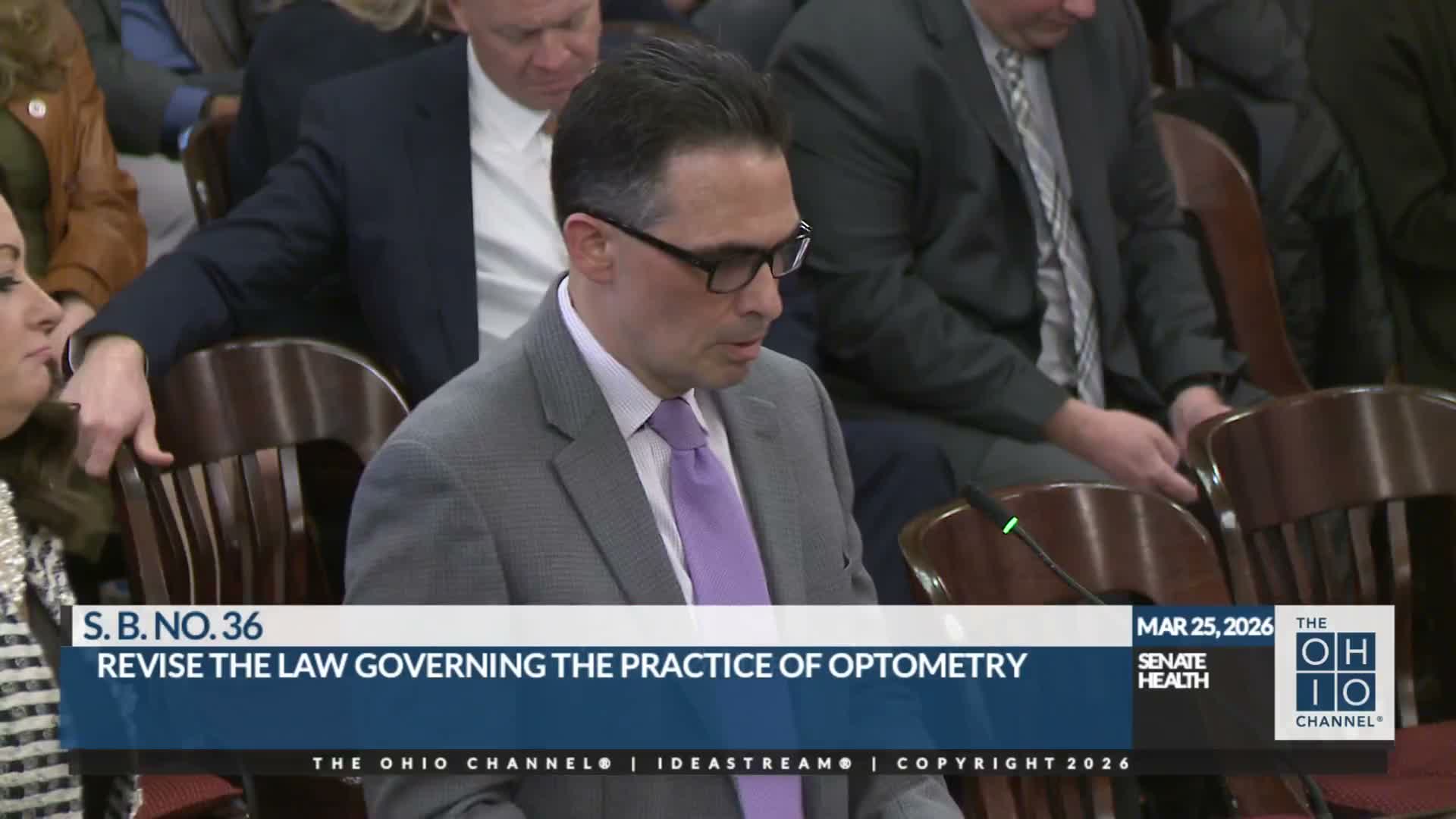
Todd Baker, representing the Ohio Ophthalmological Society, and Monica Hickel, representing the Ohio State Medical Association, told the Senate Health Committee they oppose substitute Senate Bill 36 because it would let optometrists gain authority to perform certain procedures without the depth of medical and residency training physicians receive.
"Surgical competence is not achieved through limited exposure to a procedure 3, 4, or even 5 times," Baker said, adding that competence is developed through "4 years of medical school, followed by 4 years of intense ophthalmology residency training." He and Hickel said the subbill’s proposed short course (described in testimony as roughly a one‑page, three‑day outline) cannot replicate that experience.
Baker and Hickel also challenged the bill’s regulatory design, saying the proposal places surgical certification with the vision professions board, which "lacks medical doctor representation" and excludes oversight by the state medical board. Baker said that raises "significant concerns about establishing and maintaining appropriate medical surgical standards." They cited recent experiences in other states as cautionary examples where expanded scope led to serious patient harm.
Committee members asked how the bill would treat practitioners trained in other states and whether an alternative pathway exists for optometrists who seek surgical training. Baker said the bill, as written, gives the vision professions board the authority to determine whether an individual meets the criteria and that an alternative pathway could exist, but reiterated concerns about the adequacy of short courses for surgical decision making and management.
Proponents’ stated goals of improving access to care were acknowledged by the witnesses, who said access issues exist; but they argued lower procedural and oversight standards are not the solution. "We do not believe this bill is needed," Baker said, adding that collaborative approaches that strengthen access while preserving surgical standards deserve further work.
The committee closed the sixth hearing on substitute Senate Bill 36 with no immediate vote.