
Committee adopts amendment to House Bill 20; supporters say change protects first responders without curbing filming
Get AI-powered insights, summaries, and transcripts
Sign Up Free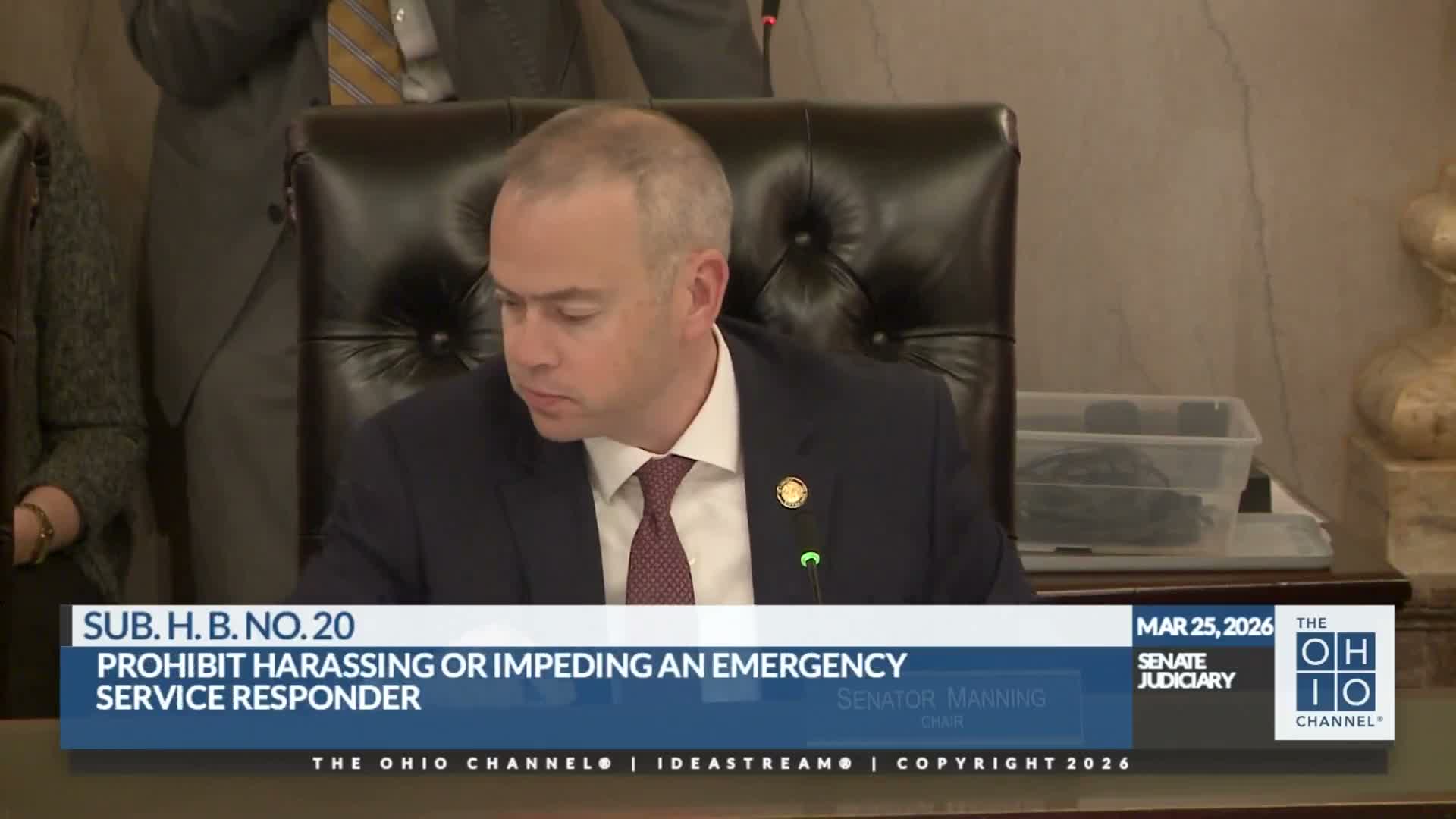
Summary
The Senate Judiciary Committee adopted an amendment to House Bill 20 creating a new obstruction offense for knowingly approaching or remaining within 15 feet of an emergency responder after a warning if the person interferes or threatens the responder; proponent witnesses from the Ohio Fire Chiefs Association and Fraternal Order of Police urged the change as a public‑safety tool and said the bill does not ban filming.
The Senate Judiciary Committee adopted amendment 1896‑1 to House Bill 20 during a hearing that also featured proponent testimony from fire chiefs and police advocates.
Vice Chair Reynolds moved the amendment, which ‘‘creates a new circumstance for obstruction if an individual, after being warned, approaches or remains within 15 feet of an emergency service responder and either interferes with or threatens the responder,’’ and the amendment was adopted "without objection," the chair announced.
Joseph Kitchen, president of the Ohio Fire Chiefs Association and fire chief of the Bath Township Fire Department, described HB 20 as designed to keep emergency scenes controlled so responders can focus on life‑saving tasks. "House Bill 20 is about ensuring that first responders can do their job without interference when seconds matter most," Kitchen said, and he emphasized the bill targets "knowing and intentional interference while still respecting the public's right to observe." He urged the committee's support.
Mike Lyman, director of government affairs for the Fraternal Order of Police of Ohio, said HB 20 raises obstruction penalties and is intended to deter aggressive behavior toward responders. "House Bill 20 increases penalty for obstructing official business ... If the victim of the offense is an emergency service responder engaged in lawful duties and the responder issued a warning ..." Lyman said, adding the bill "does not stop anyone from filming the officers" but would address those who shove a camera into an officer's face or deliberately impede performance.
Ranking member Hicks Hudson asked whether enhanced penalties for a specific responder category could create confusion in charging; Lyman responded that charging would depend on circumstances. The committee recorded the amendment's adoption and the hearing as the second hearing on HB 20; no further amendments or final disposition were recorded at this session.
Next steps include circulation of written proponent testimony noted in the record and potential subsequent hearings.