Sponsors outline "Andy's Law" to toughen penalties, tighten prison contraband controls after correction officer's death
Loading...
Summary
Sponsors of House Bill 338, "Andy's Law," told the Senate Judiciary Committee the bill strengthens penalties for killings and assaults of correctional staff, tightens contraband detection and visitation screening, and removes some tablet‑based communication tools in high‑security prisons; sponsors framed the measure as a response to the Christmas 2024 death of correction officer Andrew Lansing.
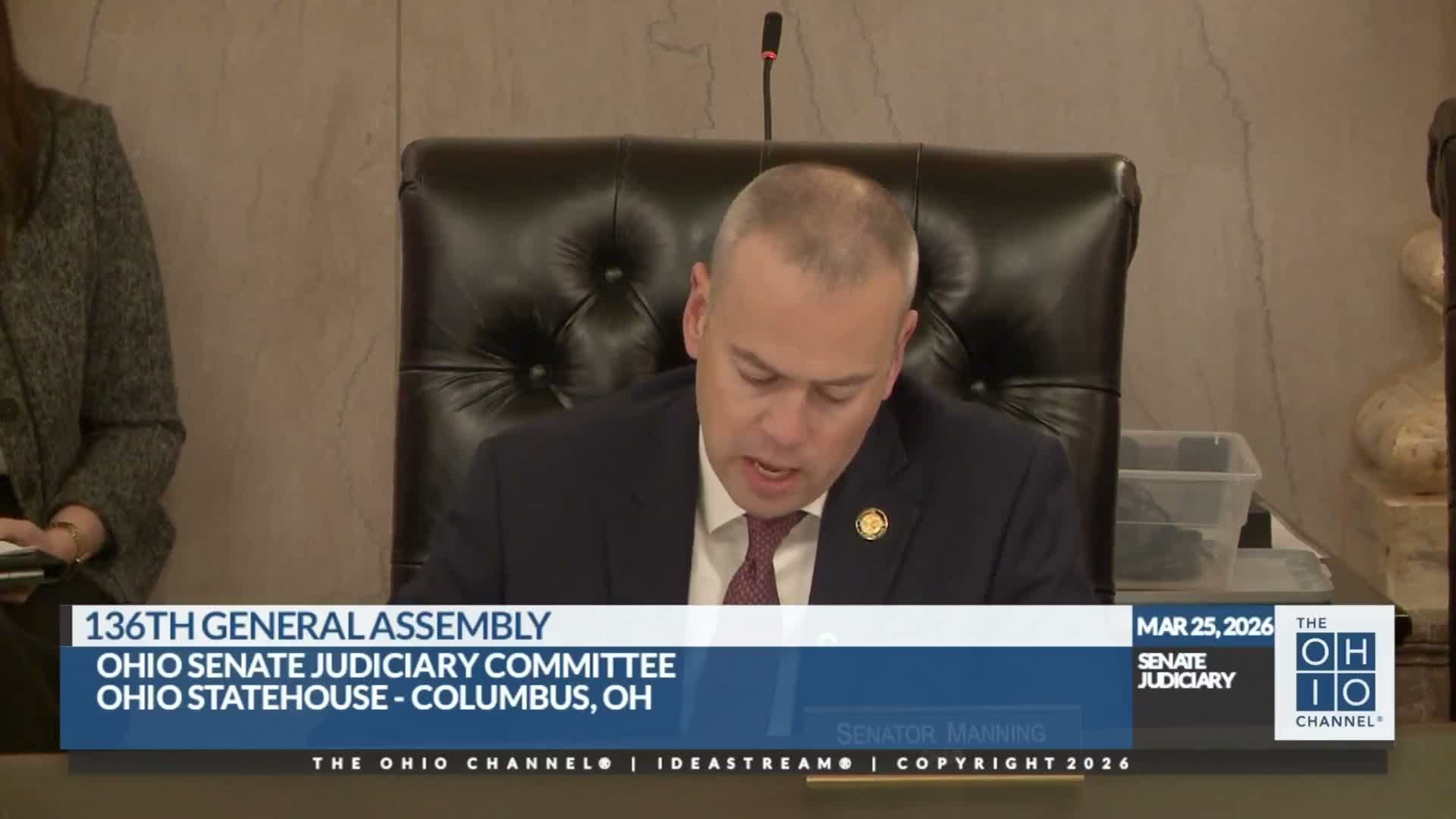
Representatives Johnson and Plummer told the Senate Judiciary Committee that House Bill 338 — nicknamed "Andy's Law" — is a response to the December 2024 murder of correction officer Andrew Lansing and is designed to strengthen penalties and operational controls in Ohio prisons.
Representative Johnson said the bill would expand aggravated‑murder charges to include the killing of correction employees and other staff working in and around facilities, and would require life without parole in those cases. "The origin of this legislation traces back to Christmas morning of 2024 when correction officer Andrew Lansing was brutally murdered by an inmate," Johnson said, adding that Lansing "was beaten so bad and his face stomped into the concrete that his own wife and family couldn't recognize him."
Sponsors described multiple provisions that pair sentencing changes with operational reforms. The bill adds mandatory consecutive prison terms for felonious assaults on correction staff, enhances penalties for harassment involving bodily substances, requires contraband‑detection K‑9 units (two per prison) trained at the State Highway Patrol facility in Marysville, and tightens visitation and screening procedures. Sponsors also said the bill would remove GTL tablets from higher‑security facilities and limit certain higher‑education programs where those programs are being abused to facilitate contraband distribution.
Representative Plummer told the committee the intent is not to end all programming, but to build "guardrails" and pilot better models. "We are leaving all vocational training alone," Plummer said, adding that vocational classes would remain even in maximum‑security prisons and that any changes to higher education programming should be tested via a pilot program in the operating budget.
Committee members pressed the sponsors on whether removing tablets and higher‑education offerings for level‑3 and level‑4 inmates would undermine reentry preparation. Vice Chair Reynolds said she was "a little concerned that if we take everything out for level 3 and 4, we're gonna set up an environment that could be even more dangerous because you're taking out any programming, all hope." Johnson responded that vocational training and certain controlled programs would continue and proposed piloting updated higher‑education models that include guardrails and completion metrics.
Sponsors also cited staffing and prosecution challenges. Johnson said some facilities face vacancy rates approaching one in three positions and that unchecked contraband contributes to overdoses and dangerous conditions; he told the committee that Ross Correctional Institute had a reported 271 overdoses in one month, which the sponsor presented as evidence of an urgent contraband problem. He and Plummer also recommended exploring additional county prosecution resources where prison populations are concentrated.
The committee did not take a vote; the sponsors said this hearing would stand as the bill's first hearing and additional witnesses would appear in subsequent meetings.
The committee's next scheduled steps are further hearings and potential amendments; no formal action on HB 338 was recorded at this session.