Get Full Government Meeting Transcripts, Videos, & Alerts Forever!
Get email alerts on the Alcohol Franchise Law topic
No spam. Unsubscribe anytime.
Wholesale trade group urges committee to preserve beer and wine franchise protections at SB 23 hearing
Summary
Jacob Evans of the Wholesale Beer and Wine Association told the Small Business and Economic Opportunity Committee that Senate Bill 23's proposed changes to Ohio's franchise framework would reduce wholesalers' incentive to invest in craft brands and harm distribution-led growth; senators pressed him on contract length, barrel thresholds (25,000 vs. 250,000) and inventory rules. The committee took no vote and concluded the third hearing.
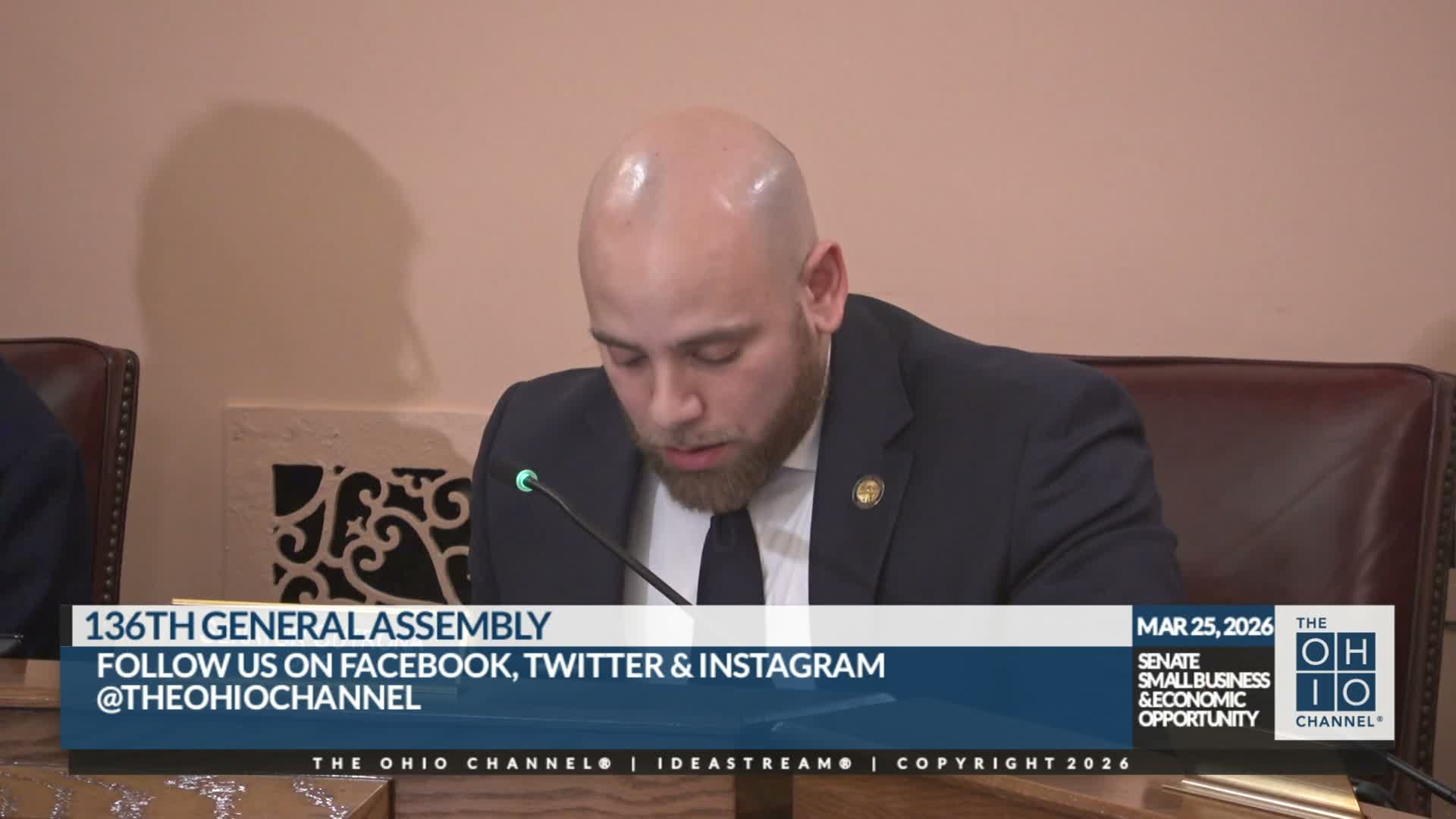
Jacob Evans, representing the Wholesale Beer and Wine Association, testified in opposition to Senate Bill 23 at a third hearing before the Small Business and Economic Opportunity Committee, arguing the bill would weaken the franchise framework that undergirds wholesaler investment in craft beer brands.
Evans told the committee that wholesalers are the first purchasers of product, pay cash up front and assume financial risk for inventory and that the ability to recover those costs over the life of a contract supports investments in marketing, refrigerated storage and distribution infrastructure. "If it ain't broke, don't fix it," he said, urging members to preserve the current system.
Why it matters: Evans said those protections let wholesalers make upfront investments — for example, he cited a wholesaler installing a 330,000-square-foot refrigerated system — and that shortening or removing franchise protections would make wholesalers less willing to fund canning lines, tap-room expansions or marketing for smaller brewers.
Evans also addressed the debate over barrel thresholds in the bill. He referenced federal Alcohol and Tobacco Tax and Trade Bureau (TTB) reporting and a federal competition report to explain how size cutoffs are counted and said a large proportion of registered brewers would be affected by the threshold under discussion. "Based upon [the TTB] report ... roughly 99.3% of all brewers registered with the TTB are [under or around the cited threshold]," he said, arguing the number matters for who remains franchise-protected.
Senators pressed Evans on specific points in a sustained question-and-answer period. Senator Gavarone asked how long typical contracts last; Evans replied that many include automatic rollovers (annual or three-year) and that most terminations occur for just cause, emphasizing that contracts provide the predictability needed for borrowing and capital planning. Senator Liston asked for clarity on the 250,000-versus-25,000-barrel thresholds; Evans cited the TTB-based breakdown and said Ohio's largest craft brewer produces roughly 135,000—150,000 barrels a year, which would leave most Ohio breweries under the threshold in question.
On inventory issues, Senator Romanchuk asked whether brewers buy back unsold product. Evans said wholesalers can remove defective product and noted federal law forbids selling alcohol on consignment; he said manufacturers can reclaim defective shipments but cannot take back product solely because it did not sell without creating a consignment situation.
Evans declined to support new protections in the bill, saying the current franchise system has supported tenfold growth in the number of craft brewers in Ohio and that the association is asking the committee to preserve, not expand or alter, the established framework. The committee concluded the third hearing on SB 23 with no vote and no additional testimony scheduled in the record.