Bill would require voters to approve cuts to municipal tax reciprocity credits
Loading...
Summary
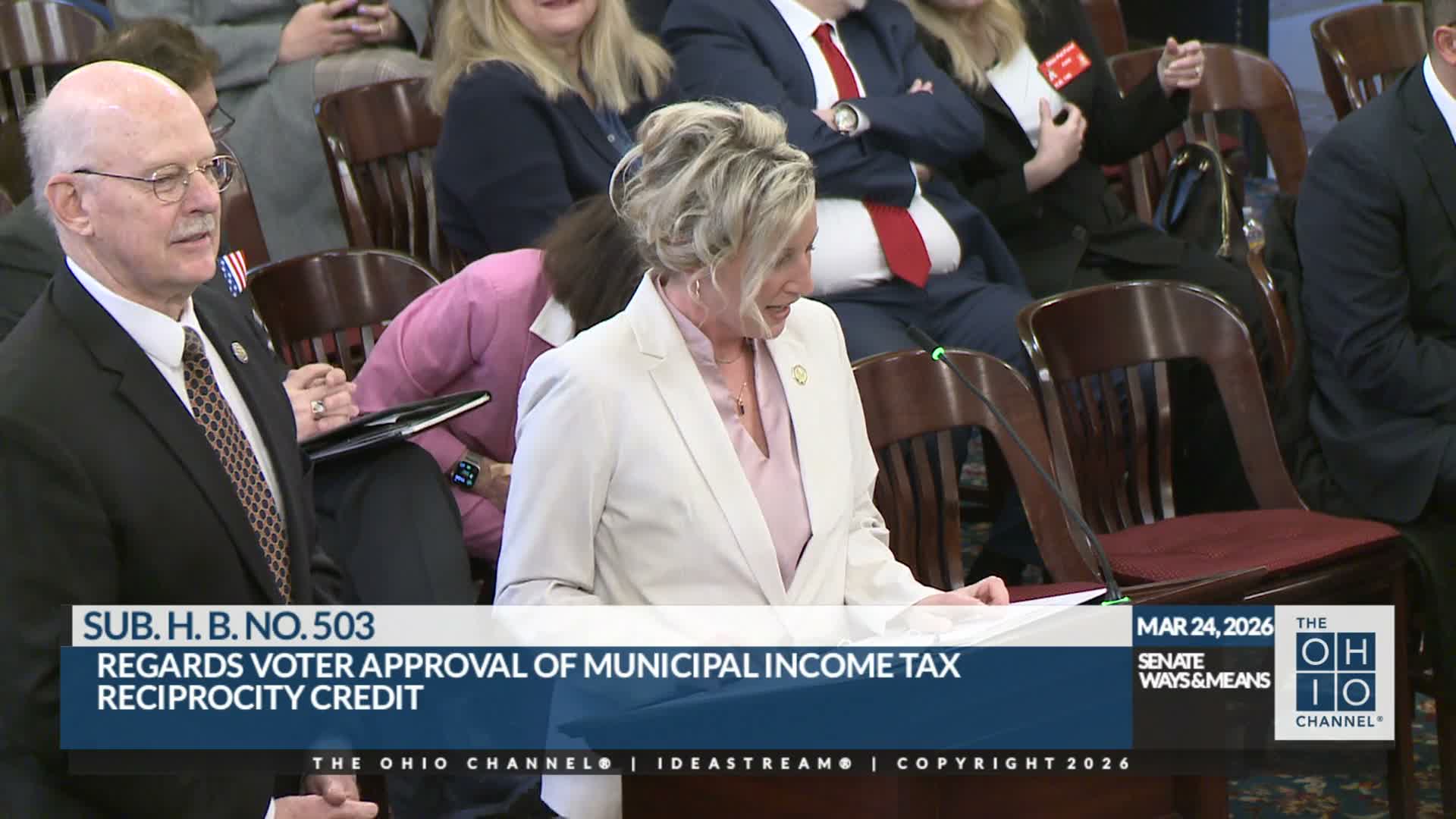
Sponsors told the Senate Ways and Means Committee that House Bill 503 would require voter approval at a general election before a city or village could reduce, repeal or modify municipal income tax reciprocity credits; sponsors said the change would add transparency and prevent unexpected tax increases for commuters.
Representatives sponsoring House Bill 503 told the Senate Ways and Means Committee that the measure would give taxpayers a direct vote before their local government reduces or eliminates municipal income tax reciprocity credits.
"House Bill 503 seeks to modernize this structure by ensuring that any reduction, appeal, or modification of a reciprocity credit is made with direct voter input at an election," the bill’s sponsor said in testimony to the committee. The sponsor described the patchwork of local reciprocity policies across Ohio as confusing and said it can produce double taxation for some residents.
A joint sponsor detailed the bill’s mechanics, saying the proposal would require voter approval at a general election to "reduce, repeal, or modify the amount or percentage of a reciprocity tax credit" and would prohibit combining a reciprocity-credit question with a tax-rate question on the same ballot. The sponsor said the bill also includes a study provision to examine the overall process.
Committee members raised practical questions. Senator Schafer said he supports the concept but asked how the bill would address concerns from larger cities that rely heavily on nonresident tax revenue. "This doesn't do that," one sponsor replied, describing the bill as an incremental change that "gives voters control" without immediately altering municipal revenues.
Committee members also pressed on implementation details. A member pointed out that the City of Columbus spans four counties and asked whether the bill’s language (as written) would submit a ballot question to only one county, which could exclude some city voters. A sponsor acknowledged this issue had not been raised previously and offered to amend the bill to address cross-county voting.
The hearing included specific examples the sponsors used to illustrate effects on taxpayers. One sponsor described a community that offered an 83 and one-third percent reciprocity credit at a 1.5 percent tax rate, then proposed raising the rate while changing the reciprocity credit — an arrangement the sponsor said should require separate, clear votes by affected residents.
The committee concluded the first hearing on House Bill 503 without taking a vote; sponsors said they would consider technical amendments identified during questioning.
The chair closed the hearing and moved on to subsequent agenda items.