Get Full Government Meeting Transcripts, Videos, & Alerts Forever!
Get email alerts on the Housing Finance topic
No spam. Unsubscribe anytime.
Port St. Lucie council denies residential PACE authorization after extended debate
Summary
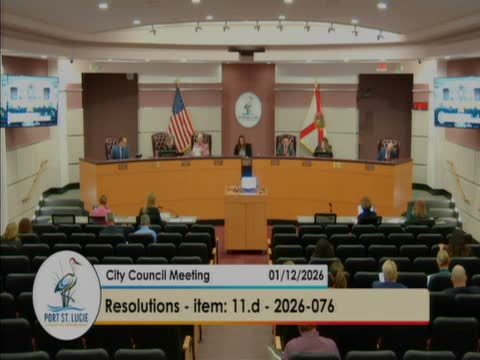
After an hours-long presentation and public comment, the Port St. Lucie City Council voted Jan. 12 to deny authorization for a residential Property Assessed Clean Energy (PACE) program, citing concerns about tax-roll liens, foreclosure risk and local oversight despite provider assurances about new consumer protections.
Port St. Lucie — The City Council voted Jan. 12 to deny item 12a, which would have authorized the use of residential PACE (Property Assessed Clean Energy) financing in the city, after a lengthy staff briefing, presentations from PACE providers and sustained council debate.
Staff briefing and program mechanics: Christina Flores, who led the staff analysis, summarized how residential PACE works: an owner applies through an approved PACE provider; the provider evaluates eligibility and finances the work; the repayment is placed on the owner’s property tax bill as an assessment and attaches to the property. Flores said the program is authorized by state statute and implemented through an interlocal agreement with a PACE district rather than a direct contract with individual providers. She walked the council through typical project terms, citing an illustrative example provided by a PACE provider: an approximately $28,000 financed project with a 20-year assessment that would add roughly $3,178 annually on that example (staff then compared that to Port St. Lucie’s average tax bill and other financing options).
Supporters: Representatives of industry providers pushed back on worst-case scenarios and pointed to new statutory consumer protections. Rachel Hobbs of Home Run Financing described prescribed disclosure materials and recorded confirmation calls designed to ensure homeowner understanding. Chris Peterson of Fortify said the public data he reviewed showed low default and tax-deed rates among PACE participants and that, in his view, the program has been “very successful.” Provider comments emphasized that contractors are vetted, that contractors are paid only after work completion, and that banks and capital partners have strong incentives to avoid poor-quality assessments.
Opponents and council concerns: Several councilmembers said they were concerned that assessments become superior liens on the tax roll and that residents might not fully grasp long-term repayment obligations. One councilmember said, “I’m not about to say yes to add taxes to people in [St. Lucie County]” (Councilwoman Pickett). Another said the city lacks practical oversight after it signs an ILA with a PACE district and that dispute resolution could be distant and slow. Council members also highlighted alternative local programs (staff noted the SELF Solar Energy Loan Fund) and questioned whether the new 2024 statute protections have been tested in practice.
Outcome: A motion to deny the item passed by roll call on Jan. 12; council recorded affirmative votes in favor of denial and at least one dissenting vote. Council direction and discussion emphasized consumer protection, further research and possible local options rather than immediate authorization.
What’s next: With the denial, the city will not enter the interlocal agreement to authorize residential PACE at this time. Councilmembers asked staff to continue researching local financing alternatives and to provide additional data to address the concerns raised, including comparative program outcomes and consumer-protection practices elsewhere.