Get Full Government Meeting Transcripts, Videos, & Alerts Forever!
Get email alerts on the Mobility Fee Ordinance topic
No spam. Unsubscribe anytime.
Port St. Lucie council declines mobility-fee ordinance after debate over affordability; accepts technical report as data only
Summary
After staff presentations and public comment, the Port St. Lucie City Council accepted the mobility plan technical report as data only and voted to deny Ordinance 25-76, which would have adopted updated mobility fees and an extraordinary-circumstances finding; council debate centered on fee size, phase-in options and impacts on housing affordability.
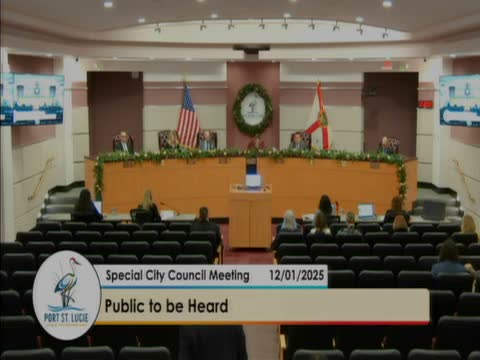
Vice Mayor Carballo opened the public hearing on Ordinance 25-76, the city’s proposed 2050 mobility plan and revised mobility-fee ordinance, and invited staff to present the technical report and the extraordinary-circumstances study.
The council heard a staff-led stakeholder Q&A and a detailed presentation from Jonathan Paul, principal of New Urban Concepts, who said the fully calculated plan would total roughly $2.2 billion and that the city had assumed about $9,250,000 a year of other funding to help offset fees. Paul told the council the proposed city-only fee increases in some assessment areas exceed the 50% statutory threshold and therefore the council would need to find “extraordinary circumstances” to adopt increases beyond that cap. As Paul put it, “the fees are higher than the 50% threshold,” meaning an EC finding would be required to adopt the larger increases or an alternative phasing schedule.
The consultant outlined phased rates that would reach fully calculated 2029 levels if adopted unchanged, giving examples for a 2,000-square-foot single-family home that varied by district. He also described the plan’s short-, mid- and long-term project lists, corridor studies (about 46 miles of study called out in discussion), and a separate set of transit pilot projects that were described as planning-only and not part of the mobility-fee calculation.
Members of the public and development interests spoke at the hearing. Islena Goldstein, representing Riverland Kennedy 2 LLC and GEO Homes, submitted a written objection and told the council the ordinance “disregards equity and proportionality,” arguing the draft removes an earlier “active adult” category that she said generated fewer peak trips and should have been retained or recognized via a streamlined credit or study process. Goldstein warned that the proposed increases could amount to a severe burden on developers and new homebuyers and raised the risk of double payment where developers already construct roadways.
Paul and staff responded that the active-adult classification was removed because it is not defined as a distinct land-use on the city’s land-use map; developers may still submit project-specific trip studies or applications for fee determinations and credits. Paul said staff had added flexibility to the ordinance to allow applicants to supply more documentation to support credit claims.
Council debate focused on two linked concerns: whether the current data and statutory environment justified invoking extraordinary circumstances now, and the affordability impact of immediate fee increases. Councilman Bonner summarized his position in terse terms: “affordability, affordability, affordability,” and said he was comfortable accepting the technical report but not comfortable finding extraordinary circumstances or increasing fees at this time. Several other council members echoed concerns about timing, the near-term statutory changes, and potential impacts on housing costs and rents.
The council considered multiple motions. A motion to accept the final technical report but not find extraordinary circumstances (and not move forward with a fee increase) failed on a 2–2 tie. The council then voted to accept the final technical report as data only; that motion carried on a unanimous vote of those present (four yes votes). Later, a motion to deny Ordinance 25-76 passed on a 3–1 vote (Councilman Bonner, Councilwoman Morgan and Councilman Pickett voting yes; Vice Mayor Carballo voting no). The clerk noted Mayor Martin was not present for the meeting.
What this means: the council recorded the technical work and data contained in the mobility plan and associated studies, but it declined to adopt the ordinance that would change the city’s mobility-fee schedule and related code amendments at this time. Staff said the ordinance had been advertised for a Dec. 8 second hearing but in light of the vote it likely will not proceed to adoption. Council members flagged the upcoming interlocal discussions with the county (the interlocal was noted in discussion as expiring in 2027) and potential state legislative changes as reasons to reassess timing.
The council adjourned until its 1 p.m. meeting.