Get Full Government Meeting Transcripts, Videos, & Alerts Forever!
Get email alerts on the Code Enforcement topic
No spam. Unsubscribe anytime.
Council advances property‑maintenance, parking and RV code updates; staff to refine front‑yard parking language
Summary
After detailed debate, council gave first‑reading approval to text amendments updating property‑maintenance (chapter 41), parking (chapter 72) and recreational‑vehicle (chapter 73) rules, but asked staff to refine front‑yard parking wording and hold one‑on‑ones before second reading.
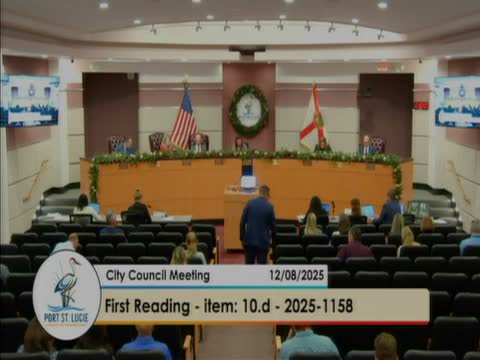
Port St. Lucie — The City Council on Dec. 8 advanced a package of code changes intended to clarify and strengthen enforcement of property‑maintenance, parking and recreational‑vehicle rules.
Neighborhood Services staff proposed definitional updates (failed culvert pipe, inoperable vehicles), prohibitions on storing land‑clearing debris on cleared lots, and expanded enforcement options for inoperative utility trailers and recreational vehicles. The parking amendments define acceptable front‑yard parking surfaces (concrete, asphalt, pavers, rock with a defined border to prevent erosion), prohibit certain box trucks from residential front‑yard parking, and permit dually trucks for private use with limitations on commercial equipment. Staff also proposed raising initial parking fines and allowing violations to be heard by a special magistrate when warnings and citations do not lead to compliance.
Councilmembers pressed staff on practical impacts: whether the changes would allow whole‑front‑lawn paving, how semi‑impervious materials would be limited, and the effects on households with many vehicles or short‑term rentals. Staff reported recent enforcement activity (2,742 parking warnings and 431 parking tickets in the prior 12 months) and proposed a six‑month outreach and education plan before aggressive enforcement. Several council members asked for one‑on‑one briefings with staff and legal before second reading to consider narrower language on front‑yard coverage and preserve neighborhood character.
What happens next: The council approved the ordinances on first reading where noted and directed staff to hold follow‑up discussions before second reading; staff will return with clarified language on permitted front‑yard materials and setback/buffer options.
Why it matters: The package aims to close enforcement gaps (for example, inoperable trailers and collapsed culverts) and to provide clearer criteria for residents and code officers. Council’s request for additional review reflects concerns about unintended outcomes such as full‑lot hardscaping and loss of front‑yard buffers.