
House Appropriations Committee hears multiple bills, seeks favorable reports on police retirement, scholarships, MDOD foundation and animal-welfare measure
Get AI-powered insights, summaries, and transcripts
Sign Up Free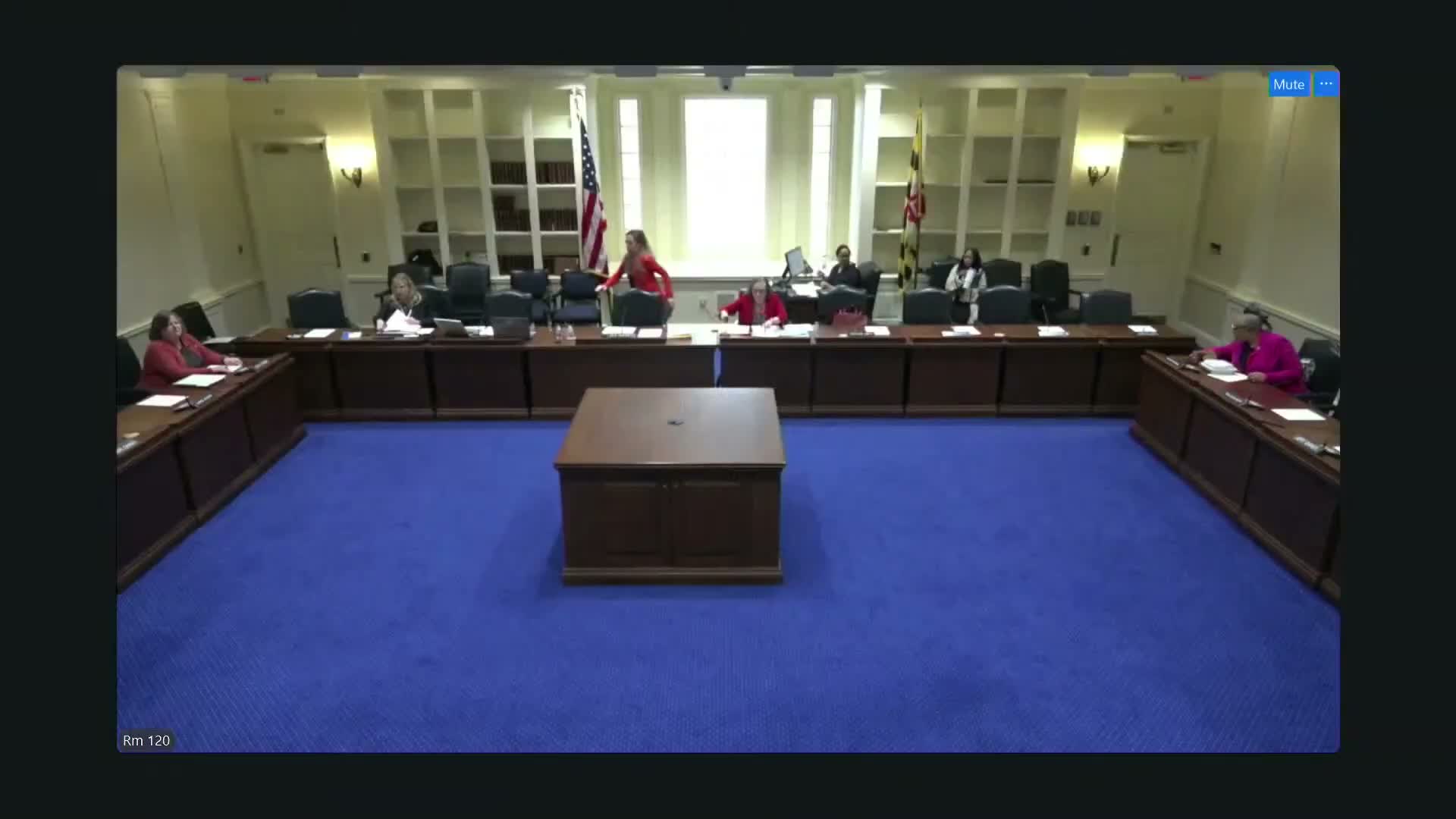
Summary
The House Appropriations Committee convened for a brief hearing in which senators and departmental representatives presented a batch of senate bills and requested favorable reports, including a measure to raise the state police retirement age, a scholarship for correctional officers, creation of an MDOD-affiliated foundation, a delay to guaranteed access grant decentralization, and a ban on sale of racehorses for slaughter.
The House Appropriations Committee met in a procedural session to hear short presentations and requests for favorable reports on a set of senate bills ranging from law enforcement workforce changes to higher-education timing and animal-welfare protections.
Senator Malcolm Augustine asked the committee to give a favorable report on Senate Bill 654, which would raise the retirement age for the State Police from 60 to 62 to help address retention. "We're trying to regrow the force, and we just need, to allow for this relatively small group of folks who came to the force later on in their careers, to be able to stay around for a little bit longer," Augustine said. He noted a technical amendment recommended by the State Retirement Board to clarify that the bill does not automatically extend DROP (deferred retirement option plan) benefits.
Senator Mary Beth Caroza requested a favorable report on SB 285, a scholarship program for correctional officers; she said the House cross-file, HB 852, "passed the House of Delegates, by 132 to 1," as stated in testimony. Catherine Kelly of the Maryland State Police Government Affairs Unit also urged support for SB 74, which she said is identical to the House bill the committee previously heard and which the House passed unanimously on March 11.
Departmental witnesses spoke briefly on other items. Anne Blackfield, deputy secretary of the Maryland Department of Disabilities, described SB 22 as establishing an affiliated foundation and said the House added amendments clarifying that the foundation "will not be directing MDOD's policies, procedures, eligibility criteria," and that funds would "support our existing priorities and programs." Elena Quiroz Slovanis, deputy secretary at the Maryland Higher Education Commission and the incoming interim secretary, requested a favorable report on SB 207 (identical to HB 231), which delays implementation of guaranteed access grant decentralization to the 2029–2030 timeframe.
Christopher Mers, executive director of the Maryland Racing Commission with the Department of Labor, asked the committee for a favorable report on SB 231, which he said would "make a sale or transfer of racehorses and racehorse breeding slot stock for slaughter illegal in our state," describing the measure as protecting animal welfare and associated economic interests.
Most presentations were brief and described as being in the same posture as House cross-files; presenters repeatedly asked for favorable reports rather than formal votes on the floor of the committee. The hearing concluded with a confirmation that several bills were in the same posture as their House cross-files and with the moderator adjourning the session. No roll-call votes or formal recorded outcomes appear in the transcript.
The committee may schedule further action or floor consideration in subsequent proceedings; the transcript records only the presentations and requests for favorable reports.