Get Full Government Meeting Transcripts, Videos, & Alerts Forever!
Get email alerts on the Maryland Stadium Authority topic
No spam. Unsubscribe anytime.
Subcommittee flags lottery bond risks as Pimlico renovation moves forward
Summary
Analysts told the Education and Economic Development Subcommittee that Maryland Stadium Authority projects rely heavily on lottery bond proceeds and coverage ratios have tightened; MSA defended the Pimlico/Laurel plan and witnesses urged preserving the major events fund.
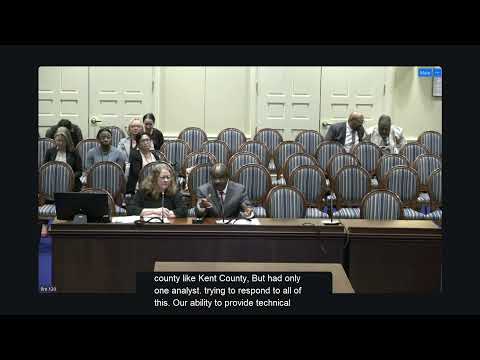
The Education and Economic Development Subcommittee heard detailed budget testimony March 30 on the Maryland Stadium Authority’s FY27 allowance, with analysts and the authority trading views about reliance on lottery bond proceeds and the fiscal risks of ongoing projects including the Pimlico renovation.
David Legislative Services analyst Patrick Frank told members the authority relies primarily on two revenue streams: state special funds that support debt service and non‑budgeted funds from bond proceeds and the authority’s own operating revenues. He flagged lottery bond coverage ratios as a key metric for fiscal health, saying, “If your biggest fund source is lottery funds and you issue a lot of bonds, you probably should pay attention to the coverage ratios of those bonds.” The DLS materials show that heavy distributions since 2019 have pushed the ratio down close to a 3x benchmark used by rating agencies.
MSA officials defended their mix of funding and described how the current construction plan is being managed. Michael Frenz, the authority’s executive director, and Craig Thompson, board chair, said they had reviewed DLS’s recommendations and would provide written responses. Gary McGuigan, MSA’s executive vice president of capital projects, outlined changes to the training‑facility strategy after the agency found the previously identified Shamrock/Shamrock Farms site largely undevelopable. He said the authority has pursued an acquisition of Laurel Park as an alternative training site and that negotiations were ongoing: “We hope to have an acquisition agreement in place in the next 30 days,” he said, adding the state would need Legislative Policy Committee and Board of Public Works review and a 90‑day closing period.
McGuigan gave a consolidated cost picture for the program: about $520 million in bonds and cash split between Pimlico (approximately $400 million) and a training center (about $120 million), with roughly $180 million already bid in construction contracts for Pimlico. He told the panel the authority remains on track to host the Preakness at Pimlico in 2027, though the clubhouse completion is targeted for 2028.
MSA chief financial officer Dawn Asher reiterated the coverage‑ratio concern. “A big concern for us is, rating agencies have identified that 3 times coverage … is a benchmark for significant credit strength,” she said, noting the authority cannot unilaterally guarantee coverage because statutory disbursements and lottery performance are set outside MSA’s control.
Committee members pressed MSA about guardrails. The analysts and several legislators urged long‑term operating agreements and stronger compliance measures for prevailing‑wage enforcement. MSA said it has a six‑person compliance unit and plans to increase field audits, including bilingual interviews with workers, to verify wage and labor practices.
The hearing also featured public testimony in defense of the authority’s major sports and entertainment grant program, which DLS recommended reducing from $10 million to $5 million annually. Industry and local tourism representatives told lawmakers that the grant program helps attract multiday events that generate hotel stays, admissions and amusement taxes, and other local revenue. Matt Liber, executive director of the Maryland SoccerPlex, testified that cutting the fund could reduce tourism revenue and the state’s competitiveness for events. “That $5,000,000 may generate $300,000,000 in revenue to the state in taxes and economic activity,” he said.
Joe Bryce, an MSA board member who chairs the subcommittee that reviews major events fund applications, urged lawmakers to reject the proposed cut: “I would urge you to reject the cut. It’s working, it’s well cared for, and it is spinning off more than you’re putting into it,” he said.
What happens next: MSA will supply additional written detail on the Laurel Park negotiations, the scope and cost implications of the changed training‑facility approach, and on its compliance plan and audit schedule. The committee did not take a formal vote during the hearing.