Get Full Government Meeting Transcripts, Videos, & Alerts Forever!
Get email alerts on the Hb 16 77 topic
No spam. Unsubscribe anytime.
Debate over House Bill 16 77 centers on proposed water authority, debt relief and resident protections
Summary
At a Jackson City public hearing, the mayor and advisers said House Bill 16 77 would create a nine-member authority to assume water/sewer debt and operations and remove roughly $197'$200 million from the city's books; residents and advocacy groups warned the shift could reduce democratic oversight and pressed for audits, a sunset and consumer safeguards. Council moved to deliberation to prepare a response to the state senate.
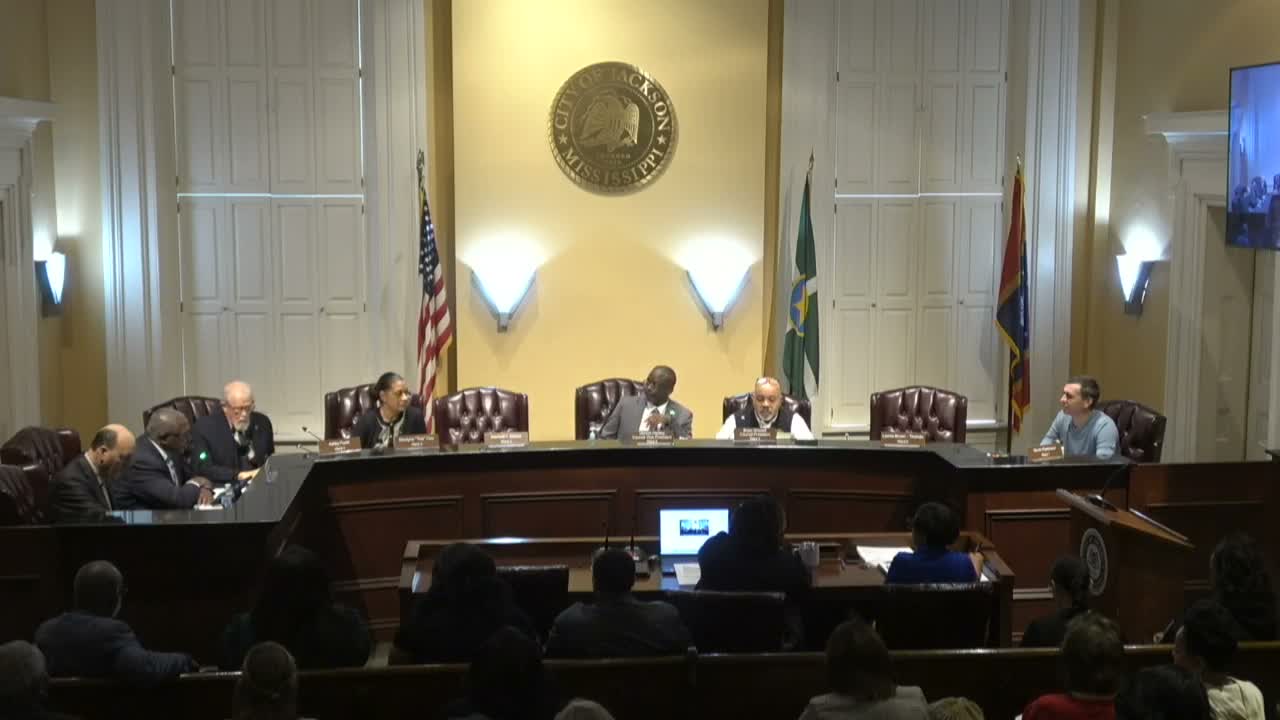
A public works committee hearing in Jackson City drew residents, business owners and state lawmakers to debate House Bill 16 77, legislation that would create a new municipal authority to lease the city's water and sewer system, assume its financing and govern rate and operational decisions.
Mayor (speaker 3) opened the administration's presentation by tracing the 2022 failure of Jackson's water and sewer systems, the federal court's intervention and the need for "a plan for what life would look like after Jackson Water goes away." He said the bill would form a nine-member authority in which Jackson would control six seats, require a lease of the system to the authority, and "result in approximately $200,000,000 being wiped off of the city of Jackson's books," freeing capacity for street repairs, crimefighting and economic development.
Drew Martin, the city attorney, told council members the bill was designed as a transition vehicle: the authority would not have power until it was appointed and until the authority and the city negotiated a lease; the authority's transition plan must also be submitted to the federal court. Martin said the authority would be a public body with obligations to establish dispute-resolution procedures and customer protections that private Jackson Water did not have. "Constitutionally, this authority is going to have to have a process by which customers can dispute their bills," he said.
Trey Hairston, bond counsel, said the outstanding water/sewer debt is about $197,000,000 and that the authority would provide a financing vehicle to refinance or restructure that debt, subject to bond-insurer and authority consent. Financial consultant Michael Thomas told the committee the city's collection rate was roughly 62% and emphasized the need to improve billing and collections, calling for a reliable system that could push collections toward the consultant's stated target of about 95%.
Public comment split along lines of urgency and caution. Supporters including business owners and faith leaders told the council the authority offered the most realistic path to remove large debt burdens and regain local influence over the system. "I stand here today in favor of the authority," said Robert Gibbs, a lifelong Jackson resident and business owner, citing the benefit of moving debt off city books.
Opponents and community groups urged stronger safeguards. Pauline Rogers, a homeowner and community advocate, said she opposed HB 16 77 because it "restructures power before repairing trust" and urged a full forensic audit of billing history, a 12-month retroactive billing cap unless fraud is shown, bar on shutoffs during disputes, mandatory water-quality testing after meter installation, and a public meter map. Nishaun B. Lambright Haines, representing the Jackson NAACP, said the bill lacks a clear sunset and would place "a structural shift and operational control away from our elected municipal leadership with no mechanism for reassessment."
State Rep. Justice Gibbs — who said the Jackson delegation initially opposed any structure that left the city without control — explained the legislative negotiations that produced the current bill and said the delegation fought to secure a majority voice for Jackson given the political realities in the House and Senate.
Administration witnesses responded to resident questions: Martin and others said the authority, as a public entity, would be constitutionally required to provide due-process dispute procedures and could establish grievance mechanisms and customer-service offices; they acknowledged several items (smart metering requirements, landlord escrow accounts) were not addressed in the bill as drafted. Jackson Water representatives and consultants also described data-cleanup challenges: most of the roughly 60,000 metered accounts now have new meters, but about 4,000 meters lack associated billing accounts and legacy data requires ongoing verification.
The hearing closed with council members and the chair pressing for wider public engagement. The chair said the council would dismiss the hearing and move into deliberation "because we will be considering something to reply to the state senate." No formal council vote occurred during the hearing.
What happens next: council deliberation and any formal council action or amendments will determine whether the city sends a response to the state senate or requests changes to the bill before it advances further in the legislature.