Get Full Government Meeting Transcripts, Videos, & Alerts Forever!
Get email alerts on the Code Compliance topic
No spam. Unsubscribe anytime.
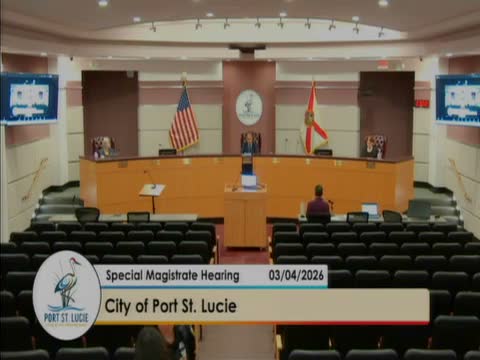
Special Magistrate orders abatements and certifies fines after Port St. Lucie code‑compliance hearing
Summary
Special Magistrate Kelly Rodriguez reviewed multiple Port St. Lucie code‑compliance cases on Feb. 19, 2026, finding violations on several properties, authorizing city abatement for public‑safety risks (including an unsecured pool and missing fence), and certifying abatement and administrative costs to be charged to respondents.
Special Magistrate Kelly Rodriguez presided over a Port St. Lucie code‑compliance hearing on Feb. 19, 2026, during which the magistrate confirmed violations on multiple properties, authorized city abatement where necessary and certified abatement and administrative costs against noncompliant property owners.
The hearing opened at 9:05 a.m. and city code officers presented photographic evidence and inspection testimony for a sequence of cases alleging high grass, open storage, unsecured pools and exterior maintenance failures. “I make a finding that the violation concerning the fence constitutes a threat to public health, safety, and welfare, and I authorize the city to abate that violation only because of the fact that this the fence is missing,” Special Magistrate Kelly Rodriguez said when ruling on one case involving an unsecured pool and missing fence panels.
Code Officer Bender described the situation at 571 Southwest Ramorra Bay, saying the city issued notice and that compliance had not been achieved; the city asked that the respondent, Carolyn W. Thomas, be ordered to bring the property into compliance by March 5, 2026, and that the city be authorized to secure the pool if necessary. “The city requests that the respondents… be ordered to comply with the cited provisions of the City of Port St. Lucie code by 03/05/2026,” Bender testified.
In several cases involving high grass and weeds, city officers said swale and yard growth exceeded the 12‑inch standard; inspectors reported heights of about 18–36 inches in the most extreme examples. For the property at 280 Southwest Andala Road, the city abated high grass on Jan. 6, 2026, and requested $395 in abatement costs and $411 in administrative costs; the magistrate found proper notice and ordered those costs assessed to the respondent. On other vacant properties the magistrate imposed a per‑day fine of $25 for ongoing noncompliance, with a maximum of $50,000, and certified abatement and administrative fees where appropriate.
Parties present who testified included code officers who identified their cases and presented the photographic records; a family member or representative appeared by phone to explain a respondent’s medical incapacity and testified that they would arrange landscaper service going forward. Magistrate Rodriguez emphasized ensuring ongoing maintenance: “So in the future, can you ensure that landscaper will cut the grass so we we're not back here again?” she asked a representative who said he would coordinate a landscaper.
Where respondents failed to correct violations by the deadlines set in prior hearings, the magistrate authorized the city to enter properties and correct violations under Florida Statute 162.085 and to seek cost recovery at follow‑up hearings. The clerk confirmed that notices of hearing were sent by certified mail and posted on the properties and that photographic evidence is retained by the City of Port St. Lucie Neighborhood Services Department.
No members of the public offered comment during the public‑comment period. The hearing concluded at 9:58 a.m.; magistrate orders include multiple compliance deadlines (commonly March 5 or March 11, 2026), authorizations to abate public‑safety risks such as unsecured pools, and certification of abatement and administrative costs for the city to recover.