Get Full Government Meeting Transcripts, Videos, & Alerts Forever!
Get email alerts on the Land Use topic
No spam. Unsubscribe anytime.
Port St. Lucie planning board recommends Sandpiper Bay land-use and PUD amendments with conditions
Summary
The Planning & Zoning Board voted to recommend approval of a small-scale future land use change and a second PUD amendment for Sandpiper Bay Resort and RPS Academy, approving consolidated CGI designation and expanded sports and support facilities with conditions including a revocable encroachment agreement and photometric (dark-sky) lighting rules.
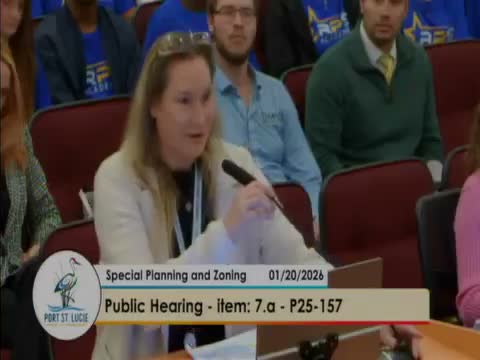
The Port St. Lucie Planning & Zoning Board on Jan. 20 voted to recommend approval of a small-scale future land use amendment and a Planned Unit Development (PUD) amendment for the Sandpiper Bay Resort and RPS Academy, moving the property’s designation to commercial general/institutional (CGI) and authorizing expanded sports and accessory facilities subject to staff conditions.
Bethany Grubbs of the city’s planning department told the board the application would consolidate approximately 28.6 acres of the property under a single CGI land-use to reflect the resort, marina and the academy’s campus and accessory uses. Staff’s analysis estimated a net potable water increase of 14,581 gallons per day and wastewater of 12,393 gallons per day under maximum intensity assumptions and noted the site is not in a flood zone; staff recommended approval with conditions tied to future site-plan reviews.
The PUD amendment, described by Grubbs as Amendment No. 2, updates the concept plan and permitted uses, adds buffering requirements (including a western berm and a 50-foot trigger buffer for parking areas), and requires a photometric plan with dark-sky lighting and a provision that lighting be switched off within an hour of events. Grubbs also said the applicant must execute a revocable encroachment agreement before site-plan approval for limited, de minimis infrastructure that lies in a city easement.
Applicants and supporters said the changes primarily formalize existing uses and add amenities for students and resort guests rather than increase residential density. Rebecca Miller, president of MPLD Consulting and the applicant’s representative, outlined plans for new and covered tennis courts, a competition lap pool, additional pickleball courts, sand volleyball courts, a student union building with a gymnasium and cafeteria, and new parking including EV spaces. "These proposed improvements are additional amenities for existing students and existing resort guests," Miller said, arguing the project would be "an upgrade" rather than a new source of daily traffic.
Proponents included multiple student athletes and RPS representatives who described the academy’s academic and athletic programs. "RPS has shaped me into the person I am today," student Giorgio Centeno told the board during public comment.
Neighbors voiced concerns over traffic, drainage, environmental impacts and construction behavior. Several residents asked where additional event traffic and overflow parking would be routed and whether the city’s infrastructure could handle large events. "Where's the water gonna go? Already, I get flooded," resident Tracy Cutgarler said, urging caution on drainage and runoff planning.
Public Works answered that a traffic impact analysis was required and provided; Clyde Coffee, Public Works, said the traffic review concluded that, based on existing vested uses on the site (335 resort rooms, a 150-student entitlement for the academy and a 100-slip marina), the proposal did not generate net new daily trips under the land-use assumptions reviewed. "Based on the existing uses... there's no change in the traffic," Coffee said, and staff noted peer review of the traffic work was completed.
Environmental questions were raised about earlier mangrove removal under previous ownership. The applicant said the removal predated the current team, that the prior owner was fined by state resource agencies, and that the current owners and contractors are restoring mangroves under monitoring. Rebecca Miller said mitigation and state monitoring are underway, adding that a prior environmental assessment by Maine Consulting Services (MCS) did not identify certain upland species onsite and that some protected animal species (for example, osprey nesting) were observed during transects.
Board members and staff emphasized that several technical issues (detailed site drainage, stormwater controls, specific traffic-mitigation measures and any expanded special-events operations) will be examined at the site-plan phase and via PUD provisions that trigger additional traffic studies and operations updates if event activity expands. The PUD also includes clauses requiring landscape buffers and a photometric plan.
After public comment and staff discussion, a board member made a motion to recommend approval of the small-scale future land use amendment; the board voted in favor. Later the board moved to recommend approval of PUD Amendment No. 2 for Sandpiper Bay Resort (P25158) with the staff condition that a revocable encroachment agreement be executed prior to site-plan approval.
FUTURE STEPS: Both the land-use amendment and the PUD amendment will move forward to the City Council review and approvals process. Site-plan review, required engineering studies and any mitigation measures (stormwater, traffic operations, construction management and environmental monitoring) will be reviewed and enforced during subsequent permitting. The Planning & Zoning Board recorded its recommendation; final legislative or quasi-judicial approvals rest with later City Council actions and required site-plan reviews.
Community members who raised concerns were told by staff and the applicant to use the city’s application portal (Fusion/Legistar) to view the full traffic and environmental reports and to submit follow-up requests; the applicant provided a direct contact for ongoing neighborhood communications.
The board adjourned after the votes; members thanked residents for attending and congratulated students who spoke.