Get Full Government Meeting Transcripts, Videos, & Alerts Forever!
Get email alerts on the Infrastructure Water Sewer topic
No spam. Unsubscribe anytime.
Consultant proposes $6,920 water and sewer impact fee for Melbourne; staff urges finding of 'extraordinary circumstances' to speed implementation
Summary
A Reftellus consultant told the Melbourne City Council workshop that proposed combined water and wastewater impact fees would be $6,920 per equivalent residential connection, and staff asked the council to find "extraordinary circumstances" so the city can implement the full increase now rather than phase it in over four years.
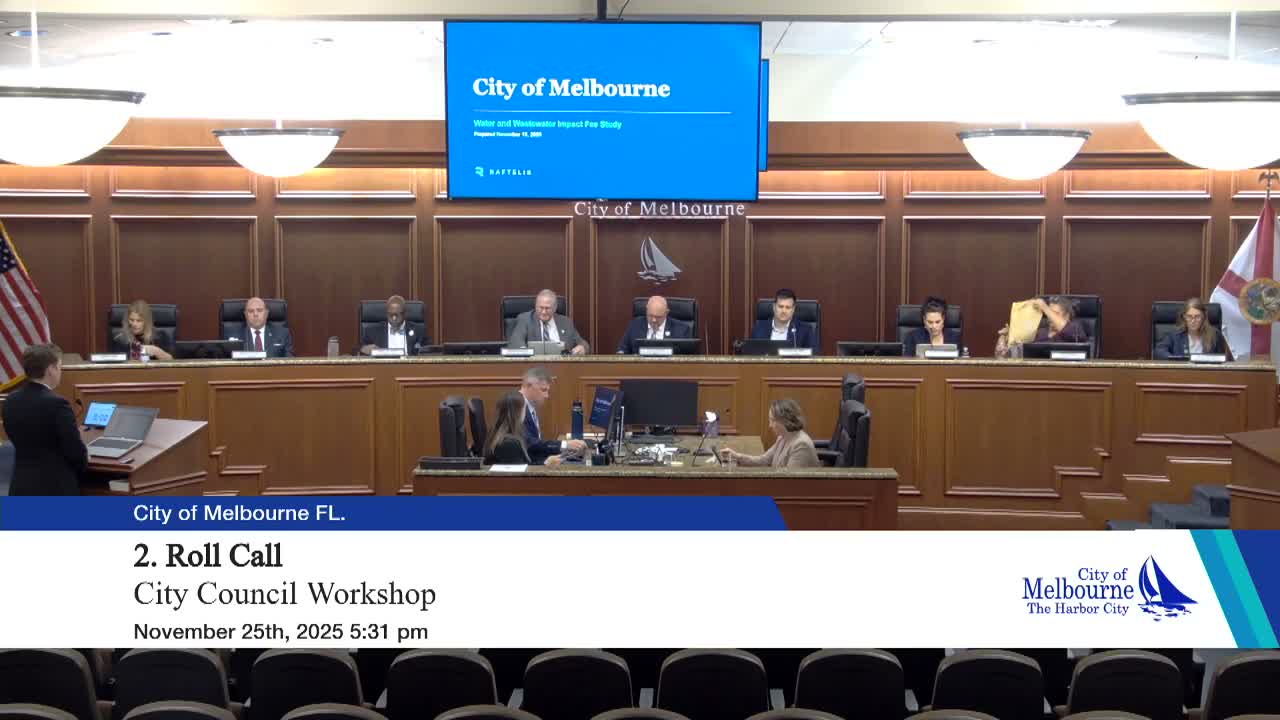
At a Melbourne City Council workshop, Trevor McCarthy, a manager with Reftellus, presented a water and wastewater impact fee study that recommends a combined fee of $6,920 per equivalent residential connection (ERC), consisting of $2,755 for water and $4,165 for wastewater. McCarthy said the fees are intended to make new development pay for growth‑related capital projects and debt service rather than shifting those costs to existing ratepayers.
"These are fees paid by new development, that create demand for water and wastewater system capacity," McCarthy said, and described the approach as "growth paying for growth." He told the council the proposed per‑ERC increase is $3,170 and noted that, on a typical Melbourne single‑family sale price of $375,000, the fee increase is under 1% of that amount.
City staff and the consultant asked the council to make a statutory finding of "extraordinary circumstances" to avoid a state‑required phase‑in for increases greater than 50% of the current fee. Under current Florida law, increases beyond 50% must be phased in over four years; McCarthy said the city could implement the full proposed fee sooner if the council finds extraordinary circumstances and approves the higher fee by the applicable voting threshold.
McCarthy cited several factors he and staff say qualify as extraordinary circumstances: sharp construction‑cost inflation (he gave an example of water plant costs rising from $5.87 to nearly $17 per gallon), final bids that have exceeded initial estimates by large margins, projected customer growth (he said information suggests more than 5,000 new residential units may connect in the next five years), and planned utility borrowing of roughly $290 million to fund growth‑related capital projects. He estimated that a phased approach would shift about $9.8 million over five years from new development onto existing ratepayers.
Council members asked detailed questions about implementation mechanics. McCarthy said multifamily units count as 0.583 of an ERC and walked through an example: at that ratio, a 285‑unit multifamily project would face about $1,149,792.60 in impact fees at the proposed rates. He also described the typical four‑year phase‑in as equal dollar increases each year if the council chose that route.
Staff warned the council of a statutory timing issue. A staff speaker said changes to state law effective Jan. 1, 2026, would tighten approval requirements for increases above 50% (shifting from a two‑thirds vote now to a unanimous vote after the change), leaving a narrow window for the council to find extraordinary circumstances and approve a higher, expedited fee amount. The consultant proposed an ordinance effective 90 days after a second reading (noted in the presentation as March 9, 2026), and staff said building permits issued before that effective date would be charged the current fee.
No formal vote was taken at the workshop. Staff told the council that the ordinance reading and first reading would occur later that evening on the regular agenda. One council member said the potential $10 million shift to existing ratepayers if the city phased the increase "keeps resonating" and voiced support for approving the full amount at the upcoming meeting.
The council heard regional comparisons showing Melbourne's proposed combined fee ($6,920) would sit above a regional survey average ($4,970) but below some statewide examples McCarthy cited (a statewide sample averaged roughly $9,000 per ERC). Staff noted that differences across utilities reflect population density, treatment types and the timing of prior fee updates.
The workshop concluded with no public comments; staff said the formal ordinance process and any required votes would occur on the regular agenda later the same evening. If the council votes to adopt the higher fee and make a finding of extraordinary circumstances, staff indicated the proposed effective date would be 90 days after adoption.